Dīgha Nikāya (DN)
Long collection (of suttas)
34 suttas, 3 vaggas (chapters).
Each card below links to that sutta's own page.
+§ – Sīla-k-khandha Vagga: Ethics group chapter
all
+DN 1 Brahma·jāla:
The Prime Net
The Prime Net

He teaches how to hear praise and criticism without elation or anger.
Ordinary people praise only his ethics and nothing deeper.
The three sections on ethics are laid out in full.
What is deep is the net of sixty-two views about self and cosmos.
Theories about the past: eternalism and partial eternalism.
Also a finite cosmos, equivocation and origination by chance.
Theories about the future run from percipient life to nirvana here and now.
Each view is a feeling born of contact in those who do not know.
Whoever holds one is caught in the net.
+DN 2 Sāmañña·phala:
Fruits of Ascetic life
Fruits of Ascetic life
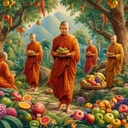
Restless on a full moon night, King Ajātasattu wants a teacher to visit.
Jīvaka Komārabhacca brings him to the Buddha in his mango grove.
Six rival teachers had already failed to answer his question.
Does the ascetic life bear a fruit that can be seen here and now?
He starts with fruits anyone can see: the slave and the farmer who go forth.
Then the graduated training through ethics and sense restraint.
Five similes remove the hindrances and four more open the jhānas.
Eight knowledges are given here instead of the usual six.
The last fruit is the ending of the asinine-inclinations.
Ajātasattu confesses his patricide and takes refuge.
+DN 3 Ambaṭṭha:
with Ambaṭṭha
with Ambaṭṭha
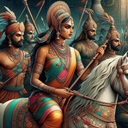
The brahmin Pokkharasāti sends his student to check the Buddha's marks.
Ambaṭṭha is rude and calls the Sakyans menials who slight brahmins.
The Buddha traces his ancestry back to a Sakyan slave woman.
Among those who put stock in lineage the aristocrats are supreme.
But lineage counts for nothing beside knowledge and conduct.
Four drains block anyone who fails at knowledge and conduct.
The sages whose hymns he recites lived nothing like brahmins now.
Ambaṭṭha sees the two hidden marks and reports back to his teacher.
Pokkharasāti comes himself and declares himself a lay follower.
+DN 4 Soṇa·daṇḍa:
with Soṇadaṇḍa
with Soṇadaṇḍa
The brahmins and householders of Campā stream out to see the Buddha.
Soṇadaṇḍa goes too and worries about losing face before the assembly.
He lists five qualities that make a brahmin.
They are birth and hymns and appearance plus ethics and wisdom.
Pressed by the Buddha he drops birth and then hymns and appearance.
What is left cannot be cut down further: ethics and wisdom.
Ethics is washed by wisdom and wisdom by ethics.
The Buddha then teaches the graduated path up through awakening.
Soṇadaṇḍa takes refuge and invites the Buddha for a meal.
+DN 5 Kūṭa·danta:
with Kūṭadanta
with Kūṭadanta
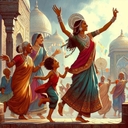
The brahmin Kūṭadanta is preparing a sacrifice of hundreds of animals.
He asks about the threefold sacrifice with its sixteen accessories.
The Buddha tells of King Mahāvijita and his chaplain.
Crime was stopped not by punishment but by giving people a living.
At that sacrifice no beast was killed and no tree was cut.
It was done with ghee and oil and honey alone.
The chaplain of the story was the Buddha himself in that life.
Better than any sacrifice is a gift, a dwelling and then the precepts.
Better still is the training up to the ending of the asinine-inclinations.
Kūṭadanta frees the animals and realizes the fruit of stream-entry.
+DN 6 Mahāli:
with Mahāli
with Mahāli

Brahmin emissaries and Oṭṭhaddha the Licchavi come to see the Buddha.
Mahāli asks why monks who hear divine sounds do not see divine sights.
Undistractible-lucidity may be developed in one direction or in both.
But monks do not live the holy life for the sake of such attainments.
They live it for dharmas that are finer than these.
Those are the four stages ending in the ending of the asinine-inclinations.
The way to reach them is the noble eightfold path.
+DN 7 Jāliya:
with Jāliya
with Jāliya
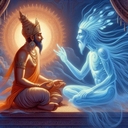
Two wanderers ask whether the soul and the body are the same thing.
The Buddha does not answer the question in the terms it was asked.
Instead he lays out the awakening sequence from a Buddha's arising.
A monk trains in ethics and sense restraint and contentment.
He abandons the five hindrances and enters the four jhānas.
One who knows and sees like that says neither same nor different.
For anyone who has done the training the question dissolves.
+DN 8 Mahā·sīha·nāda:
The Longer Discourse on the Lion’s Roar
The Longer Discourse on the Lion’s Roar
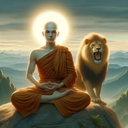
The naked ascetic Kassapa asks if all self-mortification is condemned.
The Buddha refuses the sweeping claim and neither condemns nor praises.
Some who torment themselves go to hell and some go to heaven.
A long catalogue of austerities is recited in full.
None of it makes an ascetic while ethics and mind stay undeveloped.
What is hard is ethics and undistractible-lucidity and wisdom.
The Buddha roars his lion's roar and invites anyone to test it.
Kassapa goes forth and after probation becomes an arahant.
+DN 9 Poṭṭha·pāda:
with Poṭṭhapāda
with Poṭṭhapāda

The wanderer Poṭṭhapāda asks how perception arises and ceases.
Some say it happens without cause but the Buddha says it comes by training.
Through the jhānas one perception ceases and another arises.
At the peak the monk reaches the cessation of perception itself.
Is perception the self or is the self something other than perception?
The undeclared points are set aside because they do not lead to nirvana.
What he does declare is dukkha and its origin and ending and the path.
Citta Hatthisāriputta asks about the three acquisitions of a self.
Those are worldly expressions the Tathāgata uses without being caught.
+DN 10 Subha:
with Subha
with Subha
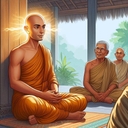
The Buddha has attained final nirvana and Subha comes to Ānanda.
He asks which dharmas the Buddha praised and roused people to take up.
Ānanda answers with three whole spectrums.
Ethics, undistractible-lucidity and wisdom.
The entire spectrum of ethics is given in its three sections.
Undistractible-lucidity runs from sense restraint to the four jhānas.
Wisdom runs to the ending of the asinine-inclinations.
Nothing higher or finer than these is left to be done.
Subha declares himself a lay follower.
+DN 11 Kevaṭṭa:
with Kevaṭṭa
with Kevaṭṭa

The householder Kevaṭṭa asks the Buddha to have a monk work a miracle.
Three demonstrations are named: psychic power and revealing and instruction.
The first two trouble him because a skeptic calls them magic charms.
Only the demonstration of instruction is one he approves of.
That instruction is the graduated training through the four jhānas.
A monk once went looking for where the four elements cease.
He asked up to the Brahmā world and no god there could answer.
The question was wrong: ask where name and form cease without remainder.
+DN 12 Lohicca:
with Lohicca
with Lohicca

The brahmin Lohicca holds that a teacher should keep good dharma to himself.
The Buddha shows that view would trap everyone in a net of selfishness.
Three kinds of teacher deserve to be reprimanded.
One who teaches without having reached the goal himself.
One whose students will not listen to what he teaches.
And one who has reached it but whose students turn away.
A teacher deserving no reprimand is a Buddha whose training bears fruit.
The graduated path through the four jhānas is that training.
Lohicca declares himself a lay follower for life.
+DN 13 Te·vijja:
The Three Knowledges
The Three Knowledges
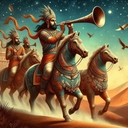
Two brahmin students argue which path leads straight to union with Brahmā.
Has a single one of their teachers ever seen Brahmā face to face?
Not one has, back through seven generations of masters.
It is like a file of blind men each holding the one in front.
Or a man in love with a woman he has never seen.
Or a staircase built for a palace whose location he does not know.
Brahmins hindered by the five hindrances cannot reach the unhindered.
The Buddha knows Brahmā and knows the way to his company.
That way is the four immeasurables pervading every direction.
+§ – Mahā Vagga: Great chapter
all
+DN 14 Mahā·padāna:
The Great Discourse on the Harvest of Deeds
The Great Discourse on the Harvest of Deeds
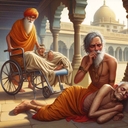
The Buddha recalls the seven Buddhas back to Vipassī.
For each he gives the lifespan and tree and chief disciples.
Then he tells the story of Vipassī in full.
What is normal for one intent on awakening from the womb onward.
The thirty-two marks are read on the newborn prince.
Riding out he meets an old man and a sick man and a corpse.
Then a renunciate, and he goes forth himself.
He sees dependent origination in both directions and awakens.
Brahmā appeals to him to teach and a great crowd goes forth.
He sends them out to wander for the good of the many.
+DN 15 Mahā·nidāna:
The Great Discourse on Causation
The Great Discourse on Causation
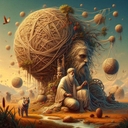
Ānanda says dependent origination seems perfectly clear to him.
The Buddha warns him off: it is deep and it looks deep.
The chain is walked back from old age and death to consciousness.
Consciousness and name-and-form turn back on each other.
The chain goes no further than that pair.
Craving is traced through seeking and acquisition and possessiveness.
The ways people describe a self are examined and rejected.
One who regards nothing as self does not grasp at anything.
The seven planes of consciousness and two dimensions are listed.
A monk freed by the eight liberations is liberated in both ways.
+DN 16 Mahā·pari·nibbāna:
The Great Discourse on the Buddha’s nirvana
The Great Discourse on the Buddha’s nirvana
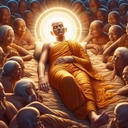
The longest discourse: the Buddha's last months and final nirvana.
It opens with the seven dharmas that prevent decline.
More sets of non-decline dharmas are then given to the monks.
Sāriputta roars his lion's roar and conduct is taught at Pāṭaligāma.
The mirror of the Dharma lets a disciple declare their own attainment.
Ambapālī the courtesan gives her mango grove to the Saṅgha.
At Beluva he falls gravely ill and tells Ānanda to be his own island.
Ānanda misses the hint and the Buddha surrenders the life force.
Cunda's meal and the last journey and the pair of sal trees.
The last words: conditions fall apart so finish the work.
+DN 17 Mahā·su·dassana:
king Mahāsudassana
king Mahāsudassana
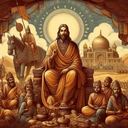
Ānanda thinks Kusinārā too small a town for the Buddha to die in.
It was once Kusāvatī, the capital of king Mahāsudassana.
The city is described with its palms and ponds and seven walls.
The wheel-turning monarch's seven treasures are listed in turn.
He builds the Palace of Principle with lotus ponds around it.
In the golden chamber he enters the jhānas and the immeasurables.
Queen Subhaddā comes with the army and he tells her to let go.
He dies with an undisturbed mind and is reborn in the Brahmā realm.
That king was the Buddha himself, and conditions are impermanent.
+DN 18 Jana·vasabha:
with Janavasabha
with Janavasabha
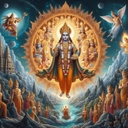
The Buddha declares the rebirths of lay followers who died at Nādika.
Ānanda suggests he do the same for the people of Magadha.
A spirit named Janavasabha announces himself as the reborn Bimbisāra.
He reports the council of the gods in the Hall of Justice.
Brahmā Sanaṅkumāra appears there and speaks through Vessavaṇa.
Four bases of psychic power are taught as the way to success.
Three openings for happiness are described in turn.
Then the four ways of remembering and the prerequisites of undistractible-lucidity.
+DN 19 Mahā·govinda:
The Great Steward
The Great Steward
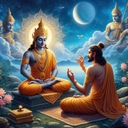
The gandhabba Pañcasikha reports a council of the gods.
Brahmā Sanaṅkumāra told there the story of the Great Steward.
The Steward was chief minister to king Disampati and then to Reṇu.
He divided the realm among seven kings and taught them all.
He went on retreat four months in kindness and saw Brahmā.
Told that household life bars the Brahmā world he went forth.
Seven kings and many brahmins went forth along with him.
But that path led only to the Brahmā world and not to nirvana.
The Buddha's path leads to dispassion and to nirvana.
+DN 20 Mahā·samaya:
The Great Congregation
The Great Congregation
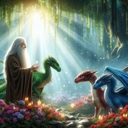
Five hundred monks, all arahants, are gathered in the Great Wood.
Deities from ten world systems come to see that assembly.
Four gods from the Pure Abodes speak verses in praise.
The Buddha announces that a great congregation has arrived.
He names them rank by rank so the monks know who is present.
Earth gods and sky gods and nagas and the kings of four quarters.
Māra brings his army against them and fails to shake anyone.
+DN 21 Sakka·pañha:
Sakka’s Questions
Sakka’s Questions
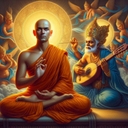
Sakka wants to see the Buddha, who is secluded in the Indasāla cave.
Pañcasikha goes ahead and sings a love song mixed with praise.
Sakka is careful not to disturb the Buddha's jhāna.
Why do beings who wish to live without hate still live in hate?
The chain runs from jealousy back to thought and to proliferation.
Which happiness and sadness to pursue and which to drop.
Restraint in the code and of the senses is examined the same way.
The questions end with the ending of craving.
Sakka gains the vision of the Dharma and is reborn as Sakka again.
+DN 22 Mahā·sati-’paṭṭhāna:
Longer [discourse on] establishing remembrance [of Dharma]
Longer [discourse on] establishing remembrance [of Dharma]

The one-way path for purification is the four ways of remembering.
Seeing the body: the breath and postures and parts and elements.
Seeing the sensations as pleasant or painful or neutral.
Seeing the mind with lust and hate and delusion or free of them.
Seeing the Dharma: hindrances and aggregates and awakening factors.
The fourth also sets out the four noble truths in full.
That detail is what makes this the longer version.
Each section repeats the refrain of internally and externally.
Seven years down to seven days brings final knowledge or non-return.
+DN 23 Pāyāsi:
With Pāyāsi
With Pāyāsi

The chieftain Pāyāsi holds there is no other world and no rebirth.
Kumāra Kassapa answers him with a long series of similes.
The sun and moon belong to another world and not to this one.
Criminals do not come back to report and neither do the reborn.
A man pulled from a cesspit has no wish to go back down.
No soul is seen leaving a body weighed before and after death.
A conch blower and a fire keeper and a caravan and a dice player.
Pāyāsi concedes and takes refuge but then gives shabby gifts.
He is reborn in a low heaven while his giver Uttara goes higher.
+§ – Pāṭika Vagga: Half moon stone chapter
all
+DN 24 Pāthika:
About Pāṭikaputta
About Pāṭikaputta

Sunakkhatta leaves the training because he is shown no miracles.
He also complains of no teaching about the origin of the world.
The Buddha reminds him of three occasions he predicted correctly.
Korakkhattiya the dog-duty ascetic died exactly as foretold.
Kaḷāramaṭṭaka lost his fame exactly as predicted.
Pāṭikaputta boasted and then could not rise from his seat.
Miracles are not why the Dharma is taught.
It leads to the goal without any of them.
The accounts of the world's origin are given and set aside.
+DN 25 Udumbarika:
The Lion’s Roar at Udumbarikā’s Monastery
The Lion’s Roar at Udumbarikā’s Monastery
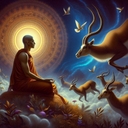
The wanderer Nigrodha is at Udumbarikā's monastery in a noisy crowd.
The householder Sandhāna comes to visit and the Buddha follows.
Nigrodha asks what training the Buddha uses with his disciples.
The Buddha takes up the wanderers' own practice of mortification.
It is spoiled by conceit and pride and self-praise.
It may reach only the shoots or the bark or the softwood.
The heartwood is the four immeasurables and past-life knowledge.
The culmination of the spiritual path is higher still.
Nigrodha and the wanderers are left depressed and say nothing.
+DN 26 Cakka·vatti:
The Wheel-Turning Monarch
The Wheel-Turning Monarch
Live as your own island with the Dharma as your only refuge.
Your own proper resort is the four ways of remembering.
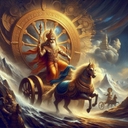
King Daḷhanemi's wheel-treasure sinks and he goes forth.
His successors keep the noble duty and the wheel returns.
Then one king rules by his own ideas and gives nothing to the poor.
Poverty leads to theft and theft to killing and the decline follows.
Lifespan falls to ten years and there is a sword-interval.
Survivors take up virtue and lifespan grows back to eighty thousand.
King Saṅkha reigns and the Buddha Metteyya arises.
Long life and beauty come from the bases of psychic power.
+DN 27 Aggañña:
The Origin of the World
The Origin of the World

Two brahmin-born monks are abused by their families for joining.
Brahmins claim to be born from Brahmā's mouth and purest of castes.
But brahmin women give birth exactly like anyone else.
A member of any caste can do bad or good and reaps the result.
He then tells the long story of how the world re-evolves.
Beings grow coarse eating solid nectar and sprouts and rice.
Gender and intercourse and hoarding and stealing appear in turn.
The people elect a king and the other circles form after that.
Caste is a matter of conduct and the awakened one is best.
+DN 28 Sam·pasād·a·nīya:
Inspiring Confidence
Inspiring Confidence
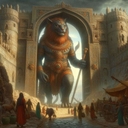
Sāriputta declares no one is more awakened than the Buddha.
Does he know the minds of all past and future Buddhas?
He does not, but he knows the pattern of the Dharma.
He then lays out seventeen unsurpassed teachings in order.
Skillful qualities and the sense fields and ways of revealing.
Attainments of vision and kinds of striving and ways of practice.
Behavior in speech and responsiveness to instruction.
Recollection of past lives and psychic powers and the four jhānas.
Nothing higher can be known of these than what the Buddha teaches.
+DN 29 Pāsādika:
An Impressive Discourse
An Impressive Discourse
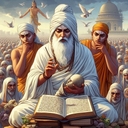
Nigaṇṭha Nātaputta has just died and his followers are quarrelling.
Cunda reports it to Ānanda and they go together to the Buddha.
A teaching badly proclaimed brings its disciples no merit.
A teaching well proclaimed by an awakened teacher does.
Disciples with regrets and disciples without them are contrasted.
The spiritual path may be incomplete or complete in every factor.
Recite the teaching in concert with attention to meaning.
Requisites are allowed for definite reasons and not for indulgence.
The undeclared and declared points are listed and views set aside.
+DN 30 Lakkhaṇa:
The Marks [of a Great Man]
The Marks [of a Great Man]

A great man has thirty-two marks and only two destinies.
He becomes a wheel-turning monarch or a fully awakened Buddha.
Each mark is traced back to a deed done in a past life.
Well-planted feet come from being firm in skillful qualities.
Wheels on the feet come from bringing happiness to many.
Projecting heels and an upright frame come from giving up killing.
Golden skin comes from not being angry.
Deep blue eyes come from looking at people kindly and openly.
Forty gapless teeth come from giving up divisive speech.
The voice of Brahmā comes from giving up harsh speech.
+DN 31 Siṅgāla:
Advice to Sigālaka
Advice to Sigālaka
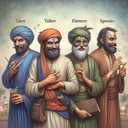
Sigālaka worships the six quarters because his father told him to.
The Buddha teaches what worshipping the six quarters really means.
First four corrupt deeds are given up: killing and stealing and lying.
Then four grounds of bad deeds: favoritism and hate and fear.
Six drains on wealth follow, from drink to laziness.
Each drain is broken down into its own six drawbacks.
Four kinds of fake friend and four kinds of good-hearted friend.
The six quarters are parents and teachers and spouse and friends.
Each is covered by five duties running in each direction.
+DN 32 Āṭānāṭiya:
The Āṭānāṭiya Protection
The Āṭānāṭiya Protection
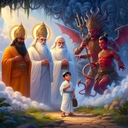
The four great kings come to the Buddha with their armies of spirits.
Many spirits have no confidence in the precepts and might harm monks.
Vessavaṇa offers the Āṭānāṭiya protection so monks live at ease.
The verses honor the seven Buddhas from Vipassī through to Gotama.
Then the four quarters and their rulers are named in order.
Anyone who learns it is safe from non-human harm.
If a spirit still troubles them they may raise a complaint.
The Buddha tells the monks to learn it and to remember it.
+DN 33 Saṅgīti:
Reciting in Concert
Reciting in Concert
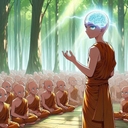
The Niganthas have split after their teacher's death.
Sāriputta gathers the monks so nothing like it happens here.
He proposes they recite the teaching in concert by number.
Ones and twos and threes and so on all the way up to tens.
Each group lists the doctrinal sets under that number.
The point is agreement on meaning and wording so the path lasts.
The Buddha rests nearby and gets up at the end to approve it.
+DN 34 Dasuttara:
Up to Ten
Up to Ten
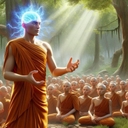
Sāriputta teaches the up-to-ten discourse for release from bonds.
It runs through groups of one to groups of ten as before.
But here each number is sorted into ten functions.
What is very helpful and what should be developed.
What should be understood and what should be given up.
What leads to decline and what leads to distinction.
What is hard to penetrate and what should be produced.
What should be directly known and what should be realized.
The whole scheme comes to five hundred and fifty items.