Khuddaka Nikāya (KN)
Minor collection (of suttas)
The "Minor Collection" of the Sutta Piṭaka.
Its exact membership and canonical status were disputed in antiquity
— the Dīghabhānakas and Majjhimabhānakas disagreed on which texts
belonged and where they should sit relative to the Abhidhamma Piṭaka.
+1 – Kp = Khuddaka-pāṭha: short-reading
Kp Khuddaka-pāṭha: 9 short discourses, including 10 precepts
A brief primer of nine short texts: four foundational formulas (the Three Refuges,
Ten Precepts, thirty-two body parts,
a novice's catechism) plus five well-known suttas found elsewhere in the canon (Maṅgala,
Ratana, Tirokuḍḍa, Nidhikaṇḍa, Mettā).
Likely a late compilation, possibly assembled in Sri Lanka as
an anthology for new monastics — it's absent from the Milindapañha and first appears by name only in the commentaries.
Commentary: Buddhaghosa's Paramatthajotikā.
+2 – Dhp = Dhammapada: a line or stanza of the Norm. (nt.)
423 verses across 26 chapters, gathered from many parts of the
canon into a single anthology of ethical and spiritual teaching.
Probably compiled later than the Thera-/Therīgāthā; first named in the Milindapañha.
Several distinct recensions survive in different languages/schools.
Commentary: the Dhammapadaṭṭhakathā,
a large collection of narrative background stories for the verses.
+3 – Ud = Udāna: [inspired] Utterances
![Udāna: [inspired] Utterances](../media/kn/kn-d_128px.jpg)
Ud Udāna:
Eighty short episodes in eight chapters,
each pairing a prose narrative with a verse the Buddha spoke spontaneously in a moment of joy or insight.
Verse is in classical meters; prose is rare.
Closely linked to the Dhammapada Commentary,
which draws roughly a third of its material from here.
+4 – Iti = Iti-vuttaka: Thus (was it) said
Iti Iti-vuttaka:
110 short suttas, each opening with the formula
"vuttaṃ h'etaṃ Bhagavatā" ("this was said by the Blessed One").
Tradition holds these were originally taught by the Buddha to the laywoman Khujjuttarā,
who relayed them to Queen Sāmāvatī's court,
prefacing each with that formula to mark them as the Buddha's own words rather than her paraphrase.
+5 – Snp = Sutta Nipāta: discourse - section, falling down, descending
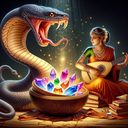
Snp Sutta Nipāta:
Five chapters (Uraga, Cūḷa, Mahā, Aṭṭhaka,
Pārāyana) of verse and mixed prose-verse suttas — some of the oldest strata of the canon.
The Aṭṭhaka and Pārāyana chapters circulated independently early
on (they're cited elsewhere in the canon as standalone works) and are the subject of the old commentary Niddesa.
Commentary: Buddhaghosa's Paramatthajotikā.
+6 – Vv = Vimāna-vatthu: mansion, heavenly palace - story
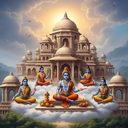
Accounts of devas describing, in their own words,
the heavenly abodes (vimāna) they earned through meritorious
deeds in past lives — reportedly related to disciples like Moggallāna and Vaṅgīsa during visits to the deva realms.
Commentary: Dhammapāla's Paramatthadīpanī (also called Vimalatthavilāsinī).
+7 – Pv = Peta-vatthu : ghost - story
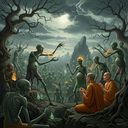
The counterpart to the Vimānavatthu: stories of beings reborn as petas (unhappy spirits) as a consequence of misdeeds,
used as cautionary teaching.
Commentary: Dhammapāla's Petavatthu-aṭṭhakathā.
+8 – Thag = Thera-gāthā: Elder [monk] - verses
![Thera-gāthā: Elder [monk] - verses](../media/kn/kn-q_128px.jpg)
Thag Thera-gāthā:
A poetic anthology attributed to monks of the Buddha's own time — some recounting a monk's path to awakening,
others simply exultant expressions of liberation.
Commentary by Dhammapāla.
+9 – Thig = Therī-gāthā: Elder [nun] - verses
![Therī-gāthā: Elder [nun] - verses](../media/kn/kn-f_128px.jpg)
*
Thig Therī-gāthā:
The companion collection to the Theragāthā,
in the voices of enlightened nuns.
Notable as one of the earliest surviving bodies of literature composed by and about women anywhere in world literature.
+10 – Tha-Ap = Therāpadāna: Past life legends of Senior Monks
🔗⛔ LBT
547 verse biographies of monks (plus two introductory sections on the Buddha and the Paccekabuddhas),
tracing their deeds across many past lives leading to their final attainment.
Widely regarded as one of the latest layers of the canon — it
names more past Buddhas than earlier texts like the Buddhavaṃsa,
suggesting a later, more elaborated cosmology.
Commentary: Visuddhajanavilāsinī.
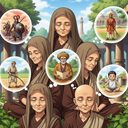
+11 – Thi-Ap = Therīapadāna: Past life legends of Senior Nuns
*
🔗⛔ LBT
The nuns' counterpart within the Apadāna collection — 40 biographies,
transmitted and commented on alongside the Therāpadāna.
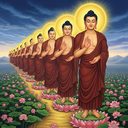
+12 – Bv = Buddhavaṁsa : Chronicle of the Buddhas
*
🔗⛔ LBT
Buddha - race, lineage, family
A verse history of the 25 Buddhas of this world-cycle,
ending with Gotama, giving each one's key details (including
the bodhisattva who would become the next Buddha under them).
Closes with an account of the distribution of Gotama's relics.
Commentary: Madhuratthavilāsinī.
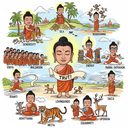
+13 – Cp = Cariyāpiṭaka: Canon of Conduct
*
🔗⛔ LBT
conduct, behavior - basket, container
Verse retellings of selected Jātaka stories,
arranged to illustrate the ten perfections (pāramī) the Bodhisatta
cultivated across his past lives on the way to Buddhahood.
Assumes the reader already knows the prose Jātaka versions.
Commentary attributed to Dhammapāla.
+14 – Ja = Jātaka: Bogus Birth stories [of Buddha and friends]
![Jātaka: Bogus Birth stories [of Buddha and friends]](../media/kn/kn-c_128px.jpg)
🔗⛔ LBT
547 tall tales of the Buddha's previous lives,
(previous lives are real, but these tales in Ja are fiction)
organized into 22 sections by length.
The canonical text preserves only the verses; the now-inseparable
prose narratives developed as oral commentary and were later fixed in the Jātakaṭṭhakathā.
One of the most culturally influential parts of the canon,
widely depicted in early Buddhist art.
+15 – Mnd = Mahā-niddesa: great - description, analytic explanation
An early canonical commentary on the sixteen suttas of the Aṭṭhaka Vagga (Sutta Nipāta).
Traditionally attributed to Sāriputta.
Commentary: Upasena's Saddhammapajjotikā.
+16 – Cnd = Cūḷa-niddesa: lesser - description, analytic explanation
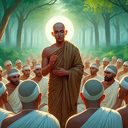
The companion volume to the Mahāniddesa,
commenting on the Khaggavisāṇa Sutta and the sixteen suttas of the Pārāyana Vagga.
Together the two Niddesas are the oldest layer of canonical commentary,
predating the fixed structure of the Sutta Nipāta as we now have it.
+17 – Ps = Paṭi-sambhidā-magga: Path of Discrimination
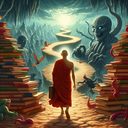
Discrimination-path
Ps KN Ps = Paṭi-sambhidā-magga:
An analytical, Abhidhamma-style treatise in three chapters (30
topics total) on the types of discriminative knowledge available to an arahant.
Draws heavily and verbatim on passages from the Vinaya and Sutta collections.
Commentary: Mahānāma's Saddhammappakāsinī.
+18 – Ne = Netti: guide, conduit
old version (incomplete, nanomli trans. Line up by hand): KN Ne
Ne Netti-p-pakarana.
pakaraṇa = an occasion;
a literary work or exposition.
(nt.)
Also called Netti-gantha.
gantha = bond;
fetter;
a composition;
a text.
(m.)
An exegetical handbook of interpretive method for reading the Buddha's teaching,
traditionally ascribed to Mahākaccāna.
Not included in all recensions of the canon.
Commentary by Dhammapāla.
+19 – Pe = Peṭako-padesa: Pitaka disclosure
Pe Peṭako-padesa:
Peṭaka (adj.) [fr. piṭaka] "what belongs to the Piṭaka,"
as title of a non -- canonical book for the usual Peṭak' opadesa "instruction in the Piṭaka."
dating from the beginning of our era (cp. Geiger, P.Gr. p. 18),
mentioned at Vism 141 DhsA 165. Cp. tipeṭaka, see also piṭaka.
Padesa [fr. pa+diś, cp. late Sk. pradeśa] indication, location, range, district;
region, spot, place
A companion methodological treatise to the Nettippakaraṇa,
also attributed to Mahākaccāna, likely composed in India before 100 BCE.
Included in the Khuddaka Nikāya by the Burmese tradition.
Valued for its early technical commentary on formulaic passages such as the four-jhāna formula.
+20 – Mil = Milinda-pañha: [King] Milinda's - questions
![Milinda-pañha: [King] Milinda's - questions](../media/kn/kn-u_128px.jpg)
🔗✅ LBT||mixed bag — the doctrinal question-and-answer core largely holds to core EBT|| 🔗⛔ LBT||mixed bag — much of the content was elaborated or invented long after the exchange it depicts, and it is canonical only in the Burmese lineage||
A dialogue between the Indo-Greek king Milinda (Menander) and the monk Nāgasena,
using question-and-answer to resolve apparent contradictions in Buddhist doctrine.
Compiled later than the historical exchange it depicts,
with much of its content likely elaborated or invented afterward.
Included in the Khuddaka Nikāya only in the Burmese canon.
Canonical status varied by lineage: the Dīghabhānakas rejected several of these (notably Cariyāpiṭaka,
Buddhavaṃsa, Apadāna, Jātaka, and Sutta Nipāta as an independent text) or reassigned them to the Abhidhamma Piṭaka,
while the Majjhimabhānakas accepted them as part of the Sutta Piṭaka.