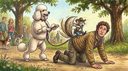
DWTD🐕
‘(D)on’t (W)ag (T)he (D)og’
Dog should wag tail, tail shouldn’t be wagging dog.
+1 – What “wag the dog” means
“The tail wagging the dog” is an idiom for an inversion of control.
The dog is the whole; the tail is one part of it.
A dog wags its tail — the whole moves the part,
and the wag means something: the dog is pleased.
When the tail wags the dog, the part is driving the whole,
and the movement means nothing at all.
The governing principle should drive the elements of the system,
never the other way around.
There should be a proper hierarchy, a proper master and servant relationship:
the master governs, the servant serves.
Invert that, and the servant is in control of the master,
and whatever the system was for is lost.
+2 – A big idea applies to many domains
A big idea like DWTD🐕 applies to many domains.
Wherever there is a governing principle and a set of elements it governs,
the inversion is possible — and it is usually what has gone wrong.
In ☸Dhamma and dhamma: ☸Dhamma is the master and the little dhamma phenomena are subservient to it,
not the other way around — DWTD☸.
In taiji and the internal arts: the whole body leads and the hands follow — section 3 below.
+3 – DWTD🐕: taiji and internal arts body movement
Ideally should move with the whole body.
What happens in practice, beginners learn by looking at what the hands and arms are doing,
and imitate that first,
and then dragging the rest of the body along with the hands.
Tail wagging the Dog.
It takes years, even decades for energy channels to open up,
for one’s whole body sensitivity to reach the point where one can directly and clearly see
what body parts is leading what, and whether the whole body moves together in perfect unison.
For beginner and intermediates, if you’re going to err better
for the hands and arms to lag the torso and legs (tail moved by dog,
lags the dog).