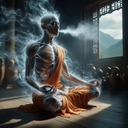
16aps🌬️😤
+Ānā-pāna-s-sati 16🌬️😤 = in breath - out breath - remembering
[this meditation is] peaceful and exquisite,
a sublime (and a) pleasurable dwelling (SN 54.9)
16APS has the wondrous property of removing unprofitable thoughts and hindrances, since the energy required to monitor physical processes fully occupies one's attentional bandwidth, leaving no room for extraneous thoughts.
16APS has the wondrous property of removing unprofitable thoughts and hindrances, since the energy required to monitor physical processes fully occupies one's attentional bandwidth, leaving no room for extraneous thoughts.
+1 – STED 16🌬️😤 instructions
all
[0.1] 🏞️ arañña-gato vā |
[0.1] 🏞️ has gone to the wilderness, or |
🌲 rukkha-mūla-gato vā |
🌲 to a root of a tree, or |
🏕️ suññā-(a)gāra-gato vā |
🏕️ to an empty dwelling. |
[0.2] nisīdati |
[0.2] They sit down, |
[0.3] 🧘 pallaṅkaṃ ābhujitvā |
[0.3] 🧘 bending into a cross leg posture, |
[0.4] 🏃📐 ujuṃ kāyaṃ paṇidhāya |
[0.4] 🏃📐 straightening the body. |
[0.5] 🌬️😤 pari-mukhaṃ satiṃ upaṭṭhapetvā. |
[0.5] 🌬️😤 They establish remembrance [of ☸Dharma] in front [, making Dharma their main focus]. |
[0.6] 🐘 So sato-va assasati, |
[0.6] 🐘 Always remembering [and applying ☸Dharma], he breathes in. |
Sato-va passasati |
Always “mindful” of [and applying ☸Dharma], he breathes out. |
+ (4sp🐘 #1 🏃 kāyā-(a)nu-passī)
Dīghaṃ vā assasanto ‘dīghaṃ assasāmī’ti pajānāti, |
(1a) When breathing in long, he discerns that: 'I am breathing in long.' |
dīghaṃ vā passasanto ‘dīghaṃ passasāmī’ti pajānāti; |
(1b) When breathing out long, he discerns that: 'I am breathing out long.' |
rassaṃ vā assasanto ‘rassaṃ assasāmī’ti pajānāti, |
(2a) When breathing in short, he discerns that: 'I am breathing in short.' |
rassaṃ vā passasanto ‘rassaṃ passasāmī’ti pajānāti; |
(2b) When breathing out short, he discerns that: 'I am breathing out short.' |
🏃 ‘sabba-kāya-p-paṭisaṃvedī assasissāmī’ti sikkhati, |
(3a) 🏃 They train themselves, [thinking]: 'I will breathe in sensitive to the entire [physical] body.’ |
🏃 ‘sabba-kāya-p-paṭisaṃvedī passasissāmī’ti sikkhati; |
(3b) 🏃 They train themselves, [thinking]: 'I will breathe out sensitive to the entire [physical] body.’ |
🌊🏃 ‘passambhayaṃ kāya-saṅkhāraṃ assasissāmī’ti sikkhati, |
(4a) 🌊🏃 They train themselves, [thinking]: 'I will breathe in pacifying bodily co-activities [which underlie what we experience as a physical body]. |
🌊🏃 ‘passambhayaṃ kāya-saṅkhāraṃ passasissāmī’ti sikkhati. |
(4b) 🌊🏃 They train themselves, [thinking]: 'I will breathe out pacifying bodily co-activities [which underlie what we experience as a physical body]. |
+ (4sp🐘 #2 vedanā-(a)nu-passī )
😁 ‘Pīti-p-paṭisaṃvedī assasissāmī’ti sikkhati, |
(5a) 😁 They train themselves, [thinking]: 'I will breathe in sensitive to [mental] joy.’ |
😁 ‘pīti-p-paṭisaṃvedī passasissāmī’ti sikkhati; |
(5b) 😁 They train themselves, [thinking]: 'I will breathe out sensitive to [mental] joy.’ |
🙂 ‘sukhap-paṭisaṃvedī assasissāmī’ti sikkhati, |
(6a) 🙂 They train themselves, [thinking]: 'I will breathe in sensitive to [physical] pleasure.’ |
🙂 ‘sukhap-paṭisaṃvedī passasissāmī’ti sikkhati; |
(6b) 🙂 They train themselves, [thinking]: 'I will breathe out sensitive to [physical] pleasure.’ |
💭 ‘citta-saṅkhārap-paṭisaṃvedī assasissāmī’ti sikkhati, |
(7a) 💭 They train themselves, [thinking]: 'I will breathe in sensitive to mental co-activities [which underlie what we experience as the “mind”].’ |
💭 ‘citta-saṅkhārap-paṭisaṃvedī passasissāmī’ti sikkhati; |
(7b) 💭 They train themselves, [thinking]: 'I will breathe out sensitive to mental co-activities [which underlie what we experience as the “mind”].’ |
🌊💭 ‘passambhayaṃ citta-saṅkhāraṃ assasissāmī’ti sikkhati, |
(8a) 🌊💭 They train themselves, [thinking]: 'I will breathe in pacifying mental co-activities [which underlie what we experience as the “mind”].’ |
🌊💭 ‘passambhayaṃ citta-saṅkhāraṃ passasissāmī’ti sikkhati. |
(8b) 🌊💭 They train themselves, [thinking]: 'I will breathe out pacifying mental co-activities [which underlie what we experience as the “mind”].’ |
+ (4sp🐘 #3 cittā-(a)nu-passī)
‘Citta-p-paṭisaṃvedī assasissāmī’ti sikkhati, |
(9a) They train themselves, [thinking]: 'I will breathe in sensitive to the mind.’ |
‘citta-p-paṭisaṃvedī passasissāmī’ti sikkhati; |
(9b) They train themselves, [thinking]: 'I will breathe out sensitive to the mind.’ |
😁 ‘abhip-pa-modayaṃ cittaṃ assasissāmī’ti sikkhati, |
(10a) 😁 They train themselves, [thinking]: 'I will breathe in producing joy in the mind.’ |
😁 ‘abhip-pa-modayaṃ cittaṃ passasissāmī’ti sikkhati; |
(10b) 😁 They train themselves, [thinking]: 'I will breathe out producing joy in the mind.’ |
🌄 ‘samādahaṃ cittaṃ assasissāmī’ti sikkhati, |
(11a) 🌄 They train themselves, [thinking]: 'I will breathe in making the mind undistractible-and-lucid.’ |
🌄 ‘samādahaṃ cittaṃ passasissāmī’ti sikkhati; |
(11b) 🌄 They train themselves, [thinking]: 'I will breathe out making the mind undistractible-and-lucid.’ |
‘vimocayaṃ cittaṃ assasissāmī’ti sikkhati, |
(12a) They train themselves, [thinking]: 'I will breathe in liberating the mind.’ |
‘vimocayaṃ cittaṃ passasissāmī’ti sikkhati; |
(12b) They train themselves, [thinking]: 'I will breathe out liberating the mind.’ |
+ (4sp🐘 #4 ☸Dhammā-(a)nu-passī)
‘a-niccā-(a)nu-passī assasissāmī’ti sikkhati. |
(13a) They train themselves, [thinking]: 'I will breathe in continuously-seeing impermanence.’ |
‘A-niccā-(a)nu-passī passasissāmī’ti sikkhati; |
(13b) They train themselves, [thinking]: 'I will breathe out continuously-seeing impermanence.’ |
‘vi-rāgā-(a)nu-passī assasissāmī’ti sikkhati, |
(14a) They train themselves, [thinking]: 'I will breathe in continuously-seeing dispassion.’ |
‘vi-rāgā-(a)nu-passī passasissāmī’ti sikkhati; |
(14b) They train themselves, [thinking]: 'I will breathe out continuously-seeing dispassion.’ |
‘nirodhā-(a)nu-passī assasissāmī’ti sikkhati, |
(15a) They train themselves, [thinking]: 'I will breathe in continuously-seeing cessation.’ |
‘nirodhā-(a)nu-passī passasissāmī’ti sikkhati; |
(15b) They train themselves, [thinking]: 'I will breathe out continuously-seeing cessation.’ |
‘paṭinissaggā-(a)nu-passī assasissāmī’ti sikkhati, |
(16a) They train themselves, [thinking]: 'I will breathe in continuously-seeing relinquishment [leading to nirvana].’ |
‘paṭinissaggā-(a)nu-passī passasissāmī’ti sikkhati. |
(16b) They train themselves, [thinking]: 'I will breathe out continuously-seeing relinquishment [leading to nirvana].’ |
+1.1 – 16aps, 16apss (samādhi) are the same
In SN 54, the Buddha starts called it ana-pana-sati-samadhi.
Perhaps to emphasize that sati and samadhi completely interpenetrate each other,
you can’t make them two separate stages of samatha and vipassana that modern Budhists tend to do.
❧
+2 – ✅EBT 16 APS
all
Goldcraft 16 Ānā-pāna-s-sati: breath meditation
Goldcraft 16.000 overview and features
Goldcraft 16.000.1 cutting off vitakka/thoughts
Goldcraft 16.000.2 ambrosia, peaceful, sublime dwelling
Goldcraft 16.000.3 Noble 👑, Brahma, pleasurable dwelling
Goldcraft 16.000.4 Even last breath at death is known!
Goldcraft 16.000.5 How does 16aps differ from other meditation methods?
Goldcraft 16.0 🔬prelude to 16 steps
Goldcraft 16.0.3 🧘 bending into a cross leg posture
Goldcraft 16.0.4 🏃📐 straightening the body
Goldcraft 16.0.5 🌬️😤 pari-mukhaṃ: what does ‘in front’ mean?
Goldcraft 16.0.6 🌬🐘 Always ‘mindful’ of what?
Goldcraft 16.1 🔬step 1: breathing long
Goldcraft 16.2 🔬step 2: breathing short
Goldcraft 16.3 🔬step 3: sensitive to entire body
Goldcraft 16.3.3 409 CE Dhyāna Samādhi Sutra
Goldcraft 16.3.5 Buddha says kāya = physical body in 16aps context
Goldcraft 16.4 🔬step 4: pacify bodily co-activities
Goldcraft 16.4.5 Buddha glosses kāya-sankhāra
Goldcraft 16.5 🔬step 5: sensitive to mental joy
Goldcraft 16.6 🔬step 6: sensitive to physical pleasure
Goldcraft 16.7 🔬step 7: sensitive to co-activities of mental experience
Goldcraft 16.8 🔬step 8: pacifying co-activities of mental experience
Goldcraft 16.9 🔬step 9: sensitive to 'mind'
Goldcraft 16.10 🔬step 10: produce joy in the 'mind'
Goldcraft 16.11 🔬step 11: make the 'mind' undistractible and lucid
Goldcraft 16.12 🔬step 12: liberate the 'mind'
Goldcraft 16.13 🔬step 13: continuously see impermanence
Goldcraft 16.14 🔬step 14: continuously see dispassion
Goldcraft 16.15 🔬step 15: continuously see cessation
Goldcraft 16.16 🔬step 16: continuously see relinquishment [into nirvana]
Goldcraft 16.100 misc. on 16aps
Goldcraft 16.100.1 pāḷi suttas dealing with 16aps
Goldcraft 16.100.2 pāḷi audio dealing with 16aps
+
+
+
Goldcraft 16.000 overview and features
Goldcraft 16.000.1 cutting off vitakka/thoughts
Goldcraft 16.000.2 ambrosia, peaceful, sublime dwelling
Goldcraft 16.000.3 Noble 👑, Brahma, pleasurable dwelling
Goldcraft 16.000.4 Even last breath at death is known!
Goldcraft 16.000.5 How does 16aps differ from other meditation methods?
Goldcraft 16.0 🔬prelude to 16 steps
Goldcraft 16.0.3 🧘 bending into a cross leg posture
Goldcraft 16.0.4 🏃📐 straightening the body
Goldcraft 16.0.5 🌬️😤 pari-mukhaṃ: what does ‘in front’ mean?
Goldcraft 16.0.6 🌬🐘 Always ‘mindful’ of what?
Goldcraft 16.1 🔬step 1: breathing long
Goldcraft 16.2 🔬step 2: breathing short
Goldcraft 16.3 🔬step 3: sensitive to entire body
Goldcraft 16.3.3 409 CE Dhyāna Samādhi Sutra
Goldcraft 16.3.5 Buddha says kāya = physical body in 16aps context
Goldcraft 16.4 🔬step 4: pacify bodily co-activities
Goldcraft 16.4.5 Buddha glosses kāya-sankhāra
Goldcraft 16.5 🔬step 5: sensitive to mental joy
Goldcraft 16.6 🔬step 6: sensitive to physical pleasure
Goldcraft 16.7 🔬step 7: sensitive to co-activities of mental experience
Goldcraft 16.8 🔬step 8: pacifying co-activities of mental experience
Goldcraft 16.9 🔬step 9: sensitive to 'mind'
Goldcraft 16.10 🔬step 10: produce joy in the 'mind'
Goldcraft 16.11 🔬step 11: make the 'mind' undistractible and lucid
Goldcraft 16.12 🔬step 12: liberate the 'mind'
Goldcraft 16.13 🔬step 13: continuously see impermanence
Goldcraft 16.14 🔬step 14: continuously see dispassion
Goldcraft 16.15 🔬step 15: continuously see cessation
Goldcraft 16.16 🔬step 16: continuously see relinquishment [into nirvana]
Goldcraft 16.100 misc. on 16aps
Goldcraft 16.100.1 pāḷi suttas dealing with 16aps
Goldcraft 16.100.2 pāḷi audio dealing with 16aps
+2.1 – The Buddha’s commentary (from sutta passages)
The Buddha’s commentary on 16 APS
Direct EBT quotes that apply to these 16 APS.
Direct EBT quotes that apply to these 16 APS.
+2.2 – Ānāpāna-smṛti in the Chinese Āgamas
all
Ānāpāna-smṛti in the Chinese Āgamas: Scripture from 2 other EBT schools
+§2.1 – K.L Dhammajoti (2008), comparative study
+3 – ✅ EBT compliant 16 APS interpretation
all
+3.1 – commentary from various non EBT sources
EBT compliant commentary for 16 APS: from non-EBT sources
+3.2 – commentary from modern meditation masters
all
+§2.1 – Thanissaro Bhikkhu
Thanissaro Bhikkhu's books and articles on dhammatalks.org,
especially
"With Each and Every Breath"
+§2.2 – Bhante Henepola Gunaratana
Beyond Mindfulness in Plain English, 2010 CE (from wisdom pub).
The book is more broadly based on EBT Jhāna.
16 APS is one of the methods he discusses,
but does not focus in detail on the 16 steps.
His older published books and writings on Jhāna follow Vism.
and is NOT EBT compliant, so be careful!
+§2.3 – Ajahn Lee (Dhamma-dharo)
Ajahn Lee's Method 2: Keeping the Breath in Mind 1.5🔗 is a superb EBT compliant 16 APS interpretation.
He does not use all the 16 APS pāli buzzwords.
Also, following his teacher Ajahn Mun,
he has preliminary practice of breath counting and
"Buddho" to eliminate distractive thoughts.
But aside from that, the essence of his 7 steps in Method 2 is Pure EBT 16 APS that takes you into Jhāna,
4 iddhi pāda and 6 abhiñña.
+4 – ✅EBT compliant, with caveats
all
+4.1 – KN Ps 16 APS
Paṭi-sambhidā-magga 1.3: This is considered canonical work in Theravada.
It's the earliest commentary existing on 16 APS.
Visuddhimagga considers the KN Ps as part of the Abhidhamma collection.
It definitely shows several Ab hallmarks,
like pedantic long lists of things and detailed analysis.
But it offers very detailed and helpful information on the nature of body,
feelings, mind in 16 APS.
+4.2 – Vimutti-magga 16 APS
Vimutti-magga 16 APS: Early Theravada Abhidhamma theory underlies all the medititative practices in Vimt. The nuts and bolts of the actual 16 APS practice described in Vimt. are EBT compliant, but some of the terminology will be scrambled and confusing, in their effort to harmonize with Abhidhamma redefinitions of important terms and concepts like body and feeling.
+4.3 – Dhyāna Samādhi Sutra 16 APS
Dhyāna Samādhi Sutra 16 APS: Text composed between 400 and 500 CE. Author Kumarajiva was an Early Buddhist Bhikkhu who converted to Mahayana. While the Sutra itself has many Mahayana elements, several of the meditative practices described such as the 16 APS follow pretty close to a pure EBT interpretation.
+4.4 – Taoist macrocosmic orbit breathing
+5 – ⛔ Not EBT compliant
all
+5.1 – ⛔ Vism. (visuddhi-magga)
⛔Vism. "Ānā-pāna-s-sati" (visuddhi-magga) interpretation of 16🌬️😤 is a completely different meditation than EBT 16 APS.
Compare with Vimt. (Vimutti-magga), which also is based on Abhidhamma, and Paṭi-sambhidā-magga 1.3, which is a precursor to both.
Compare with Vimt. (Vimutti-magga), which also is based on Abhidhamma, and Paṭi-sambhidā-magga 1.3, which is a precursor to both.
+5.2 – ⛔ Ajahn Brahm (Brahma-vamso)
⛔ BRJ👻: Ajahn Brahm (Brahmavamso), teaches anapana breath meditation that is basically the ⛔Vism. "Ānā-pāna-s-sati" method without the underlying Abhidhamma.
Keep in mind, "Not EBT compliant", doesn't necessarily imply it's bad, or it doesn't accomplish its objective, which may or may not be different than the EBT. It just means it's different than the method taught by the Buddha in the EBT, following straightforward interpretation commonly accepted by objective and discerning people who have studied the issue extensively without bias.
Keep in mind, "Not EBT compliant", doesn't necessarily imply it's bad, or it doesn't accomplish its objective, which may or may not be different than the EBT. It just means it's different than the method taught by the Buddha in the EBT, following straightforward interpretation commonly accepted by objective and discerning people who have studied the issue extensively without bias.
+6 – Miscellaneous
all
+6.1 – meditation advice for beginners
advice for beginners
(and collection of meditation Q&A)
(and collection of meditation Q&A)