Majjhima Nikāya (MN)
Middle length collection (of suttas)
152 suttas, 15 vaggas (chapters).
Each card below links to that sutta's own page.
+Vagga 1 Mūla-pariyāya: root-turning/explanation
all
+MN 1 Mūla-pariyāya:
root of all things
root of all things

The root of all things is examined through five kinds of person.
An ordinary person perceives form as form and conceives ideas around it.
That happens because form has not been completely understood.
A trainee directly knows form and is still working on the conceiving.
An arahant directly knows and conceives nothing at all.
Three more arahant passes give the reason as freedom from greed and hate and delusion.
The Tathāgata has understood it to the very end.
He has also understood that relishing is the root of dukkha.
Unusually the monks are not delighted by this discourse.
+MN 2 Sabb-āsava:
All the asinine-inclinations
All the asinine-inclinations

Seven ways of giving up the asinine-inclinations are laid out.
The first is seeing, which means knowing what to focus on.
Improper attention brings up one of six views about a self.
An educated disciple of the noble ones does the opposite.
The rest are restraint and using and enduring and avoiding.
Then dispelling and developing round out the seven.
Restraint and dispelling and developing are the three parts of right effort.
Using covers robes and almsfood and lodgings and medicine.
+MN 3 Dhamma-dāyāda:
Dharma heirs
Dharma heirs

The Buddha tells the monks to be his heirs in Dharma and not in things.
He offers leftover food to two hungry monks as a test.
The first turns it down and goes hungry for the night.
The second accepts and eats.
The Buddha praises the first because it conduces to few wishes.
Sāriputta then speaks on judicious-seclusion.
Senior and middle and junior monks are faulted for not training in it.
Then all three are praised for training in it.
The eightfold path is the middle way that removes greed and hate.
+MN 4 Bhaya-bherava:
Fear and Terror
Fear and Terror
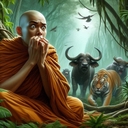
The brahmin Jāṇussoṇi asks how anyone bears the wilderness.
The Buddha lists sixteen reasons he has no fear living there.
Unpurified conduct or livelihood or thought would make it frightening.
None of those is true of him.
He deliberately picked the most fearful nights of the month to test himself.
When an animal came he did not get up or run.
The seven awakening factors were activated in sequence.
The four jhānas follow as the samādhi factor.
From that samādhi he realized the three higher knowledges.
+MN 5 Anaṅgaṇa:
Unblemished
Unblemished

Sāriputta gives a talk on four types of person.
Some have a blemish and do not know it.
Some have one and know it.
Some have none and do not know it.
Some have none and know it.
Moggallāna asks why one of each pair is better.
Blemish is a term for the wicked wishes a monk may have.
A monk with a blemish gets no respect even living secluded.
Moggallāna closes with a simile of a dirty dish nobody wants.
+MN 6 Ākaṅkheyyasutta:
One Might Wish
One Might Wish

Live by the precepts and see danger in the slightest fault.
Then seventeen things a monk might wish for are listed.
To be liked and approved by companions in the holy life.
To receive robes and almsfood and lodgings and medicine.
To make the offerings of supporters fruitful for them.
To prevail over discontent and over fear and terror.
To get the four jhānas easily and the formless liberations.
To become a stream-enterer or once-returner or non-returner.
To wield psychic power and the divine ear and eye and mind reading.
And finally to become an arahant.
+MN 7 Vattha:
Simile of the Cloth
Simile of the Cloth

A dirty cloth takes dye badly and so does a corrupted mind.
Sixteen corruptions of mind are listed from covetousness to negligence.
A monk who gives those up gains experiential confidence.
That confidence is in the Buddha and the Dharma and the Saṅgha.
The seven awakening factors are then launched in sequence.
Such a monk can eat fine food without being corrupted by it.
He develops the four divine abidings and becomes an arahant.
The brahmin Bhāradvāja asks if bathing in a river purifies anyone.
The Buddha answers in verse and the brahmin ordains.
+MN 8 Sallekha:
Self-Effacement
Self-Effacement
Many wrong views about self and world are listed first.
They are given up by seeing that this is not mine and not a self.
Then forty-four ways of self-effacement are set out.
Others are harmful and I will not be so is the pattern.
The same list is repeated as giving rise to the thought.
Then as a way around and as going up.
Then as the exposition by nirvana.
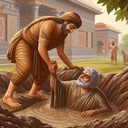
One who is sunk in mud cannot pull another out of it.
So one who is not nirvana-ed cannot liberate anyone else.
+MN 9 Sammā-diṭṭhi:
Right View
Right View

Sāriputta explains what right view actually understands.
First the unskillful and the skillful and the root of each.
Then fuel and its origin and cessation and the practice to that.
Then dukkha in the same fourfold way.
Then old age and death and rebirth and continued existence.
Then grasping and craving and feeling and contact.
Then the six sense fields and name and form and consciousness.
Then co-activities and ignorance.
And last the asinine-inclinations in that same fourfold way.
+MN 10 Sati-’paṭṭhāna:
The Foundations of Mindfulness
The Foundations of Mindfulness

The shorter discourse on establishing remembrance of Dharma.
The four ways of remembering are the one-way path.
Continuously seeing the body and the sensations.
Then the mind and then the Dharma.
The body section runs from the breath to the charnel ground.
The Dharma section covers hindrances and aggregates and awakening factors.
DN 22 is the longer version with the noble truths spelled out.
+Vagga 2 Sīha-nāda: lion's-roar
all
+MN 11 Cūḷa-sīhanāda:
Shorter Discourse on the Lion’s Roar
Shorter Discourse on the Lion’s Roar

The shorter lion-roar: what can a disciple here say if challenged?
Four things are explained by one who knows and sees.
Other religions also have confidence in their teacher and precepts.
So the answer has to be something they cannot match.
There are two views: the view of continued existence and of ending it.
There are four kinds of grasping.
Other teachings understand only some of them and only partly.
The Buddha understands every kind completely.
Giving up ignorance is what leads to arahantship.
+MN 12 Mahā-sīhanāda:
Longer Discourse on the Lion’s Roar
Longer Discourse on the Lion’s Roar
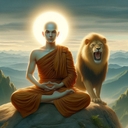
The longer lion-roar answers a monk who denied the Buddha had insight.
The Realized One possesses ten powers.
He knows the possible and karma and where every path leads.
He knows the world with its many elements and the beliefs of beings.
He reads faculties and knows corruption and cleansing in the jhānas.
He has past-life recall and the divine eye and the ending of the inclinations.
He has four kinds of self-assurance and knows the eight assemblies.
Five destinations plus nirvana are described.
Then his own austerities as a bodhisatta are recounted.
+MN 13 Mahā-dukkha-k-khandha:
Longer Discourse on the Mass of Suffering
Longer Discourse on the Mass of Suffering

Wanderers claim to teach the aggregates the same way the Buddha does.
They cannot answer on gratification and danger and escape.
For sensual pleasure the gratification is the five cords of sense pleasure.
The drawback runs through eight scenes of working life and war and crime.
The escape is removing desire and lust for it.
For material form the gratification is a girl at the peak of beauty.
The drawback is that same woman at eighty and then dead and decaying.
For sensations the gratification is the four jhānas.
Their drawback is that they too are impermanent and dukkha.
+MN 14 Cūḷa-dukkha-k-khandha:
Shorter Discourse on the Mass of Suffering
Shorter Discourse on the Mass of Suffering
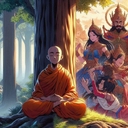
Mahānāma asks why greed still occupies him though he knows better.
Sensual pleasures stay tempting until a disciple gains jhāna.
That was true even of the Buddha before his awakening.
The gratification of sensual pleasure is the five cords.
The drawback runs through the same eight scenes as the longer version.
Jain followers hold that self-mortification purifies bad karma.
Their leader claims continuous omniscience and cannot answer questions.
Who lives in greater pleasure: the Buddha or the king?
The Buddha can sit in pleasure for seven days without moving.
+MN 15 Anumāna:
Measuring Up
Measuring Up

Moggallāna asks which qualities make a monk hard to admonish.
He lists the wicked wishes that put a monk beyond correction.
Then the opposite qualities that make one easy to admonish.
A monk should reflect and resolve not to fall under those wishes.
He should also ask himself whether he already has them.
If he finds them he should strive to give them up.
If he finds none he can abide happy and glad.
It is like looking in a mirror to find a blemish.
+MN 16 Ceto-khila:
Emotional Barrenness
Emotional Barrenness

Five kinds of emotional barrenness block the holy life.
So do five emotional shackles.
The barrenness is doubt about the Buddha and Dharma and Saṅgha.
Also doubt about the training and anger at fellow monks.
The shackles are attachment to body and sensual pleasure and sleep.
A monk who gives those up develops the four bases of psychic power.
With enthusiasm added there are fifteen factors.
Such a monk is like a chick ready to break out of the shell.
+MN 17 Vana-pattha:
Jungle Thickets
Jungle Thickets

A monk living in a jungle thicket should judge it by four cases.
In the first his practice does not settle and requisites are hard to get.
He should leave that place at once and not stay.
In the second his practice does not settle but requisites are easy.
He should still leave, because requisites are not why he went forth.
In the third his practice settles but requisites are hard to get.
He should stay anyway.
In the fourth both go well and he should stay for life.
The same four cases are then applied to villages and towns and teachers.
+MN 18 Madhu-piṇḍika:
honey cake
honey cake
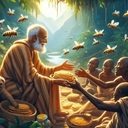
Daṇḍapāṇi asks what the Buddha teaches and gets a brief statement.
The monks cannot follow it and ask him to explain.
He gives only the brief statement again and leaves.
They go to Mahā Kaccāna and ask him to expand it.
He lays out the dependent origination of proliferation.
Eye and form give consciousness and contact and feeling.
What is felt is perceived and thought about and proliferates.
He then gives the cessation of that whole sequence.
The Buddha puts his seal of approval on the explanation.
+MN 19 dve-dhā-vitakka:
two-sorts-of-thinking
two-sorts-of-thinking
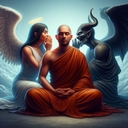
Before awakening the Buddha divided his thoughts into two sorts.
The bad sort is sensual and malicious and cruel thinking.
The good sort is renunciation and kindness and harmlessness.
A bad thought harms oneself and others and blocks wisdom.
Whatever one thinks about often bends the mind that way.
A cowherd in the crops must watch the cattle closely.
In the open he can sit at the root of a tree and relax.
So the mind settles and the four jhānas follow.
Then past lives and the divine eye and arahantship.
Māra wants to kill the deer and the Buddha leads them to safety.
+MN 20 Vitakka-saṇṭhāna:
relaxing [unwanted] thoughts
relaxing [unwanted] thoughts

Five methods remove an unwanted thought during meditation.
First replace the unskillful thought with a skillful one.
That is like knocking out a coarse peg with a fine one.
Second see the danger in it, like a carcass hung round the neck.
Third give it no attention, like closing the eyes to avoid a sight.
Fourth slow the thinking down by stages.
That is like going from running to walking to lying down.
Fifth crush mind with mind, like a strong man holding down a weak one.
Then a monk is master of his thinking and thinks what he wants.
+Vagga 3 Tatiya: third
all
+MN 21 Kakacū-’pama:
Saw simile
Saw simile

The monk Phagguna mixes with the nuns and defends them angrily.
Even if the nuns are struck he should stay unaffected.
He should keep compassion and kindness and no secret hate.
The Buddha recalls when a hint was enough for these monks.
A maid tests a housewife famous for her sweet temper.
She gets up late once and gets angry words.
She gets up later still and is assaulted.
A monk is only easy to admonish when his motive is respect for Dharma.
Even if bandits sawed off your limbs you should keep kindness.
That is the simile of the saw and it should be reflected on often.
+MN 22 Alagaddū-’pama:
Simile of the Snake
Simile of the Snake

The monk Ariṭṭha holds that sensual pleasure is no obstruction.
The monks cannot dissuade him and take it to the Buddha.
Sensual acts are impossible without sensual perceptions and thoughts.
Some learn the Dharma only to win arguments.
That is grasping a snake by the tail and getting bitten.
Grasping it rightly is like taking the snake behind the head.
The Dharma is a raft for crossing and not for carrying on the head.
Six grounds for views are examined and let go.
Seeing impermanence brings dispassion and arahantship.
+MN 23 Vammika:
🐜The Ant-Hill
🐜The Ant-Hill

A deity gives the monk Kassapa a riddle about an ant-hill.
Kassapa cannot solve it and brings it to the Buddha.
The ant-hill is this body.
Fuming at night and flaming by day is planning and then acting.
The brahmin is the Buddha and the sage is a monk in training.
The sword is wisdom and the digging is energy.
The bar is ignorance and the bullfrog is anger.
The forked path is doubt and the box is the five hindrances.
The tortoise is the aggregates and the axe is the five cords.
The dragon under it all is a monk with the inclinations ended.
+MN 24 Ratha-vinīta:
Prepared Chariots
Prepared Chariots
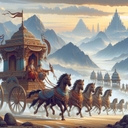
Monks praise Puṇṇa Mantāṇiputta to the Buddha.
Sāriputta wants to meet him and finds him in the Blind Wood.
He asks whether one goes forth for purification of ethics.
Puṇṇa says no to that and to purification of mind and view.
He says no to going beyond doubt and to knowledge and vision.
One goes forth only for nirvana without grasping.
Seven relay chariots carry a king stage by stage.
Each purification is only for the sake of the next one.
The two elders are delighted to have met at last.
+MN 25 Nivāpa:
Fodder
Fodder

A sower puts out fodder to trap deer.
The first herd eats it and is caught.
The second avoids it until starving and is caught anyway.
The third makes a lair near the bait and is still caught.
The fourth makes its lair where the sower cannot follow.
The first ascetics are negligent and fall to sensual pleasure.
The second live on simple food and still come back.
The third hold speculative views about the world.
The fourth go where Māra and his assembly cannot follow.
That place is the four jhānas and the formless attainments.
+MN 26 Pāsarāsi:
Noble Search
Noble Search

Monks sitting together should discuss Dharma or keep noble silence.
There is an ignoble search and a noble search.
The ignoble search is for what is itself subject to birth and death.
The Buddha tells of his own going forth while young.
He learned all Āḷāra Kālāma had and left.
He learned all Uddaka son of Rāma had and left too.
Non-Buddhist teachers also have the five faculties.
He then investigated without any teacher and awakened.
Brahmā Sahampati asks him to share what he found.
He surveys the world and goes to the group of five monks.
+MN 27 Cūḷa-hatthi-pad-opama:
Shorter Elephant’s Footprint Simile
Shorter Elephant’s Footprint Simile
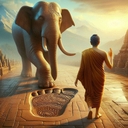
The wanderer Pilotika tells how he judges the Buddha awakened.
A woodsman infers a big elephant from a big footprint.
Jāṇussoṇi repeats this to the Buddha.
The Buddha says the simile is not yet complete.
A woodsman must follow the tracks until he sees the elephant itself.
So the Buddha lays out the whole gradual training to nirvana.
Only the ending of the inclinations is the real footprint.
Jāṇussoṇi becomes a lay follower.
+MN 28 Mahā-hatthipad-opama:
Longer Simile of the Elephant’s Footprint
Longer Simile of the Elephant’s Footprint

Sāriputta gives the longer elephant-footprint discourse.
The footprint of an elephant contains every other footprint.
So every skillful Dharma fits inside the four noble truths.
The form aggregate is then broken into four primary elements.
The earth element is examined inside and outside the body.
Then water and fire and wind in the same way.
Each is impermanent and can be seen as not a self.
The body is like a building made of sticks and stones and space.
+MN 29 Mahā-sāropama:
Longer Simile of Heartwood
Longer Simile of Heartwood

A monk ordains for the right reasons and then grows negligent.
He is like a man who takes branches and leaves for heartwood.
Another develops ethics and grows negligent on the strength of it.
He takes shoots instead of heartwood.
Another develops undistractible-lucidity and stops there.
He takes the bark.
Another gains knowledge and vision and stops there.
He takes the softwood.
Only permanent liberation is the heartwood itself.
The holy life is not lived for possessions or honor or vision.
+MN 30 Cūḷa-sāropama:
Shorter Simile of Heartwood
Shorter Simile of Heartwood
The brahmin Piṅgalakoccha asks whether all six teachers are awakened.
The heartwood simile is given first in its own right.
A man needing heartwood takes branches or shoots or bark or softwood.
Only the last man knows heartwood and takes it.
A monk who stops at ordination or ethics or samādhi is one of those men.
A monk who stops at knowledge and vision is another.
Here the discourse goes further than the longer version.
The four jhānas are better than knowledge and vision.
So are the formless attainments.
The heartwood is cessation of perception and feeling with arahantship.
+Vagga 4 Mahā-yamaka: great-pairs
all
+MN 31 Cūḷa-gosiṅga:
Shorter Discourse at Gosiṅga
Shorter Discourse at Gosiṅga
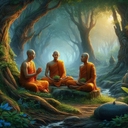
The Buddha visits Anuruddha and Nandiya and Kimbila in the woods.
He asks whether they are living in harmony.
Anuruddha says they live as milk mixes with water.
Each sets his own mind aside and follows the others.
Whoever comes back first prepares the seats and the water.
They meet three times a day to discuss Dharma.
The Buddha asks whether they reached superhuman distinctions.
The spirit Dīgha Parajana then praises them to the Buddha.
+MN 32 Mahā-gosiṅga:
Longer Discourse at Gosiṅga
Longer Discourse at Gosiṅga
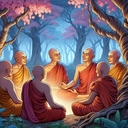
Several famous senior disciples gather in the Gosiṅga wood.
Sāriputta asks each to describe the monk who adorns that forest.
Ānanda names the learned monk who teaches widely.
Revata names the one who loves solitude and masters samādhi.
Anuruddha names the one with a powerful divine eye.
Mahākassapa names the one content with little.
Moggallāna names the one who enjoys Dharma discussion.
Sāriputta names the master of mind who enters any attainment at will.
They report the whole conversation to the Buddha.
His own answer is the monk who does not rise until he is an arahant.
+MN 33 Mahā-gopālaka:
Longer Discourse on the Cowherd
Longer Discourse on the Cowherd

An unskilled cowherd fails at eleven things and loses the herd.
A monk lacking eleven Dharmas cannot grow in this training.
He does not know form and is not skilled in characteristics.
He does not pick out the fly eggs or dress the wounds.
He does not smoke out the pests or know the ford.
He does not know satisfaction or the trail or the pastures.
He milks the herd dry and shows no respect to senior monks.
The skilled cowherd does all eleven and keeps the herd.
So the monk with those eleven Dharmas grows in this training.
+MN 34 Cūḷa-gopālaka:
Shorter Discourse on the Cowherd
Shorter Discourse on the Cowherd

An unintelligent cowherd drove his cattle across the Ganges at the wrong place.
They were swept away and drowned in midstream.
So it goes with teachers who do not know this world or the next.
An intelligent cowherd found the ford and crossed at the right place.
The bulls went first and then the cattle and then the calves.
So the Buddha leads arahants first and then the lower attainments.
Even the calf just born gets across behind its mother.
The discourse closes in verse.
+MN 35 Cūḷa-saccaka:
Shorter Discourse With Saccaka
Shorter Discourse With Saccaka

Saccaka brags that he can defeat the Buddha in debate.
He holds that form and feeling and the rest are his self.
The Buddha asks whether a king rules in another realm.
So can he command his own form not to change?
Saccaka goes silent and the spirit Vajirapāṇi appears over him.
The Buddha is not even sweating.
Saccaka is a hollow banana tree beside real heartwood.
Dummukha adds a simile of a crab with its claws broken off.
The Buddha then teaches not-self through to arahantship.
+MN 36 Mahā-saccaka:
Longer Discourse With Saccaka
Longer Discourse With Saccaka

Saccaka returns to ask about developed body and mind.
Outsiders claim it and cannot bear even ordinary pain.
The Buddha tells the story of his own asceticism.
He learned the sphere of nothingness from Āḷāra Kālāma and left.
He learned neither perception nor non-perception from Ramaputta.
Three similes of fire sticks show why austerity fails.
He held his breath and cut his food to almost nothing.
He recalled the first jhāna he had known as a boy.
He ate enough to have strength and entered the four jhānas.
From the imperturbable fourth he reached the three higher knowledges.
+MN 37 Cūḷa-taṇhā-saṅkhaya:
Shorter Discourse on Ending of Craving
Shorter Discourse on Ending of Craving

Sakka asks the Buddha for a brief summary of the holy life.
Nothing at all is worth insisting on is the answer.
Whatever is felt is seen as impermanent and let go.
Moggallāna wonders whether Sakka really understood it.
He goes up to heaven and finds Sakka showing off a palace.
He shakes the palace with his toe to rouse some urgency.
Sakka then repeats the teaching correctly.
Moggallāna returns and the Buddha gives the same talk a third time.
+MN 38 Mahā-taṇhā-saṅkhaya:
Longer Discourse on Ending of Craving
Longer Discourse on Ending of Craving

Sāti the fisherman son holds that consciousness is what is reborn.
The Buddha calls him a fool and checks the other monks.
Consciousness is reckoned by the specific conditions it arises from.
A fire is named for the fuel it burns.
Four nutriments are then set out.
The whole of dependent origination follows in both directions.
One who sees that does not speculate about a past or future self.
The embryo and the parents and the origin of dukkha are described.
The discourse closes with ordination and the gradual training.
+MN 39 Mahā-assapura:
Longer Discourse at Assapura
Longer Discourse at Assapura
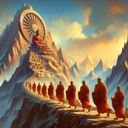
The monks are told to live up to the name of ascetic.
It begins with shame and fear of wrongdoing.
Then conduct of body and speech and mind and a pure livelihood.
Then guarding the sense doors and eating the right way.
Then wakefulness with only the middle watch for sleep.
Then remembering and applying Dharma in every posture.
The five hindrances are removed with their similes.
The four jhānas follow with their similes.
Then the three higher knowledges with theirs.
Only then is the title of ascetic or brahmin earned.
+MN 40 Cūḷa-assapura:
Shorter Discourse at Assapura
Shorter Discourse at Assapura

The shorter Assapura discourse is about outward marks.
A monk does not become an ascetic by robe or dust or bathing.
Nor by living at the root of a tree or reciting much.
If a covetous and malicious monk could get there by outward form.
Then anyone at all could do it just by taking up the form.
The real path is giving up covetousness and malice and anger.
The seven awakening factors run in sequence.
The four divine abidings stand where the jhānas usually stand.
A lotus pond quenches thirst for anyone from any direction.
+Vagga 5 Cūḷa-yamaka: lesser pairs
all
+MN 41 Sāleyyaka:
People of Sālā
People of Sālā
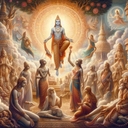
The brahmins of Sālā ask why some are reborn well and some badly.
Some conduct themselves contrary to Dharma and some in line with it.
Immoral conduct by body is killing and stealing and sexual misconduct.
By speech it is lying and divisive and harsh and useless talk.
By mind it is covetousness and malice and wrong view.
Moral conduct is the abandoning of each of those ten.
One who keeps them may wish for rebirth among any of the gods.
That wish is fulfilled because the conduct is pure.
Better still they may wish for the ending of the inclinations.
+MN 42 Verañjaka:
People of Verañja
People of Verañja
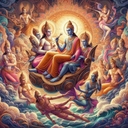
The brahmins of Verañja put the same question as those of Sālā.
Why are some reborn in a bad place and some in a good one?
The answer is the ten courses of conduct in both directions.
Three by body and four by speech and three by mind.
Immoral conduct leads to hell and moral conduct to heaven.
One whose conduct is pure may aim at any rebirth and get it.
The rest of the discourse is word for word MN 41.
+MN 43 mahā-vedalla:
Greater Set of Questions & Answers
Greater Set of Questions & Answers
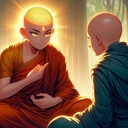
Koṭṭhita puts a long series of questions to Sāriputta.
Discernment is what sees the four noble truths.
Consciousness is what cognizes the three kinds of sensation.
Consciousness and discernment cannot be pulled apart.
One is to be known and the other developed.
Perception is what perceives the colors.
A mind divorced from the bodily senses can still know the formless.
First jhāna has five factors and gives up five hindrances.
Vitality fabrications and the faculties are examined next.
Four kinds of awareness-release differ in words and agree in limit.
+MN 44 cūḷa-vedalla:
Shorter Set of Questions & Answers
Shorter Set of Questions & Answers

The layman Visākha questions the nun Dhammadinnā.
Self-identification is the five grasping aggregates.
The eightfold path is sorted into ethics and samādhi and wisdom.
Samādhi is unification of mind and its basis is the four rememberings.
Its equipment is the four right efforts and its development is practice.
Three fabrications are of body and speech and mind.
Then the attainment of the cessation of perception and feeling.
How one enters it and emerges and what is felt on emerging.
The Buddha later confirms every one of her answers.
+MN 45 Cūḷa-dhamma-samādāna:
Shorter Discourse on Taking Up Dharma-[Practices]
Shorter Discourse on Taking Up Dharma-[Practices]

Four ways of taking up a practice are set out by result.
The first is pleasant now and painful later.
That is indulging the five cords of sense pleasure.
The second is painful now and painful later.
That is useless austerity in the wanderers style.
The third is painful now and pleasant later.
That is resisting the hindrances against the grain.
The fourth is pleasant now and pleasant later.
That is the four jhānas and rebirth among the gods.
+MN 46 Mahā-dhamma-samādāna:
The Great [Discourse] on Taking Up Dharma [practices]
The Great [Discourse] on Taking Up Dharma [practices]
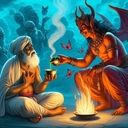
Beings want the good to come and the bad to go.
The opposite happens and the discourse asks why.
An ordinary person cultivates what should be dropped.
An educated disciple cultivates the other way round.
Four permutations of practice and future result are listed.
They are set out first for the ignorant and then for the wise.
Wrong action and speech and view fill in the painful ones.
Four similes follow: a poisoned gourd and a bronze cup.
Then fermented urine with medicine and honey with ghee.
The best way is like the sun clearing the rainy-season sky.
+MN 47 Vīmaṃsaka:
The Inquirer
The Inquirer

A monk who cannot read minds should still inquire into the Buddha.
He should look and listen for anything corrupt in him.
Then for anything mixed of clean and unclean.
Then for what is clean and can be seen and heard.
He should ask whether the state was reached long ago or recently.
He should check that fame has not brought its dangers with it.
He should see that abstaining comes from ended greed and not from fear.
And he should ask the teacher what reasons he has for saying so.
Confidence founded on that inquiry is well grounded and unshakable.
+MN 48 Kosambiya:
[The monks of] Kosambi
[The monks of] Kosambi
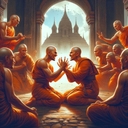
The monks of Kosambi are quarrelling and will not be reconciled.
Six warm-hearted Dharmas make monks live at ease together.
Then the noble view and seven factors of stream entry.
The first is knowing one has overcome the hindrances and views.
The second is that cultivating that view brings calm and nirvana.
The third is that no outsider has this view.
The fourth is that only a minor offence is still possible.
The fifth is that duties never crowd out the training.
The last two are listening to Dharma with samādhi and with joy.
A disciple with those seven factors is a stream-enterer.
+MN 49 Brahma-nimantanika:
On the Invitation of Brahmā
On the Invitation of Brahmā

A Brahmā holds the view that his own world is permanent.
The Buddha reads his mind and appears in the Brahmā world.
He tells Brahmā plainly that the view is ignorant.
Māra possesses one of the retinue to argue against him.
The Buddha names Māra at once.
Brahmā warns him that other monks thought they escaped his reach.
The Buddha agrees he would be in reach if he clung to those things.
He sees realms Brahmā cannot see and knows things as they are.
Brahmā tries to vanish and fails, and the Buddha vanishes and speaks.
Māra returns to urge silence and the Buddha sees the agenda.
+MN 50 Māra-tajjanīya:
Rebuke of Māra
Rebuke of Māra

Moggallāna notices that Māra has got inside his belly.
He tells Māra that he was once a Māra himself.
In that life he harassed the Buddha Kakusandha and his disciples.
The monk Sañjīva sat in cessation and could not be burned.
Māra Dūsī possessed brahmins to make them abuse the monks.
When that failed he made them flatter the monks instead.
Then he struck the chief disciple and drew blood.
He fell into hell in that instant.
The discourse closes in verse.
+Vagga 6 Gahapati: householders
all
+MN 51 Kandaraka:
With Kandaraka
With Kandaraka
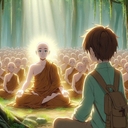
Kandaraka wonders at how silent the whole assembly is.
The Buddha says every Buddha assembly is like this at best.
Monastics and lay people alike practise the four rememberings.
Humans are shady and hard to read and animals more transparent.
Four types of person are then set out.
The first mortifies himself with austerities.
The second mortifies others and includes butchers and hunters.
The third mortifies both and includes kings at sacrifice.
The fourth mortifies neither and is the whole gradual training.
That runs from ordination through the jhānas to the higher knowledges.
+MN 52 Aṭṭhakan-āgara:
Man From the City of Aṭṭhaka
Man From the City of Aṭṭhaka
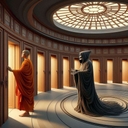
The householder Dasama asks Ānanda for one Dharma leading to nirvana.
Ānanda answers with the four jhānas.
In each of them a monk sees that it is made and conditioned.
Whatever is made is impermanent and liable to cease.
Then the four divine abidings are given the same way.
Then the first three formless attainments.
That gives eleven doors instead of the one that was asked for.
Dasama says a man looking for one entrance found eleven.
+MN 53 Sekha:
A trainee
A trainee

The Buddha is asked to speak first at the new Sakyan hall.
His back hurts afterwards so he asks Ānanda to continue.
Ānanda lays out the gradual training of a disciple in training.
He is ethical and guards the sense doors.
He eats in moderation and is dedicated to wakefulness.
He has seven true Dharmas and gets the four jhānas easily.
A hen sitting properly hatches her chicks without wishing for it.
So a trainee who does this breaks out of ignorance.
A disciple with the three higher knowledges is accomplished in knowledge.
+MN 54 Potaliya:
With Potaliya the Wanderer
With Potaliya the Wanderer

Potaliya objects to being addressed as householder.
He says he has refused all work and cut off all judgments.
The Buddha says cutting off judgments means something else here.
Eight Dharmas are needed and each depends on the one before it.
Then seven similes for the danger in sensual pleasure.
A dog gnawing a bare bone and a vulture chased for its scrap.
A man carrying a grass torch into the wind.
A pit of glowing coals and a delightful park seen in a dream.
Borrowed goods and a man up a tree another man is felling.
Then unified equanimity and the fourth jhāna and the three knowledges.
+MN 55 Jīvaka:
With Jīvaka
With Jīvaka
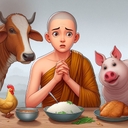
Jīvaka reports a rumor that the Buddha eats meat killed for him.
Meat may not be eaten if it is seen or heard or suspected so.
A monk spreads kindness over a village and is invited to eat.
He eats without attachment and seeing the danger in it.
So he is blameless in that meal.
One who kills for a monk makes much bad karma in five ways.
The Buddha reads the Brahmā-abiding of kindness as complete ending.
The same is done for compassion and joy and equanimity.
Jīvaka accepts that the monks eat allowable and blameless food.
+MN 56 Upāli:
(name of layperson)
(name of layperson)
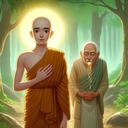
The Jain leader holds three kinds of action and calls the bodily strongest.
The Buddha holds mental action to be the most potent of the three.
Dīgha reports the exchange and the Jains agree the Buddha is wrong.
Upāli sets out to beat him in debate.
Dīgha warns that the Buddha is a formidable converter.
Four examples show the Jain position contradicting itself.
Accidentally killing insects and killing by mind alone are among them.
Upāli admits he was won over by the very first simile.
He takes refuge and is told to keep supporting the Jains anyway.
He reaches stream entry and the Jain leader spews hot blood.
+MN 57 Kukkuravatika:
The Ascetic Who Behaved Like a Dog
The Ascetic Who Behaved Like a Dog
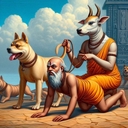
A dog-duty ascetic and a cow-duty ascetic come to the Buddha.
Behaving fully like a dog leads to the animal realm or hell.
The same holds for behaving fully like a cow.
Four kinds of deed are then set out.
Dark deeds with dark results and bright deeds with bright results.
Deeds that are both dark and bright with mixed results.
And deeds neither dark nor bright that end all deeds.
The cow ascetic becomes a lay follower.
The dog ascetic ordains and soon becomes an arahant.
+MN 58 Abhaya-rāja-kumāra:
With Prince Abhaya
With Prince Abhaya

The Jain leader sends prince Abhaya to trap the Buddha in a dilemma.
Does the Buddha ever say what is disliked by others?
A nurse pulls a stick out of a boy mouth and draws blood.
She does it because she wants his welfare.
So the Buddha says what is true and beneficial at the right time.
Right speech is set out in more detail than the usual formula.
Abhaya asks whether the answers are premeditated or on the spot.
A wheelwright asked about wheels does not have to prepare.
+MN 59 Bahu-vedanīya:
Many [kinds of] sensations
Many [kinds of] sensations
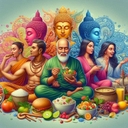
The carpenter Pañcakaṅga and the monk Udāyī disagree about sensations.
Ānanda reports the disagreement to the Buddha.
Both are right, because he has classified sensations many ways.
The five cords of sense pleasure are one kind of pleasure.
The first jhāna is a better pleasure than those.
Each jhāna in turn is better than the one before.
So are the formless attainments up to the ninth.
The ninth has no sensation at all.
It is still called pleasure, and that is the highest sense of the word.
+MN 60 Apaṇṇaka:
Guaranteed
Guaranteed

The householders of Sālā ask for a teacher they can trust.
The Buddha offers the guaranteed teaching instead of a person.
Some deny another world and deeds and their results.
If they are wrong they have made bad karma for the next world.
If they are right they are still blamed by the wise here and now.
So the denial loses either way and the affirmation wins either way.
The same reasoning is run for doctrines of non-doing and no-cause.
Then for the formless realms and for cessation.
The one who takes up the good side is safe on both counts.
+Vagga 7 Bhikkhu: monks
all
+MN 61 amba-laṭṭhika-rāhul-ovāda:
Advice to Rāhula at Ambalaṭṭhika
Advice to Rāhula at Ambalaṭṭhika
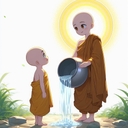
The Buddha tips out a water dipper and leaves a trace behind.
So little shame is left in one who lies deliberately.
A royal elephant that risks its life holds nothing back.
A monk who lies for gain has nothing he would hold back either.
So Rāhula is told never to joke with a lie.
A mirror is for looking at yourself.
Reflect the same way before and during and after every act of body.
Then the same for every act of speech and of mind.
Every ascetic of past and future and present purifies conduct that way.
+MN 62 mahā-rāhul-ovāda:
(The) Greater Rāhula Admonishment
(The) Greater Rāhula Admonishment

Rāhula walks the alms round behind the Buddha and gets a teaching.
Every form is to be seen as not mine and not a self.
He skips his meal and sits down to meditate.
Sāriputta tells him to develop remembering of breathing.
Rāhula asks the Buddha how it is done.
First the five properties of earth and water and fire and wind and space.
Then meditation on becoming as level and unshaken as each of them.
Then the antidotes: kindness for ill will and the ugly for lust.
And perceiving impermanence for the conceit of a self.
Then the sixteen steps of breath meditation up to the last breath.
+MN 63 Cūḷa-mālukya:
Shorter Discourse With Māluṅkya
Shorter Discourse With Māluṅkya

Māluṅkyaputta will disrobe if the Buddha does not answer him.
He wants to know whether the world is eternal and the rest.
The Buddha asks when he ever promised such answers.
A man shot with an arrow refuses treatment until his questions are answered.
He wants the caste of the archer and the make of the bow.
That man dies with the arrow still in him.
None of those views brings the end of dukkha.
So remember what is declared and what is left undeclared.
+MN 64 Mahā-mālukya:
longer (discourse with) mālukya
longer (discourse with) mālukya

Māluṅkyaputta remembers the five lower fetters wrongly.
A baby has no concept of a fetter and the tendency is already there.
The five lower fetters are taught for the ordinary person and the disciple.
There is a path for giving them up and without it they cannot be cut.
Heartwood is not got by hacking at the bark of a standing tree.
Identity view cannot cease without the mind first being calmed.
Seven paths are given for cutting the five lower fetters.
They are the four jhānas and the first three formless attainments.
In each the monk sees the state as made and reaches arahantship or non-return.
The last two are left out because seeing cannot be done inside them.
+MN 65 Bhaddāli:
With Bhaddāli
With Bhaddāli
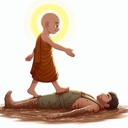
Bhaddāli will not keep the rule about eating in one sitting.
The Buddha allows him two sessions and Bhaddāli still refuses.
Later he comes and apologizes.
An arahant asked to be a bridge over mud would lie down at once.
A monk who ignores the training rules does not succeed on the path.
One who keeps them does.
Some monks are pressed again and again and others are not.
The early Saṅgha had fewer rules and more arahants.
A thoroughbred colt is broken in stages and gains ten factors.
+MN 66 Laṭukik-opama:
quail simile
quail simile

Udāyī recalls how hard the evening-meal rule once seemed.
A quail dies caught by a creeper that an elephant would snap.
So a small fetter binds a weak monk and not a strong one.
A poor man clings to a hut and a wife he should let go of.
A rich man gives up far more without difficulty.
The five cords of sense pleasure are what should be feared.
The four jhānas are to be developed and not feared.
In the first jhāna the thinking is still perturbable.
In the second the rapture is, and in the third the pleasure.
No fetter is too small to drop and no jhāna is enough to stop at.
+MN 67 Cātuma:
At Cātumā
At Cātumā

The Buddha dismisses five hundred noisy monks at Cātumā.
Sakyan clansmen appeal to him to receive them again.
A young seedling needs water and a calf needs its mother.
Brahmā Sahampati makes the same appeal with the same similes.
Sāriputta says he would have lived in solitude too.
Moggallāna says he would have taken over the teaching.
Four dangers face one who has gone forth.
Waves are anger and crocodiles are gluttony.
Whirlpools are the five cords of sense pleasure.
Sharks are lust for women, and each of the four ends in disrobing.
+MN 68 Naḷakapāna:
At Naḷakapāna
At Naḷakapāna
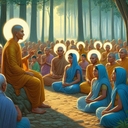
Young monks from good families have gone forth at Naḷakapāna.
Are they content in the holy life or do they pine for it?
The Buddha gives inspiring talks to supply their Dharma thoughts.
Gladness and rapture and pleasure follow from those.
That is the seven awakening factors in sequence.
Living at ease is the code phrase for the four jhānas.
The reason he declares the rebirths of the dead is given.
It is not for gain or flattery but to inspire the living.
The same is said of nuns and laymen and laywomen.
+MN 69 Goliyāni:
With Gulissāni
With Gulissāni

Sāriputta gives the talk, prompted by the wilderness monk Gulissāni.
A wilderness monk visiting the Saṅgha should respect his companions.
He should be careful where he sits and know the supplementary rules.
He should not enter the village too early or return too late.
He should not socialize with families before or after the meal.
He should not be restless or fickle or gossipy.
He should be easy to admonish and guard the sense doors.
He should eat in moderation and be committed to wakefulness.
He should have vigor and remembering and undistractible-lucidity.
And he should reach the formless liberations and the superhuman state.
+MN 70 Kīṭāgiri:
(name of place)
(name of place)

Not eating in the evening is declared good for health.
Some monks say eating whenever they like suits them better.
It was never taught that every sensation grows the unskillful.
Six kinds of sensation are sorted by what they cause to grow or decline.
Some monks still need to be assiduous and some no longer do.
Seven types of awakened person are then set out.
Freed both ways and freed by wisdom and eyewitness.
Attained to view and freed by justifiable-trust.
Follower of the Dharma and follower by justifiable-trust.
The gradual training closes with four reflections that carry a disciple.
+Vagga 8 Paribbājaka: Wanderers
all
+MN 71 Te-vijja-vaccha:
To Vacchagotta on the Three Knowledges
To Vacchagotta on the Three Knowledges

Vacchagotta asks whether the Buddha is continuously omniscient.
He is not omniscient in that way and never claimed it.
What he claims is the three higher knowledges.
Recollection of past lives and the divine eye.
And the ending of the asinine-inclinations.
No layperson living at home is an arahant.
Far more than five hundred lay followers have been reborn in heaven.
In ninety-one aeons only one Ājīvaka ascetic went to heaven.
+MN 72 Aggi-vaccha:
With Vacchagotta on Fire
With Vacchagotta on Fire

Vacchagotta puts ten speculative questions to the Buddha.
Each is set aside rather than answered.
A thicket of views is dukkha and does not lead to nirvana.
What he sees instead is the rise and fall of the aggregates.
So where is an arahant reborn?
A fire that has burned its fuel has not gone in any direction.
The question of where does not apply to it.
Vacchagotta compares the Saṅgha to the heartwood of a great tree.
+MN 73 Mahā-vaccha:
Longer Discourse With Vacchagotta
Longer Discourse With Vacchagotta
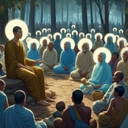
Vacchagotta asks for the whole teaching in brief.
It is the skillful and the unskillful.
Far more than five hundred monk disciples are arahants.
So are far more than five hundred nun disciples.
Celibate laymen and laywomen in the same number are non-returners.
Non-celibate laymen and laywomen in that number are stream-enterers.
So the holy life is complete in every one of its parts.
Vaccha asks to ordain and becomes a trainee in a fortnight.
Calm and insight developed together bring the six higher knowledges.
He becomes an arahant.
+MN 74 Dīgha-nakha:
with wanderer named ‘long nails’
with wanderer named ‘long nails’
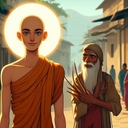
The wanderer Long-Nails holds that he approves of nothing at all.
Then he does not approve of that view either.
Approving of everything is worse than approving of nothing.
So is approving of some things and not others.
Each position is examined for the trouble it makes.
The body is physical and made of the four elements.
Only one of the three kinds of sensation is felt at a time.
Not delighting in any sensation leads to arahantship.
Sāriputta becomes an arahant while standing and listening.
Long-Nails becomes a stream-enterer.
+MN 75 Māgaṇḍiya:
(name of brahmin)
(name of brahmin)

Brahmins are talking about the Buddha and one calls him a life-destroyer.
He overhears with the divine ear from his retreat.
Māgaṇḍiya joins and hears about gratification and danger and escape.
The Buddha describes the luxury of his own lay life.
He does not miss it, because he has the pleasure of jhāna.
The gods do not envy human pleasures either.
A leper scratches his sores and cauterizes them and calls it pleasure.
A cured leper would not go back to that fire for anything.
A blind man is cheated with a filthy cloth called white.
Cured by a surgeon he sees for himself that he was lied to.
+MN 76 Sandaka:
with Sandaka
with Sandaka
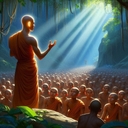
Ānanda comes to the wanderer Sandaka and gives a talk.
Four ways negate the holy life altogether.
Denying karma and rebirth, and denying that killing is bad.
Denying any cause for corruption, and holding seven uncreated substances.
Then four kinds of unreliable holy life.
A teacher who claims knowledge in every posture and is caught out.
One who goes only by oral transmission and one only by logic.
And one who is simply dull.
Then the skillful Dharma that does make the path work.
The emancipated in this training are beyond counting.
+MN 77 Mahā-sakuludāyi:
Longer Discourse with Sakuludāyī
Longer Discourse with Sakuludāyī

Udāyī says loyalty to the Buddha rests on five ascetic practices.
Those are not the reason, since his own disciples exceed him in some.
The five real ones start with higher ethics.
Then knowledge and vision and higher discernment.
Then the four noble truths applied to real problems.
Then the whole body of teachings, the thirty-seven factors of awakening.
All seven sets are listed from the rememberings to the eightfold path.
Then the eight liberations and eight dimensions of mastery and ten kasinas.
Then the four jhānas with their similes and the four elements.
Then the mind-made body and the six higher knowledges with similes.
+MN 78 Samaṇamuṇḍika:
(name of person)
(name of person)

Uggāhamāna calls a man invincible if he does no bad deed or word.
Then a helpless baby is invincible, since it can do none of them.
The Buddha ideal ascetic has ten Dharmas instead.
They turn out to be the eightfold path plus right knowledge and liberation.
First the unskillful behaviors and where they stem from.
How they cease, and that right effort is the practice for it.
Then skillful ethics in the same fourfold way.
Three unskillful resolves are lust and ill will and cruelty.
They cease in the first jhāna.
The three skillful resolves cease in the second.
+MN 79 Cūḷa-sakuludāyi:
shorter (discourse with) sakuludāyi
shorter (discourse with) sakuludāyi

The Buddha visits Udāyī and his students in the peacock sanctuary.
He teaches conditionality rather than argue about past and future.
Udāyī teacher claims a doctrine of the ultimate splendor.
Is that splendor brighter than a beryl gem on a blanket?
The gem is brighter, and so the claim collapses.
Is there a world of perfect happiness and a path to reach it?
It is realized when a fourth-jhāna meditator meets those gods.
Monks train for things finer than a world of perfect happiness.
Those are the four jhānas and the three higher knowledges.
Udāyī wants to ordain and his students will not let him.
+MN 80 Vekhanasa:
with Vekhanasa
with Vekhanasa

The wanderer Vekhanasa also claims the ultimate splendor.
He cannot say what it is when asked.
A beryl gem on a cream blanket outshines whatever he means.
The five cords of sense pleasure are described in full.
Sensual pleasure has a highest point and it is not the highest happiness.
Vekhanasa gets angry and abuses the Buddha.
He is told that knowledge comes from practice and not from claims.
He becomes a lay follower.
+Vagga 9 Rāja: kings
all
+MN 81 Ghaṭikāra:
with Ghaṭikāra
with Ghaṭikāra

The Buddha smiles at a spot where the Buddha Kassapa once lived.
Kassapa chief lay attendant was a potter named Ghaṭīkāra.
His best friend was a brahmin student named Jotipāla.
Ghaṭīkāra tries again and again to bring him to see the Buddha.
In the end he grabs him by the belt and by the hair.
Jotipāla goes, hears the Dharma and ordains.
King Kikī offers Kassapa the rains and is refused.
Ghaṭīkāra had already been given that place.
He is a non-returner who cares for his blind parents and takes no pay.
The Buddha reveals that he himself was Jotipāla.
+MN 82 Raṭṭhapāla:
with Raṭṭhapāla
with Raṭṭhapāla
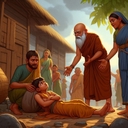
Raṭṭhapāla is the only son of a rich family at Thullakoṭṭhita.
His parents refuse permission to go forth.
He lies down on the bare ground and says he will die there.
They give in and he ordains and becomes an arahant.
He comes back on alms round and his own father does not know him.
He is given yesterday porridge and eats it gladly.
His family lay out gold and dress up his former wives to tempt him.
He tells them heaps of gold and coin are still not enough.
King Koravya asks why a healthy young man goes forth.
The answer is the four summaries: all is impermanent and owns nothing.
+MN 83 Maghadeva:
King Makhādeva
King Makhādeva
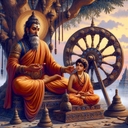
The Buddha smiles in the mango grove at Mithilā.
King Makhādeva once ruled there and kept a noble custom.
When his first grey hair appeared he handed the kingdom to his son.
Then he shaved his head and went forth and lived the four abidings.
His son and his line kept the same custom for many generations.
King Nimi was the last to keep it.
His son kept his hair and let the custom lapse.
That king was the last of the line.
A custom that ends in the four abidings only leads to a Brahmā world.
The custom the Buddha has set up leads all the way to nirvana.
+MN 84 Madhura:
At Madhurā
At Madhurā
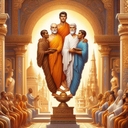
Kaccāna is asked whether brahmins really are the highest caste.
King Avantiputta of Madhurā puts the question.
If a rich man of any caste can hire servants of any other.
Then wealth and not birth is what decides who serves whom.
A thief of any caste is punished the same way by a king.
One who goes forth from any caste is honored the same way.
So the brahmin claim is only talk in the world.
The king takes refuge and Kaccāna points him to the Buddha.
+MN 85 Bodhi-rāja-kumāra:
To Prince Bodhi
To Prince Bodhi

Prince Bodhi holds that pleasure cannot be reached through pleasure.
The Buddha once thought so himself.
He tells the story of his going forth and his two teachers.
He learned nothingness and then neither perception nor non-perception.
Three fire-stick similes and then the harshest austerities.
He held the breath and cut his food to nothing.
He recalled the first jhāna of his boyhood and ate enough to reach it.
From the fourth jhāna came the three higher knowledges.
Brahmā had to beg him to teach what he had found.
A disciple with five qualities can reach the goal in seven years or less.
+MN 86 Aṅgulimāla:
On Angulimāla
On Angulimāla

Aṅgulimāla is a bandit who wears a garland of his victims fingers.
The Buddha walks alone onto his road and cowherds warn him off.
Aṅgulimāla runs after him at full speed and cannot catch up.
He shouts stop and is told that the Buddha has stopped already.
It is Aṅgulimāla who has not stopped.
He throws away his weapons and ordains.
King Pasenadi comes hunting him and finds him a monk.
On alms round he is stoned and bleeding and bears it.
He becomes an arahant and speaks verses on his own turning.
+MN 87 Piya-jātika:
Born from Those Who Are Dear
Born from Those Who Are Dear

A householder has lost his only son and wanders the charnel ground.
The Buddha tells him that grief is born from those who are dear.
He refuses that and says the dear bring joy and happiness.
He takes the argument to some gamblers who agree with him.
Queen Mallikā hears about it from King Pasenadi.
She asks him whether he would grieve if she died.
She asks the same about his daughter and his generals and his realm.
He admits he would grieve for every one of them.
So grief really is born from those who are dear.
+MN 88 Bāhitika:
The Cloak
The Cloak
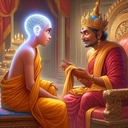
King Pasenadi meets Ānanda on the bank of the Aciravatī.
He asks whether the Buddha ever did anything blamed by the wise.
Ānanda answers that he never did.
What is blamed is whatever is unskillful.
Ascetics and brahmins with judgment are the ones who blame it.
The Buddha praises the giving up of everything unskillful.
He does it himself and roused others to do the same.
The king offers Ānanda an imported cloak in thanks.
Ānanda passes his old robe on down the line of monks.
+MN 89 Dhammacetiya:
Monuments to the Dhamma
Monuments to the Dhamma

King Pasenadi is at Medaḷumpa and hears the Buddha is nearby.
He rides out and hands his sword and turban to his general.
He bows his head to the Buddha feet and kisses them.
He explains that he sees monuments to the Dharma here.
Other ascetics quarrel and these monks live in harmony and smile.
He himself cannot get his own courtiers to obey like these monks.
He has seen clever debaters give up their questions on the way in.
Two of his own carpenters honor the Buddha above their own king.
So he concludes that the Buddha is fully awakened.
+MN 90 Kaṇṇakatthala:
At Kaṇṇakatthala
At Kaṇṇakatthala

King Pasenadi visits the Buddha at Kaṇṇakatthala.
His sisters have sent a question about omniscience.
There is no ascetic who knows and sees everything at once.
The king asks whether the four castes differ in their destiny.
In striving they do not differ at all.
Two elephants or horses of equal training do equal work.
The king asks whether gods and Brahmās return to this world.
Those with malice return and those without it do not.
The general Viḍūḍabha and the brahmin Sañjaya argue over the answer.
+Vagga 10 Brāhmaṇa: brahmins
all
+MN 91 Brahmāyu:
Brahmāyu
Brahmāyu

The brahmin Brahmāyu is a hundred and twenty years old and learned.
He sends his student Uttara to check the thirty-two marks.
Uttara sees thirty of them and the last two are shown by psychic power.
He follows the Buddha for seven months watching everything he does.
A long account of his walking and eating and teaching follows.
Uttara reports back and Brahmāyu comes himself.
He asks in verse who counts as a brahmin and a master of knowledge.
The Buddha answers him in verse and then teaches the gradual path.
Brahmāyu becomes a non-returner and dies soon after.
+MN 92 Sela:
To Sela
To Sela

The matted-hair ascetic Keṇiya prepares a great drink offering.
He invites the Buddha and the Saṅgha for the following day.
The brahmin Sela arrives with three hundred students.
He hears that a fully awakened one is there and doubts it.
He checks the thirty-two marks and the last two are shown to him.
He praises the Buddha in verse as a wheel-turning monarch of Dharma.
The Buddha answers that he is a king whose wheel none can turn back.
Sela and all three hundred ordain on the spot.
Within a week every one of them is an arahant.
+MN 93 Assalāyana:
To Assalāyana
To Assalāyana

Five hundred brahmins send Assalāyana to argue for caste purity.
He holds that only brahmins are pure and born of Brahmā.
Brahmin women give birth exactly like women of any caste.
In the western lands masters become servants and servants masters.
A bad deed sends any caste to hell and a good deed to heaven.
Anyone at all can develop kindness and can wash in a river.
Fire lit from any wood gives the same light and heat.
Two brahmin half-brothers by different mothers are compared.
Seven brahmin sages once cursed the sage Devala and failed.
+MN 94 Ghoṭamukha:
To Ghoṭamukha
To Ghoṭamukha
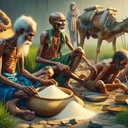
The brahmin Ghoṭamukha holds that no ascetic life is in line with Dharma.
Udena says the same could be argued either way without inquiry.
Four kinds of person are set out.
The one who mortifies himself and the one who mortifies others.
The one who mortifies both and the one who mortifies neither.
Only the last is at peace here and now.
The whole gradual training through the jhānas is that fourth kind.
Ghoṭamukha offers his yearly stipend and is told a monk takes no gold.
He builds an assembly hall at Pāṭaliputta instead.
+MN 95 Caṅkī:
(name of brahman)
(name of brahman)
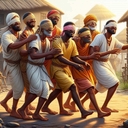
Caṅkī wants to visit the Buddha and five hundred brahmins object.
He defends the visit and goes anyway.
Is any brahmin qualified to say that he himself knows and sees the truth?
Not one of them, back through the line of teachers.
It is a file of blind men holding on to each other.
Five things may turn out true or false: oral tradition and faith and the rest.
Justifiable-trust preserves the truth without declaring it settled.
Awakening to the truth means checking a teacher for greed and anger and delusion.
Then arrival at the truth is reached by twelve steps in reverse order.
Caṅkī becomes a lay follower.
+MN 96 Esukārī:
To Esukārī
To Esukārī

The brahmin Esukārī asks about the four kinds of service.
Brahmins assign each caste the castes it may serve.
The Buddha does not say service is right or wrong by caste.
He says it is right when it makes a person better and not worse.
The same applies to inherited wealth in each of the four castes.
He assigns no wealth at all except the noble Dharma.
Anyone from any caste who follows it reaches the goal.
A fire lit from any wood gives the same light.
Esukārī becomes a lay follower.
+MN 97 Dhanañjāni:
To Dhānañjāni
To Dhānañjāni

Sāriputta hears the brahmin Dhanañjāni is oppressing people.
He is squeezing brahmins for the king and the king for the brahmins.
Sāriputta asks whether family duty excuses bad conduct.
It does not, because nobody else takes the result of it.
Later Dhanañjāni falls gravely ill and sends for Sāriputta.
Sāriputta walks him up through the destinies to the Brahmā world.
He teaches him the four divine abidings and leaves.
The man dies and is reborn in the Brahmā world.
The Buddha says Sāriputta stopped short of what he could have taught.
+MN 98 Vāseṭṭha:
To Vāseṭṭha
To Vāseṭṭha

Two brahmin students argue over what makes someone a brahmin.
One says birth and the other says conduct.
They bring the question to the Buddha and he answers in verse.
Among plants and insects and animals birth really does make species.
Among humans birth makes no such difference.
A farmer is called a farmer by his work and a thief by his.
So a brahmin is named by what he does and not by his mother.
The one who is free of craving is the true brahmin.
Both students become lay followers.
+MN 99 Subha:
To Subha
To Subha

The student Subha holds that householders make more merit than monks.
The Buddha says he speaks about each case on its own facts.
Wrong practice fails in either state and right practice succeeds in either.
Householder work is a big undertaking with a small reward.
Going forth is a small undertaking with a large one.
Brahmins name five things that make merit and monks call them assets.
Truth and austerity and celibacy and study and generosity.
The four divine abidings are what really lead to the Brahmā world.
Subha admires a builder who knows the way and takes refuge.
+MN 100 Saṅgārava:
To Sangārava
To Sangārava

The brahmin student Saṅgārava asks about the three kinds of teacher.
Some go by oral tradition and some by reasoning alone.
Some have realized a Dharma for themselves that was never heard before.
The Buddha places himself in the third group.
He tells the story of his going forth and his two teachers.
Then the austerities and the three fire-stick similes.
Then the first jhāna recalled from boyhood and the four jhānas.
Then the three higher knowledges in the last watches of that night.
Saṅgārava asks whether gods exist and gets an answer he cannot dispute.
+Vagga 11 Devadaha: name of place
all
+MN 101 Devadaha:
at Devadaha
at Devadaha
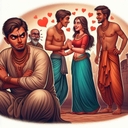
Jains hold that all present feeling is the result of past deeds.
The Buddha questions them and they cannot support it.
Removing an arrow hurts, and that pain is from the surgery.
So not all present pain comes from the past.
Their leader claims to know everything at every moment.
Five things about their own austerity turn out either way.
Ten legitimate grounds for rebuking them are listed.
Then how exertion and striving really are fruitful.
A man jealous over a woman suffers until the desire goes.
Painful effort is used only as far as it is needed.
+MN 102 Pañcattaya:
The Five and Three
The Five and Three

Speculations about the future are gathered into five kinds.
Speculations about the past are gathered into three.
Each rests on perception or on the ending of it or on cessation.
Every one of them is only what those teachers feel and grasp.
The Buddha declares the ending without grasping instead.
Rapture of seclusion is the code for the first two jhānas.
Spiritual pleasure is the code for the third.
Neither pain nor pleasure is the code for the fourth.
A teacher may call any of those the highest nirvana here and now.
The real one is known by seeing the grasping in each and letting go.
+MN 103 Kinti:
What Do You Think About Me?
What Do You Think About Me?
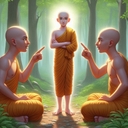
The Buddha asks the monks what they think he teaches for.
Not for arguing and winning, but for the sake of the higher Dharma.
If two monks disagree on the higher Dharma settle the meaning first.
If they disagree on wording only, do not make a quarrel of it.
If one has fallen away in conduct, the timing of the reproof matters.
Ask whether now is the time, and whether he can bear to hear it.
A monk who can be raised from unskillful to skillful is worth the trouble.
Even at the cost of a quarrel, that raising is worth it.
But a quarrel with no such gain is not worth anything.
+MN 104 Sāmagāma:
At Sāmagāma
At Sāmagāma
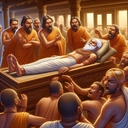
The Jain leader has died and his followers are already fighting.
Ānanda fears the same could happen to this Saṅgha.
A quarrel about livelihood or the code is trifling.
A quarrel about the path or the practice is the serious kind.
Six roots of a dispute are listed, starting with anger and contempt.
Then seven ways of settling a legal issue.
Presence and recollection and the majority and the covering over.
Then six warm-hearted Dharmas that keep monks living at ease.
Those are the real safeguard against the split.
+MN 105 Sunakkhatta:
To Sunakkhatta
To Sunakkhatta
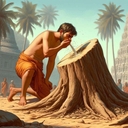
Sunakkhatta reports that some monks are claiming attainments.
The Buddha says some claims are true and some are conceit.
A teaching is given to the one who is inclined to worldly things.
Another to the one inclined to the imperturbable.
Another to the one inclined to nothingness or to nirvana.
An arrow is pulled out and the poison is cleaned away.
The wound must then be guarded or it festers again.
The arrow is craving and the poison is ignorance.
One who eats what he should not eat opens the wound again.
+MN 106 āneñja-sappāya:
Conducive to the Imperturbable
Conducive to the Imperturbable

The five cords of sense pleasure are impermanent and hollow.
Three ways lead to the imperturbable.
First a mind made vast and exalted beyond the sensual realm.
Second seeing that all form is only the four elements.
Third seeing that form of past and present and future is impermanent.
Three more ways lead to the dimension of nothingness.
Dropping perceptions of form and seeing emptiness and seeing not mine.
Then dropping the perception of nothingness gives the next attainment.
Clinging to the equanimity there is what blocks nirvana.
Not clinging to it is the noble liberation.
+MN 107 Gaṇaka-moggallāna:
To Gaṇaka Moggallāna
To Gaṇaka Moggallāna

Moggallāna the accountant asks about gradual training.
Every craft has its own graduated steps and so does this one.
The Buddha starts a new monk on ethics and the code.
Then guarding the sense doors and moderation in eating.
Then wakefulness and remembering and lucid-discerning.
Then sitting in a secluded place and removing the five hindrances.
Then the four jhānas.
He is a guide who shows the road to Rājagaha and no more.
Some travellers take a wrong turn and some arrive.
+MN 108 Gopaka-moggallāna:
With Gopaka Moggallāna
With Gopaka Moggallāna
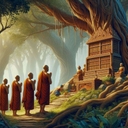
The Buddha has attained final nirvana and Ānanda is asked a question.
Did he appoint any single monk to take his place?
He did not, and the Saṅgha takes refuge in the Dharma.
Ten inspiring qualities are what make a monk honored instead.
Vassakāra asks whether every kind of jhāna is praised.
Not the jhāna of one still overcome by the five hindrances.
Only the four jhānas are praised.
A horse trainer only trains the horse worth training.
Vassakāra says the Buddha praised what deserves praise.
+MN 109 Mahā-puṇṇama:
The Greater Discourse on the Full-Moon Night
The Greater Discourse on the Full-Moon Night
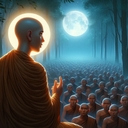
On the full-moon night a monk asks about the five aggregates.
What are they rooted in and what is their cause?
Desire is the root of every one of them.
Form is the four elements and feeling is contact and so on.
Identity view comes from regarding any of them as a self.
Gratification and drawback and escape are given for each.
The underlying tendency to conceit is examined.
The not-self formula is run through all five aggregates.
Sixty monks reach arahantship while the discourse is spoken.
+MN 110 Cūḷa-puṇṇama:
The Shorter Discourse on the Full-Moon Night
The Shorter Discourse on the Full-Moon Night
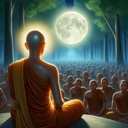
On another full-moon night the Buddha speaks of two kinds of person.
A bad person has bad qualities and bad friends and bad advice.
He thinks and speaks and acts like a bad person.
He holds wrong view and gives gifts in the wrong way.
So he is reborn in a bad destination.
A good person is the exact opposite in every one of those.
He has good friends and gives with respect and with his own hand.
So he is reborn in a good destination.
A bad person cannot be known by a bad person at all.
+Vagga 12 Anupada: one by one
all
+MN 111 anu-pada:
one after another
one after another

Sāriputta is examined for insight one state at a time.
In the first jhāna each of its factors is known as it arises.
They are known as they remain and as they pass away.
The same refrain runs through the second and third and fourth jhānas.
Then infinite space and infinite consciousness and nothingness.
In those attainments the seeing is done while still inside.
The eighth requires emerging before the seeing can be done.
So does the ninth, and there Sāriputta ended the inclinations.
There is no further escape beyond the ninth attainment.
Sāriputta is the son of the Buddha who keeps rolling the wheel.
+MN 112 Chabbi-sodhana:
the sixfold purification
the sixfold purification
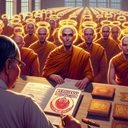
A monk claims arahantship and should be examined with five questions.
How does he relate to what is seen and heard and sensed and cognized?
How does he relate to the five aggregates?
How to the six elements and to the sense fields inside and out?
How to the body and the underlying tendencies?
His answer runs through the sixfold purification.
Ordination and pure conduct and contentment with the requisites.
Then guarding the sense doors and remembering and lucid-discerning.
Then removing the hindrances and the four jhānas.
Then the imperturbable fourth used to see the noble truths.
+MN 113 Sap-purisa:
good person
good person

A bad person exalts himself for his eminent family.
A good person reflects that family does not end greed or hate.
The same is done for wealth and fame and getting requisites.
A bad person exalts himself for learning and for the monastic texts.
Or for teaching Dharma or living in the wilderness.
Or for rag robes or almsfood or a tree root or a charnel ground.
A bad person even exalts himself for attaining the first jhāna.
And for the second and third and fourth and the formless attainments.
A good person practises for the ending of grasping and exalts nobody.
The list ends at the cessation of perception and feeling.
+MN 114 Sevitabb-āsevitabba:
should be cultivated, and not cultivated
should be cultivated, and not cultivated

Sāriputta expands what should be cultivated and what should not.
Bodily behavior is of two kinds and one of them is to be dropped.
The test is whether unskillful qualities grow or decline.
The same test is applied to verbal and mental behavior.
Then to mind and to perception and to view.
Then to reincarnating and to the objects of the six senses.
Then to robes and lodgings and villages and people.
In every pair the one that grows the unskillful is dropped.
The Buddha confirms all of it and repeats it himself.
+MN 115 Bahu-dhātuka:
many elements
many elements
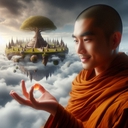
A monk is called astute when he is skilled in four things.
Skilled in the elements means the eighteen and then several other sets.
Earth and water and fire and air and space and consciousness.
Pleasure and pain and happiness and sadness and equanimity and ignorance.
Sensuality and renunciation and malice and good will and cruelty and compassion.
The sensual and form and formless realms.
Then the conditioned element and the unconditioned.
Skilled in the sense fields and in dependent origination follow.
Skilled in the possible and impossible closes the list.
+MN 116 Isigili:
At Isigili
At Isigili

The mountain Isigili is named for the sages it once swallowed.
Five hundred Buddhas awakened for themselves and lived there.
Their names are known and are recited.
Ariṭṭha and Upariṭṭha and Tagarasikhī are among them.
Each of them ended craving and broke through to the deathless.
They are called sages who are beyond the reach of darts.
The discourse closes with their names in verse.
+MN 117 Mahā-cattārīsaka:
great forty
great forty

Noble right samādhi is taught with its supports and its equipment.
The other seven path factors are what support it.
Wrong view and right view are set out first.
Right view is of two kinds: with inclinations and noble without them.
The same doubling is done for resolve and speech and action and livelihood.
Right view leads to right resolve and on down the chain.
That makes the ten-factor path with knowledge and liberation added.
Ten right factors wipe out the ten wrong ones.
Anyone who dares to criticize this teaching is due a rebuke.
+MN 118 Ānāpānas-sati:
Remembering Dharma on breathing
Remembering Dharma on breathing

Monks are practising together at the end of the rains.
Remembering of breathing is developed in sixteen steps.
Steps one to four fulfil the continuous seeing of the body.
Steps five to eight fulfil the seeing of the sensations.
Steps nine to twelve fulfil the seeing of the mind.
Steps thirteen to sixteen fulfil the seeing of the Dharma.
The four rememberings then fulfil the seven awakening factors.
Remembering leads to investigation and to vigor and to rapture.
Then tranquility and samādhi and equanimity.
The seven awakening factors fulfil knowledge and freedom.
+MN 119 kāyagatā-sati:
body-immersed-remembering
body-immersed-remembering

Remembering immersed in the body is of great fruit and benefit.
It runs through the first four steps of breath meditation.
Then the four postures and lucid-discerning in all activities.
Then the thirty-one parts of the body and the four elements.
Then the nine stages of a decomposing corpse.
Then the four jhānas with their similes.
Māra cannot find an opening in a mind full in that way.
A tank full to the brim gives water at a touch.
Ten benefits follow, from bearing cold and heat to the divine eye.
The last is the ending of the asinine-inclinations.
+MN 120 Saṅkhār-upapatti:
intentional rebirth
intentional rebirth
A monk can direct where his next rebirth will be.
With faith and ethics and learning and generosity and wisdom.
He fixes his mind on well-to-do warrior-nobles and is reborn there.
The same works for brahmins and for householders.
Then for the gods of the four great kings and the realms above them.
Then for the Brahmā of a thousand and of ten thousand.
Then for a hundred thousand and the realms above those.
Then for the formless realms.
Best of all is to aim at the undefiled freedom of heart.
Then he is not reborn anywhere at all.
+Vagga 13 Suññata: emptiness/voidness
all
+MN 121 Cūḷasuññata:
The Shorter Discourse on Emptiness
The Shorter Discourse on Emptiness
The Buddha tells Ānanda that he now lives in emptiness.
A forest hut is empty of people and animals and still has the forest.
So the mind settles on the single perception of earth.
A bull hide stretched with pegs is smooth and level.
Then singleness on infinite space and on infinite consciousness.
Then on nothingness and on neither perception nor non-perception.
Then the signless samādhi that touches all six senses.
Even that is made and conditioned and is seen so.
Arahantship is reached from inside the signless samādhi.
Every arahant of every age reached it through this same emptiness.
+MN 122 Mahā-suññata:
Longer Discourse on Emptiness
Longer Discourse on Emptiness

A monk who delights in company does not shine.
A Tathāgata discovers emptiness by unifying the mind in the jhānas.
He then lives in emptiness with confidence in every posture.
He lives in it while thinking and while active and while still.
A monk should check whether his mind is drawn to the five cords.
He should watch the rise and fall of the five aggregates.
Do not follow the Buddha around for theoretical instruction.
There is a peril for the teacher and one for the student.
And a peril for anyone leading the holy life.
Ānanda is told to treat him as a friend and not as an enemy.
+MN 123 Acchariya-abbhuta:
incredible and amazing
incredible and amazing

The monks marvel at how much the Buddha knows of past Buddhas.
He answers with the wonders of his own conception and birth.
He was rememberful and lucid in the group of Joyful Gods.
He was rememberful and lucid on entering the womb.
The galaxy shook and a great light surpassed the glory of the gods.
Four deities came to guard the four directions.
His mother was naturally ethical and free of desire and of fatigue.
She gave birth standing up after exactly ten months and died seven days later.
He came out clean and took seven strides and spoke.
He knows sensations and perceptions as they arise and remain and pass.
+MN 124 Bākula:
with Bākula
with Bākula
Bākula is a hundred and sixty years old and answers a former friend.
In eighty years no perception of sensuality has arisen in him.
Nor any perception of ill will or of cruelty.
Nor any thought of those three.
He never accepted a robe from a householder or cut one with a knife.
He never sewed with a needle or taught a woman or ordained a novice.
He never spent the rains near a village.
He was awakened on the eighth day after ordaining.
He calls the monks together and attains final nirvana sitting among them.
+MN 125 Danta-bhūmi:
tamed levels
tamed levels
Prince Jayasena doubts that this teaching leads to unified mind.
A trained elephant and an untrained one cannot be compared.
Someone standing on the mountain sees what those below cannot.
A wild elephant is taken from the forest and tied to a post.
So a new monk is given ethics and the sense doors and moderation.
Then wakefulness and remembering and the removing of the hindrances.
Then the four rememberings without thoughts of sensuality.
That is the first jhāna, and the elephant learns to like its new food.
The imperturbable fourth jhāna bears cold and heat and insults.
Then the three higher knowledges, and patient endurance is its mark.
+MN 126 Bhūmija:
with Bhūmija
with Bhūmija

Bhūmija is asked whether hoping or not hoping decides the fruit.
He answers that it is right practice that decides it.
The Buddha confirms it and gives four similes twice over.
A man needing oil presses sand and gets nothing.
A man needing milk pulls on the horn of a cow.
A man needing butter churns water in a pot.
A man needing fire rubs a wet log with a drill.
With wrong view and wrong practice all four fail.
With right view and right practice all four succeed.
Prince Jayasena would have understood if the similes had been used.
+MN 127 Anuruddha:
(Chief disciple famous for divine eye)
(Chief disciple famous for divine eye)
Pañcakaṅga asks Anuruddha about two kinds of awareness-release.
He thinks measureless and expansive are two names for one thing.
Anuruddha says they are two different practices.
Measureless is pervading the four abidings in all eight directions.
Expansive is pervading them over a gradually larger space.
Four kinds of god are reborn to match those two practices.
Gods gathered together show many flame colors and one radiance.
Once dispersed each radiance can be told apart.
Flies follow the luggage without assuming it is permanent.
Some of those radiances are corrupted and some are pure.
+MN 128 Upak-kilesa:
corruptions
corruptions
The monks of Kosambi are quarrelling and will not stop.
The Buddha speaks verses and leaves them to it.
He encourages the monk Bhagu and then visits three others.
Anuruddha and Nandiya and Kimbila live in harmony and silence.
He tells of his own struggle for knowledge and vision.
Eleven corruptions blocked it instead of the usual five.
Doubt and lack of attention and sloth and terror and excitement.
Discomfort and too much vigor and too little and longing.
Diversity of perceptions and excessive focus close the list.
Threefold samādhi then fulfilled the awakening factors and the jhānas.
+MN 129 Bāla-paṇḍita:
The Foolish and the Astute
The Foolish and the Astute

A fool is known by three things: what he thinks and says and does.
He thinks killing and stealing are perfectly proper.
He sees kings punish criminals and knows his turn is coming.
He laments in this life and then goes to a bad destination.
The pain of hell is beyond any comparison a king could make.
A stone the size of the Himalaya gives some idea of the span.
The animal realm and the grass-eaters and the dung-eaters follow.
A blind turtle meeting a floating yoke is more likely than a human birth.
An astute person is the exact opposite in all three.
His heaven is described through a wheel-turning monarch and his treasures.
+MN 130 Deva-dūta:
Messengers of the Gods
Messengers of the Gods
A man in a doorway sees everyone going in and out.
So the divine eye sees beings going to their destinations.
One reborn in hell is asked whether he saw the first messenger.
That is a baby collapsed in its own filth.
The second is an old woman bent over and trembling.
The third is a man gravely ill and helpless.
The fourth is kings punishing bandits.
The fifth is a corpse.
He saw them all and was too negligent to act.
The wardens of hell then give him the fivefold crucifixion.
+Vagga 14 Vibhaṅga: expositions, analysis
all
+MN 131 Bhadd-eka-ratta:
One Fine Night
One Fine Night

A passage for recitation is given with its analysis.
Do not run back to the past or hope for the future.
What is past is left behind and what is future has not come.
See clearly what is present here and now.
Running back to the past means relishing the aggregates as they were.
Hoping for the future means longing for them as they will be.
Faltering means taking present form and feeling as a self.
One who lives this way is called ardent both day and night.
+MN 132 Ānanda-bhaddeka-ratta:
Ānanda and one fine night
Ānanda and one fine night
Ānanda gives this same talk to the monks in the assembly hall.
The Buddha comes and asks who had been teaching.
The monks tell him it was Ānanda.
He asks Ānanda to give the recitation and analysis again.
Ānanda repeats the verses and the whole analysis.
It is word for word the teaching of MN 131.
The Buddha then repeats the verses and the analysis himself.
He confirms that Ānanda taught it exactly right.
+MN 133 Mahākaccāna-bhaddeka-ratta:
Mahākaccāna and One Fine Night
Mahākaccāna and One Fine Night

A deity tells the monk Samiddhi to memorize this recitation.
Samiddhi does not have it and asks the Buddha for it.
The Buddha gives the verse and then goes to rest.
The analysis is left untaught.
The monks go to Mahā Kaccāna and ask him for it.
He gives the analysis in his own words.
Running back to the past and hoping for the future.
Then faltering amid the things that have presently arisen.
The monks bring it to the Buddha, who confirms all of it.
+MN 134 Lomasakaṅgiya-bhaddeka-ratta:
Lomasakaṅgiya and one fine night
Lomasakaṅgiya and one fine night

A deity asks Lomasakaṅgiya whether he has this recitation.
He does not have the analysis or even the verse.
The deity has the verse and recites it to him.
He is told to learn the verse and the passage and the analysis.
That deity had heard it in the time of the Buddha Kassapa.
Lomasakaṅgiya goes to the Buddha and asks for the whole thing.
The Buddha recites the verse.
Then he gives the analysis in full.
+MN 135 Cūḷa-kamma-vibhaṅga:
small [discourse on] karma analysis
small [discourse on] karma analysis

The student Subha asks why people differ so much at birth.
The answer is that beings are the owners of their own deeds.
Killing brings a short lifespan and abstaining brings a long one.
Habitually hurting brings sickly health.
Being irritable brings an ugly appearance.
Envy brings insignificance and cruelty brings low birth.
Being stingy brings poverty and giving brings wealth.
Being obstinate brings low status and respect brings high.
Asking the wise about the skillful brings wisdom.
+MN 136 Mahā-kamma-vibhaṅga:
big [discourse on] – karma – analysis
big [discourse on] – karma – analysis

A monk gave a wrong answer to a wanderer about karma.
The Buddha shows how the answer should have been given.
Four types of person are seen by those with the divine eye.
One does evil and goes to hell and one does evil and goes to heaven.
One does good and goes to heaven and one does good and goes to hell.
Each observer turns his one case into an absolute rule.
That is the flaw, and all four rules are wrong.
The full account brings in deeds done earlier or later.
And the view held at the moment of death.
Only that whole analysis fits all four cases.
+MN 137 Saḷ-āyatana-vibhaṅga:
six sense fields analysis
six sense fields analysis
The six sense fields are analyzed with everything that follows them.
Six inside and six outside and six kinds of consciousness and contact.
Eighteen mental explorations come from joy and distress and equanimity.
Those give thirty-six positions once householder and renunciate are split.
Renunciate joy is the rapture of the awakening factors and the jhānas.
Rely on something superior to give up something inferior.
Renunciate equanimity gives up renunciate joy.
Equanimity of diversity belongs to the third and fourth jhānas.
Equanimity of unity belongs to the four formless attainments.
The teacher meets three kinds of disciple with unshaken equanimity.
+MN 138 Uddesa-vibhaṅga:
recitation analysis
recitation analysis
The Buddha gives a brief statement and leaves.
Consciousness should be neither scattered outside nor stuck inside.
And there should be no agitation from clinging.
The monks ask Mahā Kaccāna to elucidate it.
Scattered outside means following the six senses out to their objects.
Stuck inside means clinging to the rapture of any of the four jhānas.
Agitation from clinging means taking form or feeling as a self.
Each of the three is then given in its positive form.
The monks bring it to the Buddha, who validates every word.
+MN 139 Araṇa-vibhaṅga:
non-conflict-analysis
non-conflict-analysis
The middle way is glossed and the topics are listed first.
Do not indulge in sensual pleasure and do not mortify yourself.
Know what it means to flatter and what it means to rebuke.
Teach the Dharma without doing either of them.
Know how to distinguish the kinds of pleasure.
Sensual pleasure is to be feared and the four jhānas are not.
Do not talk behind people backs or sharply to their faces.
Do not speak hurriedly and do not insist on local terms.
Each item is then connected back to non-conflict.
+MN 140 Dhātu-vibhaṅga:
element-analysis
element-analysis
The Buddha spends a night in a potter shed with a stranger.
Pukkusāti has gone forth on faith without ever meeting him.
A person consists of six elements and six bases of contact.
Then eighteen mental explorations and four foundations.
Earth and water and fire and air and space and consciousness.
Fire sticks rubbed together give heat that ceases when parted.
When all else is set aside only equanimity remains.
A goldsmith works the gold until it is workable and bright.
That equanimity is directed to the formless attainments and let go.
Pukkusāti is gored by a bull and is reborn a non-returner.
+MN 141 Sacca-vibhaṅga:
truth-analysis
truth-analysis

The four noble truths are the supreme wheel of Dharma.
Sāriputta guides people to stream entry and Moggallāna to arahantship.
The Buddha asks Sāriputta to give the analysis.
Dukkha is broken down into rebirth and old age and death.
Then lamentation and sadness and distress.
Then not getting what you wish for and the five grasping aggregates.
The origin is craving and the cessation is its fading away.
The path is the eightfold path, and each factor is defined.
Right view is knowledge of the four truths themselves.
+MN 142 Dakkhiṇā-vibhaṅga:
The Analysis of Offerings to the Teacher
The Analysis of Offerings to the Teacher
The nun Mahāpajāpatī offers the Buddha a pair of new garments.
He tells her to offer them to the Saṅgha instead.
Ānanda points out that she was his stepmother and nurse.
The Buddha lists the kindnesses that are hard to repay.
Fourteen kinds of personal offering are then set out.
Each has its own measure of merit.
Seven kinds of offering are made to a Saṅgha rather than a person.
A personal offering is never as fruitful as one to the Saṅgha.
Four ways of purifying an offering close the discourse.
+Vagga 15 Saḷ-āyatana: six-bases
all
+MN 143 Anāthapiṇḍik’-ovāda:
Advice to Anāthapiṇḍika
Advice to Anāthapiṇḍika
Anāthapiṇḍika is gravely ill and sends for Sāriputta.
Sāriputta comes with Ānanda and gives him a teaching.
Do not grasp the eye or any consciousness dependent on it.
The same is run through all six senses inside and out.
Then through consciousness and contact and sensation.
Then the six elements and the five aggregates.
Then the four formless attainments.
Then this world and the next and all that is seen and heard.
Anāthapiṇḍika weeps, because he never heard such Dharma as a layman.
He asks that lay people be taught this too and dies a god in Tusita.
+MN 144 Chann’-ovāda:
Advice to Channa
Advice to Channa

Channa is gravely ill and tells Sāriputta he means to take his life.
Sāriputta asks him not to and offers to fetch food and medicine.
Channa says his act is blameless because he is not attached.
Sāriputta tests him on the eye and eye consciousness.
Does he regard them as self or as belonging to a self?
Channa answers that he sees them as not a self.
He knows that by the cessation he has seen in them.
He takes his own life, and Sāriputta doubts he was an arahant.
The Buddha confirms that Channa died blameless and free.
+MN 145 Puṇṇ’-ovāda:
Advice to Puṇṇa
Advice to Puṇṇa
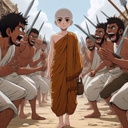
Puṇṇa asks the Buddha for the teaching in brief.
Welcoming and clinging to a visible form gives rise to relishing.
Relishing is the origin of dukkha.
The same is run through all six sense doors.
Not welcoming them ends the relishing and the dukkha.
Puṇṇa plans to live among the rough people of Sunāparanta.
If they abuse him he will think them kind for not hitting him.
If they hit him he will think them kind for not using a knife.
If they kill him he will think of monks who wished for such a death.
He becomes an arahant and gathers five hundred followers of each kind.
+MN 146 Nandakovāda:
Advice from Nandaka
Advice from Nandaka

The Buddha asks Nandaka to teach five hundred nuns.
Is the eye permanent or impermanent, and is it a self?
The same question is run through all six senses.
Then through the six external objects and the six consciousnesses.
An oil lamp burns with an impermanent wick and flame.
Nobody would say its light was permanent.
A tree with an impermanent trunk has no permanent shadow.
A butcher separates hide and flesh and cannot put the cow back.
The knife is wisdom and it cuts the inner fetters.
After a second day of the same talk all five hundred are stream-enterers.
+MN 147 Cūḷa-rāhul’-ovāda:
Advice to Rāhula
Advice to Rāhula
Thousands of gods gather to watch Rāhula be led to arahantship.
Is the eye permanent or impermanent, and is it a self?
The same for visible form and eye consciousness and eye contact.
Then for feeling and perception and co-activities and consciousness.
Then the whole set is run through the ear and nose and tongue.
Then through the body and the mind.
Seeing this a disciple grows disenchanted.
Disenchantment brings dispassion and then freedom.
Rāhula becomes an arahant and thousands of gods enter the stream.
+MN 148 Cha-chakka:
six by six
six by six

Six sets of six are enumerated first.
The senses inside and outside and the six consciousnesses.
Then contact and feeling and craving.
None of those can be a self, since each arises and passes away.
Identity originates by taking any of them as mine or as myself.
Identity ceases by truly seeing each of them as not mine.
Pleasant feeling breeds the tendency to greed.
Painful feeling breeds repulsion and neutral feeling breeds ignorance.
Removing those tendencies is done at feeling itself.
Sixty monks become arahants while the discourse is spoken.
+MN 149 Mahā-saḷāyatanika:
The Great Discourse on the Six Sense Fields
The Great Discourse on the Six Sense Fields

One who does not truly know the six sense doors is inflamed by them.
The aggregates grow and craving grows and dukkha grows with them.
One who truly knows them is not inflamed.
For him the aggregates do not grow and craving fades.
The eightfold path is perfected in that seeing.
So are all seven sets of the factors of awakening.
Calm and insight are the things to be developed by direct knowledge.
Ignorance and craving are the things to be given up.
Knowledge and freedom are the things to be realized.
The whole scheme is then run through all six sense doors.
+MN 150 Nagaravindeyya:
With the People of Nagaravinda
With the People of Nagaravinda

The people of Nagaravinda are asked which teachers deserve respect.
Not the ones who are not free of greed and hate and delusion.
They are no better in that than the questioner himself.
The ones who are free of the three do deserve it.
The question is run through all six sense doors.
What evidence is there for telling them apart?
Those teachers live in remote places with nothing tempting to see.
Nobody stays there who has not given up the three roots.
So the way they live is itself the evidence.
+MN 151 Piṇḍa-pāta-pāri-suddhi:
Almsfood purification
Almsfood purification

Sāriputta comes back from alms round with a radiant face.
He has spent the day in emptiness.
A monk should review whether desire remains for the six senses.
Then whether the three unskillful roots remain.
Then the five cords of sense pleasure and the five hindrances.
Then whether the five aggregates are completely understood.
Then the seven sets from the four rememberings to the eightfold path.
Then whether calm and insight have been developed.
Then whether knowledge and freedom have been realized.
Reviewing that way is how almsfood is made pure.
+MN 152:
Indriya-bhāvanā
Indriya-bhāvanā
A brahmin teaches that developed faculties mean not seeing or hearing.
Then the blind and the deaf would have the best-developed faculties.
The unexcelled development is something else entirely.
Liking and disliking arise and equanimity is established at once.
As fast as a strong man blinks or snaps his fingers.
As fast as a water drop rolls off a lotus leaf.
As fast as spit leaves the tongue or an arm flexes.
As fast as water dries on a pan heated all day.
A trainee still feels horror and disgust at what arises.
A noble one with developed faculties chooses how to perceive it.