
☯🦍 QiGor Dharma
principles to memorize
☯4.1
☯4.2

☯4.3
☯4.4

☯8.1
☯8.2
☯8.3
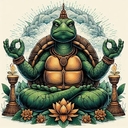
☯8.4

☯8.5

☯8.6

☯8.7

☯8.8
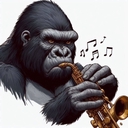
❤️9.1

❤️9.2

❤️9.3
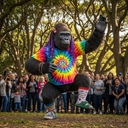
❤️9.4

❤️9.5
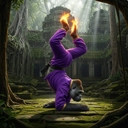
❤️9.6

❤️9.7

❤️9.8

❤️9.9
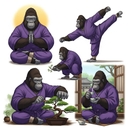
+1 – Introduction
all
| . | . | |
+1.0 – what, why, how?
This book focuses mainly on ‘why’ and ‘how’.
The book ‘gorilla Dharma arsenal’ (⚔️🛡️) focuses on the ‘what’,
the details of the exercises.
how to use this book:
commit it to memory, the main principles.
every so often, a few times a year at least,
review the full text to check if your memory was accurate and
if you’ve gained any deeper insight on some of the nuances.
+1.1 – gorilla sati (remembrance) memorizes gorilla ☯Dharma
4 mobile truths: move it or lose it.
the mental counterpart for sati is
sati: use it or lose it.
If you don’t recollect regularly the gorilla Dharma principles,
they’ll fade from your memory.
If you have something valuable, and you want to use it,
you can’t use it unless you have it in your hands.
If you have valuable skills, Dharma weapons,
you can’t use those weapons unless you have them memorized,
ready to deploy and practiced frequently.
Dharma is to be remembered, investigated,
practiced.
+2 – gorilla breathing
all
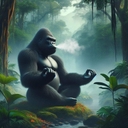
There are 4 sections to the breath.
1. Inhale
2. time between inhale and exhale
3. exhale
4. time between exhale and inhale
repeat until dead
+2.1 – natural breathing
all
Not trying to control the breath.
Not even needing to pay attention to the breath.
But if you are paying attention to the breath,
maintain relaxation.
Just let body naturally adjust according to physical activity intensity.
If you start running for example, breath gets faster and deeper without any conscious volition on your part.
+Best Breathing technique in general for most exercises
I'll have more to say in detail later,
but in brief I'd advise people to breathe naturally,
and not try to force your breathing to coordinate inhales and exhales with detailed qigong physical movement.
Or even if you do want to or need to coordinate breath to precise physical movements,
in your learning stage for a few weeks or months until you're familiar with the movements,
prioritize passaddhi (pacification awakening factor,
relaxation) and jhāna first,
before you try to synchronize breathing with specific movements.
If you're all tense trying to sync breathing,
you block passaddhi and jhāna,
which will nullify the effectiveness of qigong.
+2.2 – diguju breath
See Diguju
+2.3 – coordinated breath
This is when a particular exercise calls for you to
coordinate the timing of physical movement
with a particular cycle of the breath.
example:
a qigong that tells you to raise your arms on an inhale,
pause 2 seconds keeping your arms in place,
then lower your arms on the exhale.
+2.4 – jhānic breath
The general principle is,
whatever physical spatial location on your body you focus on,
the mind sends qi/energy there.
An ordinary person, not using any jhāna,
also sends energy there with the mind,
just to be able to probe what's going on with the body,
activating the nerves and reading the sensations.
someone with jhāna competency,
who has spent a good long time charging up their jhāna battery,
can send extra energy to any part of the body that has a clear pathway
(no energy blockages to that part of the body).
It's like the difference between turning on the tap water in your kitchen faucet,
and turning on a firehose.
Much greater jhānic water pressure to push anywhere in the body.
The current of energy can be expressed and sensed as heat,
hydraualic water flow,
electrical sensations,
gooey magnetic force with shape,
luminosity - visible light when strong enough,
powers the divine eye,
etc.
So the idea with jhānic breath,
is that with the physical breath,
one has already mastered the ability to pacify,
relax that fully.
So one pays more attention to the interesting correlates of the physical breath
as described in previous paragraph: gooey magnetic force,
luminosity, heat, etc.
16🌬️😤 breath energy is not just the physical breath,
it includes correlate phenomena of the breath.
Or if you don't agree with that,
You could just see it as kāya-gatā-sati 🏃 four elements meditation.
16aps is a subset of kāyagata-sati, and both have the wonderous property
of being able to occupy the full bandwidth of one's attention
to drive out distractive verbal thoughts (mental talk).
+2.5 – health preservation, longevity breath
In short, do as much jhānic breathing as possible 24/7,
but you also need to do a gorilla RDA (recommended daily allowance)
of moderate cardio vascular exercise
that uses close to your full lung capacity.
Because not doing any physical stretching,
not challenging and utiilizing the full range of breath (lung capacity,
etc.) everyday,
not doing any resistance weight training (body weight is fine,
don’t need gym equipment),
your body will atrophy.
more details later...
❧
+3 – Three doctors: Ounce of prevention better than...
all
TCM = traditional chinese medicine
Story of 3 Chinese TCM doctors
A long time ago, in China.
Ernest was a promising young student hoping to apprentice with a TCM Chinese doctor.
Instead of looking for a local expert,
he thought,"
why not find the best doctor in all the land?
The worst that can happen is they say no.
+3.1 – 1st brother, Dr. Chen
So Ernest set out to find Dr. Chen, who was celebrated for his
skills and knowledge of medicine and his ability to heal even the most fatal disease.
He cured the emperor’s son who was believed dead,
in a miraculous exhibition of his skills.
Because his fame spread far and wide,
his medical practice was nonstop, and he accumulated vast fame and wealth.
He lived in a palace with whatever luxury and pleasure you could imagine.
After meeting and interviewing with Dr. Chen,
the doctor said:
"You are a fine and promising young student,
and you'd make a fine apprentice.
But before you decide, you really should talk to my older brother,
who is is also a TCM doctor.
Dr. Yang, is far more skilled and wise than I am.
+3.2 – 2nd brother, Dr. Yang
Ernest, humble but ambitious, thanked Dr. Chen,
and promised to consider his options carefully before making a decision.
So he set off to find Dr. Yang.
After trekking across the country to Dr. Yang's house,
he was rather surprised at how pedestrian Dr. Yang's dwelling stood,
in comparison to Dr. Chen's palace with all its fine material wealth and luxury.
Now Dr. Yang's house was no ordinary house.
It was a mansion, and stood out in his affluent neighborhood and province,
but it was no palace.
He introduced himself to Dr. Yang, and again the interview went well,
and Dr. Yang agreed he would make a fine apprentice.
Ernest, who was polite and humble, but could not resist asking,"
Dr.
Yang, why do you seem to have fewer patients,
less fame, and much less wealth then your younger brother Dr. Chen,
who says your skill and wisdom far exceed his?
Dr. Yang explained:
I deal with illnesses while they are chronic or minor,
preventing sickness from getting worse and returning the body to health.
I care for my patients through acupuncture and herbs to rebalance them back to good health when they become ill.
I prevent minor illnesses from becoming fatal catastrophes,
so it's not as dramatic and impressive when I succeed in my job.
The fame and wealth reflect that.
Dr. Yang further suggested:
Ernest, You are a fine and promising young student,
and you'd make a fine apprentice.
But before you decide, you really should talk to my older brother,
who is is also a TCM doctor.
Dr. Hu, is far more skilled and wise than I am.
Among the three brothers, he is by far the best.
+3.3 – 3rd brother, Dr. Hu
Ernest, humble but ambitious, thanked Dr. Yang,
and promised to consider his options carefully before making a decision.
So he set off to find Dr. Hu.
After trekking across the country to Dr. Hu's house,
he was rather surprised at how pedestrian Dr. Hu's dwelling stood,
in comparison to Dr. Chen's palace with all its fine material wealth and luxury,
and Dr Yang's mansion in the swanky neighborhood.
Shockingly, Dr. Hu's dwelling was so modest it did not even stand out in his neighborhood,
which was lower middle class and nothing impressive to begin with.
Ernest introduced himself to Dr. Hu, and again the interview went well,
and Dr. Hu agreed he would make a fine apprentice.
Ernest, who was polite and humble, but could not resist asking,"
Dr.
Hu, why do you seem to have fewer patients,
less fame, and much less wealth then your younger brother Dr. Yang,
who says your skill and wisdom far exceed his?
And to say nothing of your youngest brother Dr. Chen,
who lives in a palace with every kind of luxury imaginable.
Dr. Hu explained:
I heal sickness before it even develops,
before people even realize they're sick,
and they have no idea how castastrophic the sickness can become.
My methods and skills are only seen and truly appreciated by the wise.
I give advice on meditation, qigong, yoga,
exercise, food, and lifestyle to keep my patients well and not becoming sick in the first place.
When I succeed at my job, it's not dramatic and impressive as my younger brothers.
My fame and wealth reflect that.
So which of the three brothers should Ernest apprentice under?
Dr. Chen, Dr. Yang, or Dr. Hu?
Who is the smart choice?
Who would you choose?
+3.4 – Doctor of all doctors
Dr. Hu further suggested:
Ernest, You are a fine and promising young student,
and you'd make a fine apprentice.
But before you decide, you really should talk to my teacher,
a disciple of the Buddha.
To cure illness is noble, to prevent illness is better.
But to discover and realize the root of illness,
the root of existence, is beyond compare.
To go forth under such a being, there is nothing better or more worthwhile than that.
+3.5 – Conclusion
“An ounce of prevention is worth a pound of cure.”
— Benjamin Franklin.
“Prevention is better than cure” appears in various later Sanskrit medical formulations.
“Praestat cautela quam medela.”
“Caution is better than cure.”
A close Latin formulation of the preventive principle.
tracing the source of craving, and abandoning it,
prevents the cause of pain and suffering in cyclic existence.
- frankk paraphrasing and summarizing some Buddhist principles.
+3.10 – Chinese source
Here are some Chinese sources for the story,
which first appeared in a
Taoist text that may be apocryphal, but the original idea did appear
in "Huang Di Nei Jing", the most famous Chinese medical text that
mentioned the three levels of doctors.
| The Huangdi Neijing states, “The superior physician treats illness before it arises; the middling physician treats illness when it is about to arise, | 《黃帝內經》中提出「上醫治未病,中醫治欲病, | |
| the inferior physician treats illness after it has arisen.” | 下醫治已病」 | |
| The story of the three brothers of Bian Que comes from Heguanzi, Volume 2, Chapter 16, “The Worthy of the Age.” | 扁鹊三兄弟的故事出自于《鶡冠子·卷下·世贤第十六》。 | |
| The original text is as follows: | 原文如下: | |
| King Xiang of Zhuo asked Pang Nuan, saying: “Does a ruler also have something to do for his state?” | 卓襄王问庞暖曰:“夫君人者亦有为其国乎?” | |
| Pang Nuan said: “Has Your Majesty never heard of Yu Fu as a physician? | 庞暖曰:“王独不闻俞跗之为医乎? | |
| Once illness has formed, he must treat it; ghosts and spirits avoid him; when the King of Chu faced the invading troops, it was like Yao appointing people, | 已成必治,鬼神避之,楚王临朝为随兵故,若尧之任人也, | |
| not using relatives, but necessarily employing those capable of treating illness; not appointing those he favored, but necessarily employing experienced physicians, | 不用亲戚,而必使能其治病也,不任所爱,必使旧医, | |
| when the King of Chu heard that illness was spreading and was upon his body, he would necessarily wait for Yu Fu.” | 楚王闻传暮●在身,必待俞跗。” | |
| King Xiang of Zhuo said: “Good.” | 卓襄王曰:“善。” | |
| Pang Nuan said: “Has Your Majesty perhaps forgotten? | 庞暖曰:“王其忘乎? | |
| In ancient times, Yi Yin treated Yin; the Grand Duke treated King Wu of Zhou; Baili treated Qin; Shen Fu treated Ying; | 昔伊尹医殷,太公医周武王,百里医秦,申麃医郢, | |
| Yuan Ji treated Jin; Fan Li treated Yue; Guan Zhong treated Qi—and five states became hegemonic. | 原季医晋,范蠡医越,管仲医齐,而五国霸。 | |
| Their excellence was one and the same, yet their methods and techniques were different.” | 其善一也,然道不同数。” | |
| King Xiang of Zhuo said: “I wish to hear about their methods.” | 卓襄王曰:“愿闻其数。” | |
| Pang Nuan said: “Has Your Majesty never heard how King Wen of Wei questioned Bian Que? | 暖曰:“ 王独不闻魏文王之问扁鹊耶? | |
| He asked: ‘You three brothers—which of you is the most skilled at practicing medicine?’ | 曰:‘子昆弟三人其孰最善为医?’ | |
| Bian Que said: ‘My eldest brother is the most skilled; my second brother is next; Bian Que is the least skilled of all.’ | 扁鹊曰:‘长兄最善,中兄次之,扁鹊最为下。’ | |
| King Wen of Wei said: ‘Can this be explained?’ | 魏文侯曰:‘可得闻邪?’ | |
| Bian Que said: ‘My eldest brother observes the spirit of an illness; before it has taken form, he removes it, and therefore his reputation does not extend beyond our family. | 扁鹊曰:‘长兄于病视神,未有形而除之,故名不出于家。 | |
| My second brother treats illness when it is still as fine as a hair, and therefore his reputation does not extend beyond our neighborhood. | 中兄治病,其在毫毛,故名不出于闾。 | |
| As for Bian Que, I pierce the blood vessels, administer medicines, and cut into the flesh; therefore my reputation spreads and becomes known among the feudal lords.’ | 若扁鹊者,镵血脉,投毒药,副肌肤,闲而名出闻于诸侯。’ | |
| King Wen of Wei said: ‘Excellent. | 魏文侯曰:‘善。 | |
| If Guan Zhong had practiced the art of medicine according to Bian Que’s method, how close might Duke Huan have come to achieving his hegemony!’ | 使管子行医术以扁鹊之道,曰桓公几能成其霸乎!’ | |
| In all these cases, they prevent illness from becoming illness, treat it without gaining a reputation, and make it have no visible form; when the achievement is complete, | 凡此者不病病,治之无名,使之无形,至功之成, | |
| those below call it “natural.” | 其下谓之自然。 | |
| Therefore, the good physician transforms it, while the clumsy physician ruins it; even if [the patient] is fortunate enough not to die, wounds and scars remain.” | 故良医化之,拙医败之,虽幸不死,创伸股维。” | |
❧
+4 – Four Mobile Truths: Move it or lose it
all

The Sati (7🐘) memory device:
4 truths all start with 4 M’s: 1. modulate,
2. modify, 3. multipurpose, 4. maximize
+4.0 – suffering, four mobile truths and four noble truths
all
To make it easier to remember the main ideas of gorilla Dharma,
I’ve numbered them and organized them in a way that parallels and complements the four noble truths.
+§0.1 – suffering (in qigor 🦍☯Dharma) refers to unnecessary pain and injury in Buddhist sitting meditation culture
+§0.2 – nirvana, cessation of suffering (in qigor 🦍☯Dharma) means
You apply qigor 🦍☯Dharma at all times in how you deeply relax and maximize jhāna in all of your activities.
This is actually described in many suttas,
But what is not in the suttas, are specific types of exercises that will give a full range of motion to all body parts,
loose energetic blockages, prevent and heal injuries,
etc.
+4.1 – first mobile truth: there is pain and injury in Buddhist sitting meditation culture
all
unnecessary pain and injuries.
+§1.1 – remedy: Modulate what you measured
Don’t do something exactly the same under every circumstance by default.
According to time, location, health conditions,
situation, there are different optimal strategies.
Things that you modulate:
1. how many repetitions you do
2. the speed of what you do
3. the intensity
4. frequency, how many times a day, per hour, per month, etc.
example: on a cold day at noon, even though you’re usually warmed
up at this time of day and ready to do certain exercises,
because it’s cold do some extra gentle exercises to warm up
and measure yourself to make sure things are warm and soft before you proceed.
+measure before you modulate
+Moderating moderation
don’t get stuck into thinking everything should be modulated by moderating the quantity of it,
namely reducing it.
The principle of diminishing returns applies,
but some things you shouldn’t moderate.
For example, 7🐘 sati “mindfulness”, should be and can be done all the time.
You don’t want to moderate that.
Jhana 4j🌕 can be done most of the time,
even doing exercises you can maintain a partial jhana.
Some things, rather than thinking about diminishing returns and moderating/reducing that activity,
you should be instead thinking, how can I exploit the hell out of this and do it even more?
+1.1 – measure: gorilla buffet of bite size samplers
all
first, note that “measure” is an extra ‘m’ I stuck into the 4 M’s of the 4 gorilla truths.
'measure’ corresponds to pañña/wisdom,
the sampajano in S&S🐘💭, the ‘lucid-discerning’ that rides shot gun with sati/remembering always.
The gorilla buffet principle, is that you should do a few reps,
just taking a few seconds, of all the moves in your arsensal and taste it,
try it out to determine how many and how long you should do that move.
If you have an injury and need to do a certain move more,
do more of it.
If you’ve gotten strong in another area and don’t need to do as much to maintain that strong area,
you can lessen that exercise.
The same principle works with eating.
If you’re at a buffet, take a bit size sample of everything,
then taste the sample (“measure”).
How good that tastes, tells you how much your body needs those nutrients.
If you need more, eat more.
If you don’t need it, it won’t taste good.
+mentally sample the buffet
You can also just mentally imagine tasting a sample of food to ascertain whether you need those nutrients.
You can mentally try out an exercise ,
your gorilla intuition will tell you if you need to do more
+gorilla buffet principle trains the sati faculty!
This is important.
Even you don’t plan to sample everything the buffet,
mentally go through everything once a day,
or once a week, frequently enough to keep that item in your memory.
If you don’t remember something, then you can’t use it.
If you remember it, it’s a weapon in your arsenal AN 7.67
+1.2 – don’t fall into binary thinking
It’s not either you’re a superhero or you’re a failure,
either do or don’t do.
There’s an infinite continuum of possibilities,
using ‘modulate the measured’ principle.
like fad diets, binging and purging.
People think either you have to be on a painful diet that you hate,
or you have a happy unhealthy diet.
If you ‘modulate and measure’, it’s a kind of middle path that
can attain a sustainable a healthy diet that also tastes great.
instead, measure and modulate, to create a sustainable healthy habit
+1.3 – foot in the door momentum: bully the bully
all
this one works closely with the “1.2 binary thinking”.
underpromise, overdeliver
sometimes people won’t commit to attaining a goal,
such as first jhana j1🌘, because they don’t want to be someone who can’t keep a promise or vow.
what you should do instead, is commit to something attainable,
like 5 minutes a day attempting first jhana.
then you find that it’s such a pleasant and valuable experience with so many benefits,
you naturally increase the amount of time.
you got your foot in the door, and you use the momentum to build on it.
if you had been discouraged to even commit to trying to attain first jhana,
you would have failed because you never even made the attempt.
+bully the bully, turnabout is fair play
this is a mental trick to help with your motivation to commit to self improvement projects.
for countless lifetime, mara has been using the ‘foot in the
door’ principle to lure you into developing wrong bad habits.
example: “I’m just going to watch a few minutes of t.v.
and then do the project I committed to.”
what actually happens?
You channel surf a few minutes, something catches your interest and then hours are wasted.
mara got his foot in your door and lured you into his trap..
So now you’re going to use mara’s trick on him,
and use “foot in the door” method to develop healthy sustainable habits for self improvement.
Bullying the bully.
instead of being mara’s victim, now you can derive joy knowing
you’re the one bullying mara everytime you use ‘foot in the door’ to develop a new wholesome habit.
that’s bullying the bully, and what a lovely motivating perception to give you rapturous joy (4😁).
+Example 1: Jogging is stupid, or so I thought
I hated jogging most of life.
I used to think it was stupid and only for sadistic masochists.
But 10 years ago, I realized I needed some of aerobic cardio health benefits.
So I committed to doing 10 minutes a day of slow to moderate jogging.
gradually, over time, I increased it over time because I saw the benefits,
and now I do 30min a day or more (meeting RDA of health experts).
I got my foot in the door, and built on it.
Most people would just fall into binary thinking,
either do it and give up, or just don’t even try.
I used to hate jogging, thinking it was the most pointless activity ever.
But after a few years, when my cardio vascular system strengthened,
and light jogging was no longer a painful activity,
then I began to appreciate the health benefits,
and began to experience occasionally the endorphins and runners high people talk about.
Using the ‘foot in the door momentum’ principle,
I turned what was once the most hated thing into a valuable
ally and a beloved friend Shake & Bake that I spend 60 minutes a day with.
+Example 2: When in doubt, do jhana
I used the ‘foot in the door’ principle to make sure I meet daily quotas of jhana practice.
I tell myself, “even though you’re really busy and need to do X,
just sit down do do 5 minutes of jhana,
or 5 minutes of taiiji, then do that chore X.”
What happens is once I commit to 5 minutes,
it always stretches into 30 minutes or 60 minutes.
It’s hard to ever do less than 20 minutes because jhana is blissful
and really easy to do if you make a daily lifelong practice of it.
Once you feel the bliss, and can see and think clearly,
it’s very easy to see, ok, chore X is not so important and can wait 5 minutes...or 45 minutes.
So my typical day, I commit myself to 8 sessions at minimum 5 minutes each,
of either sitting meditaiton or taiji/qigong related standing/walking equivalent exercise.
That’s 40 minutes total which is easy to make a firm commitment that I’ll do.
But because those activities are so inherently blissful once you gain competence,
what I actually end up doing is a minimum of 4-6 hours a day.
That may sound like a lot of time, but when you charge your jhana battery for 4-6 hours,
then you need 3-5 less hours of sleep.
That’s the power of the ‘foot in the door’ principle.
I make a commitment of 40 minutes, and I reap much greater rewards
because it’s a positive slippery slope and gateway drug.
❧
+4.2 – second mobile truth: the causes of pain and injury
all
+§2.1 – Modify the gems and the trash
a) modifying gem might improve and yield something even better
but without trying and being complacent,
you would never know.
Innovate, experiment, modify
b) what seems to be trash, with some modification,
turn into treasure
+gorilla ethos: Qigong movements improvised in an impromptu way, often without authorization.
Before you can improvise effectively (gorilla jazz improv of 🦍🎱),
you have to do your due diligence and systematically train with the 4 gorilla truths.
+4.3 – third mobile truth: cessation of pain and injury
all
§3.1 – how: Maximize jhāna
+§3.2 – gorilla nirvana mantra: fast, slow, high, low, check zen, stay zen, always zen
maximize the 🦍🎱 and anything else in the gorilla arsenal
maximize time efficiency
maximize energy efficiency
maximize health benefits
maximize purpose of your precious life
+4.4 – fourth mobile truth: way to end pain and injury
all
+§4.1 – by (M)ultipurpose (m)atchmaking and (m)ultiplexing
feeding two birds with one scone
Cutting 3 carrots with one slice
Getting 5 things for the price of one
Examples of what to do:
1. while waiting 10 minutes for pressure cooker to finish (gorilla truth #4, maximum efficiency of energy and gas to cook food, fastest also),
do shake and bake Shake & Bake which accomplishes cardio and aerobic strenghthening,
tap and slap accupressure on feet ,
and chant some pali suttas.
So in 10 minutes of time, you’ve accomplished 5 important necessary things to do that don’t interfere with each other.
That is, you don’t compromise quality by matchmaking and multiplexing those activities together.
2. while lying on back in sleeping bag or bed, can do wrist circle exercises, ankle circles, neck circles, all at the same time.
3. while doing a standing forward bend, dumbell rows. The weights even increase the stretch of the forward bend, while the rowing dumbells strengthens neck, shoulder, back muscles.
Examples of what not to do:
1. read an important book or article while your coworker is telling you something important.
You’ll miss pieces of what you’re reading or what you’re hearing.
You’ve just compromised quality and integrity
2. driving and doing something on your cel phone at the same time.
This isn’t multi tasking, it’s about to be multi crashing in every sense of the word.
3. crossing the street and staring at your cel phone at the same time instead of observing road conditions for people running stop signs and traffic lights.
many people have died from doing this.
❧
+5 – TBD
+6 – TBD
+7 – TBD
+8 – 🎱🦍 mobile eightfold path, a.k.a. Eight pieces of Gorilla
all
+8.1 – 👣 Buddha takes a stand
all
There’s a saying that “you don’t want to be a one legged man in an ass kicking contest.”
But if that one legged man is a man of taiji,
then it’s a completely different story.
+§1.0 – fundamental principles of correct standing
all
These fundamentals should be done whenever you stand,
not just when you’re intentionally doing a meditation in the ‘standing’ posture.
+§0.1 – wrong ways of standing
* knees, ankles, hips locked – often you see people standing with legs straight,
like stilts or crutches.
Why is this ‘wrong’ or bad?
Because parts of your leg are totally tense to lock everything out into a stilt,
and other muscle and tissue that isn’t getting used starts to atrophy.
The tension from tightened tissue blocks circulation of qi,
blood, and energy leading to further decline of both tense and relaxed parts of the leg.
You may not realize how wrong this is when you’re young,
but when you get old you’ll definitely know the effects of wrong standing with the pain and injuries you accumulate.
Why do people stand wrong in this way?
Maybe because they’re tired, and this allows some parts of their leg to feel more relaxed.
* full body weight not evenly distributed on entire foot.
If your foot is not evenly supporting all of your body weight,
it means you’re biased leaning forward,
or backward with most of your body weight on your heels,
or favoring the outsides or insdes of your feet.
Why is this ‘wrong’ or bad?
Because you want to share the load equally whenever you can.
Putting extra pressure on one part diminishes circulation of energy.
* spine is crooked, leaning forward, leaning backward,
or sideways
* wearing uncomfortable shoes because they’re fashionable – this damages not just your feet,
but causes a chain reaction of other body parts along your spine
getting damaged to compensate for foot pain and discomfort.
You have to decide whether fashion is more important to you,
or health.
If you’re really powerful and successful,
you can flex and flaunt your power by wearing comfortable shoes and clothing that promotes good health,
and thereby change the culture by trickling down and influence everyone else to abandon fickle fashion.
* don’t tense up following good standing meditation advice: There’s
plenty of good advice out there on good standing practice,
but sometimes Taiji and qigong instructions are too many,
too detailed, and as a result the student becomes very tense trying to do all those details.
I’m not saying don’t listen to your teachers,
but your first priority is don’t block jhāna by being tense and nervous trying to follow details.
Maintain passaddhi/pacification of body and mind,
deeply relax, THEN gradually try to incorporate the details of whatever qigong system you’re doing.
+§0.2 – correct way of standing
* Your hips, knees, ankles, all have at least a tiny bit of bend in them.
* If you have damaged nerves, numb parts in your calves,
lower leg, entire leg, hips, butt, etc.,
from too much sitting meditation, really make sure to bend your knees and ankles at least a tiny bit,
and get your calves and foot muscles to engage and feel like they’re working,
supporting the whole body weight.
It took me many years to regenerate nerves and sensation in all parts of my feet and lower leg,
before I could do standing meditation properly in this aspect.
* Your body weight is centered on your feet,
meaning that, imagining your foot is completely flat for simplicity,
the weight is evenly distributed across the entire flat surface,
not biased to the front, back, or sides.
* spine is straight, not leaning forward, leaning backward, or sideways: see 🏃📐 ujuṃ kāyaṃ
Ones you have jhāna, you’ll get the J.A.S.I. ('Jazzy') effect,
the ideal way to effortlessly maintain straight spine.
+In short, correct standing entails
Engage your entire legs, entire body,
every cell of your body.
If you’ve got jhāna, you should feel like you’re boneless,
no skeleton, nothing that feels rough,
heavy, stiff, tense in your body.
Your body feels like soft liquid, or light as air,
empty as space.
Or like a single contiguous blob of magnetic gooey force,
no arms, no legs.
If you flex your elbows, knees, ankles,
you don’t feel any bones.
You feel light, weightless, like you could levitate if you meditate for a couple of weeks without doing anything else.
Every cell in your leg, every cell in your body feels like it’s effortlessly sharing the load it takes to stand.
This is advanced higher level.
At lower levels, it should feel like the work load is distributed evenly among all your foot and leg cells,
there are no body parts taking undue extra pressure,
and no slacker cells idling and wasting away.
❧
+A. Standing static postures
Only externally static, internally depending on which the 4 jhanas you abide in,
it can be a raging volcano, an ocean rumbling in your dan tien,
a still pond, or just empty luminosity.
+What meditation to do while standing statically?
Prior to jhana, work on pacifying body and thinking.
A great way to do this is completely immersing your awareness in the breath as it suffuses the entire physical body,
aka 16 APS (anapana).
Basically, any meditation you can do in the sitting posture you can do in the standing posture.
A taoist spin on 16 APS
Visualize a white hot gooey magnetic ball of energy the size of a basketball in your dan tien (near belly).
With your eyes closed, visualize and keep your mind immersed in that white ball.
Eventually, with a good 4th jhana, it won’t just be a visualization,
there will actual luminosity that pervades the entire body,
and you can make a gooey magnetic ball of qi roll around anywhere on your body,
and compress and stretch that gooey mass.
how do you know if you’re really relaxed?
The biggest problem for most people is they’re not relaxed in the kaya-passaddhi and taiji sense of relax,
and they don’t even know it.
If you’re fully physically relaxed, you should feel forces permeating every part of your body,
sometimes heat, hot liquid, electricity,
other strange sensations running in loops and channels.
As chanels are getting cleared, euphoria and blissful sensations in parts and eventaully every cell of the body.
At a higher stage when the forces smoothe out,
maybe you feel just like a water balloon,
at higher stage, maybe like an air balloon that expands and contracts.
At a higher stage, body feels empty and luminous.
If you’re physically relaxed but not mentally relaxed,
you won’t experience those symptoms of physical relaxation above.
Mentally relaxed means citta passaddhi,
a-vitakka-a-vicara samadhi.
In other words, you’ve stopped coarse thinking,
only subtle perceptions and intentions relating to your meditation object remain.
MN 19, MN 20, 16 APS are especially helpful in developing this.
why stand when you can sit?
* If your qi channels aren’t opened up very well,
not limited to leg channels, after long sits (of many hours continuously) you’ll start to get drowsy.
* doing daily sessions of standing, say,
20min, 30min, 60min, develops some leg strength and if done well can help open up the leg channels.
Whereas sitting longer than the flexibility of your body allows (say 2 to 3 hours of advanced sitting meditators),
the qi channels in your legs start choking off your extremities (especially feet,
toes, lower leg).
If you see young meditators in a monastery frequently stumble,
lose their balance, fall while walking,
this is a strong hint they may be pushing themselves too hard and sitting too long.
What they should do instead is shorten some of the sits,
add some short yoga stretching sessions,
do some standing and walking meditation until they’ve loosened
up and are able to comfortably sit for the desired length without any part of their body in pain,
discomfort, or going numb.
+1 – 🌌Wuji posture
legs shoulder width apart, arms completely relaxed at side.
Weighting is about 50/50 between left and right side.
Prior to opening up all the energy channels in the body very well,
if you’re relaxed enough, you might experience some vibrations and shaking in the body.
This is normal, you shouldn’t feel ashamed or self conscious.
Shaking can take years to gradually fade.
Many people don’t experience bodily shaking because they’re standing (or sitting) too tense.
+2 – Wuji with hands covering dan tien
one hand over the other, covering your dan tien.
Energetically, how does this differ from plain wuji #1?
Similar to how cross leg posture connects and energy channels between right side and left side of your body,
you might feel a stronger, more consolidated energy from doing this.
+3 – Tree hugger
See the video 8x-meridian.webm
It has nice 3d video animation with camera angles all around the body.
+4 – Leaning tower of wuji
Starting from posture 1 (standard wuji).
1. close your eyes, don’t worry about details of what the posture looks like externally. Kaya passaddhi, true relaxation is an internal art. Learn to feel where tension and relaxation is.
2. Shift your weight completely to the right leg (you were 50/50 split weight prior).
2a.
While shifting weight, try to keep spine + torso relatively straight,
but don’t worry if it curves slightly.
Main thing is stay completely relaxed.
2b.
While shifting, don’t introduce any tension by lifting either shoulder,
or adjusting neck orientation, or subtly pushing off the left leg with any upward direction.
2c.
your right leg, as you shift, let it compress and sink into the
ground from the additional body weight being added to it,
rather than keep the right leg stiff and resisting the weight shift.
If your two legs were an hour glass, imagine all the sand was in the left leg,
and gradually shifting and sinking into the lower right leg.
Internally, after you finish shifting weight,
you should feel a few inches shorter,
most of that from the right leg and hip compresing.
3. your ending position, you kind of look like “leaning tower of pisa”. Your right leg feels a few inches shorter than before you started from the compression, your right hip feels like a shock absorber that got compressed as well, hips folded in as you shifted weight.
4. check your shoulders for relaxation, with subtle “medusa principle” movement.
4a.
your right arm should be dangling freely,
and if you quietly relax and observe your right arm,
gravity and the weight of your free arm dangling should cause
your shoulder area tissue to expand and lengthen by several centimeters at least.
With eyes closed, it feels like my arm lengths by several inches.
4b.
your left arm, try to relax the same way as much as possible,
but it won’t lengthen because of your “leaning tower”,
the weight of your arm is supported by your body (hand and wrist area will be resting on body from the lean).
But your left arm will get it’s chance to shine and lengthen when you repeat this exercise for the left side.
5. similar with shoulders, look for and dissolve tension in the neck by using the medusa principle (soft like octopus, no bones, just liquid or magnetic energy sloshing around). If you don’t understand medusa yet, try just making very small motions with your neck, side to side, or circular, and observe which part of the neck is tense and which parts are relaxed as you move slowly. And then appy sati, remember what tension and relaxation feels like, and using that memory as a reference point, coupled with medusa movement, you know what you’re shooting for when the taiji master tells you to “relax deeply”.
6. your left leg is completely relaxed. You are now a one legged man of taiji, with 3 arms. The left leg is the 3rd arm. Your weight is completely supported by the right leg. Test this by lifting the hand of the left leg just slightly off the ground to see how it affects your balance.
7. empty out your 3 arms, imagine for a moment having all 3 amputated, no arms, just emptiness there. You’re just a leaning tower of spine and right leg. Feel how relaxed those 3 arms are, and try to make your leaning tower feel just as empty and relaxed, using subtle, almost invisible medusa movements to adjust yourself.
do the same for the other side
repeat these steps for the other side of the body.
sample practice sequence
alternate between 3 postures: left side,
right side, and 50/50 standard #1 wuji stance with arms hanging freely.
Maybe start with about one minute on each.
Or try left side, 50/50 wuji, then right side,
wuji 50/50. Try different combinations,
even up tp 5 minutes for each.
original source
The original move was a taiji quan relaxation qigong designed to loosen the shoulders,
but without much explanation other than “relax”.
The explicit details of that I figured out on my own over many years,
but basically any taiji master who has relaxed shoudler and
body are intuitively doing most of what I’m saying in explicit detail,
but they might be doing it subconsciously and the internal adjustment is too subtle to see externally,
and they don’t know how to explain it in detail other than “relax”.
❧
+5 – relaxed fit playing guitar
(coming soon)
+B. Static standing with some arm action
c.
cloud hands / feet walking
d.
ocean in the palm of your hand
e.
wing chun palm changes
f.
3 palm change
g.
skiing: on one leg, arms and other leg are “skiing”
❧
+8.2 – 🚶🚶🚶 march of the arahants
+8.3 – FLT: full lotus turtle
all
(🚧 book is going through major reorganization right now)
+A comprehensive guide to sitting meditation postures
As a memory device for the nomenclature (7🐘),
FLT is a pun on FTL (faster than light).
Turtles are not known for being fast.
The turtle reference is to a set of turtle (animal known for longevity,
living even 200 years) qigong exercises ostensibly for the neck,
but really when done correctly with the whole body,
the undulating motion adjusts, massages every single vertebrae in the spine.
🦵🦶Kicks for hips: Kicking drills to open up hips and give them full range of motion.
+ a 3 min video of my favorite exercises to support FLT
all
video: FLT video: megaturtle full lotus around the world,
cat/cow flexing, shimmy
https://notesonthedhamma.blogspot.com/2019/06/flt-video-megaturtle-full-lotus-around.html
+-🐱🐮 I do a lot of flying cat cow in that video
all
+🐱🐮 flying cat cow
the principle of alternating forward and backward bending of the spine,
as well as all other directions of spinal flexing (left,
right, and everywhere in between)
+great to do after a long sit
all
+🙀🐈💩the cat and the scat
great exercise for sitting meditators,
squatting safely
+It’s not just about knees and hips, spine is super important
all
+ 🏃📐 ujuṃ kāyaṃ: proper way to straighten spine
Important tip: even if you can do a perfect full lotus posture,
if you’re planning to do long sits (3-8 hours or more),
consider sitting on some time of wedge setup for your long sits.
You may be able to have perffect posture for 20min to 45 min,
but most people probably can’t keep perfect posture effortlessly for 8 hours.
+ for long sitting meditation: my favorite stretch f...: supine hamstring hip opening
+pull up bar traction great for spacing out spine
all
+inversion tables
(work in progress)
+🐢 around the world
a.
sun salutation warmups
b.
various angle leg and bound angle
c.
plough variations
d.
updog medusa and turtle
e.
gorilla crouching jazz doens’t need yoga mat
f.
turtle was a guest host, then a permanent partner
+The move I do most frequently helpful for full lotus seated
under the video /silk reeling / silk neck brian
starting at 6 min mark, this is the turtle movement.
Ostensibly, it's to loosen the neck joints.
But if you do it right, it lengthens and expands every vertebrae in the spine.
The radical gorilla enhancement is not just doing it in that
one front-to-back plane of motion demonstrated in the video,
but take it off the rails and “go around the world” (you should
be able to sweep about a 180 range from left to right)
Some examples:
1. Do a 180 sweep from left to right side
2. from a starting backbend, with arms held forward in whatever way to counterbalance and help you feel stable, do the turtle with a 180 sweep. I call this around the world turtle
3. This can be done from a sitting posture, cross legged, legs spread out, whatever.
4. From a standing, forward bend (your torso is inverted, upside down), do "around the turtle". It feels really trippy and it releases your lower vertebrae from the inversion.
Nowadays, at least a few minutes before and after every sit,
I do
"around the world turtle" combined with various sitting postures (lotus,
double pigeon, kneeling, bound angle),
and especially the seated angle as shown in the video
/yoga/iyengar/iyengar-instructor-seated-angle
Over time (months, years), gradually spread your legs farther apart.
+Misc., References
all
+sometimes in civilized society, there is good reason to slap the shit out of someone
1. finger toe spacers: interlace your fingers with your toes.
1b.
rotate feet and hands about ankles and wrists
2. slapping palms to bubbling wells, HARD.
https://qigor.blogspot.com/2024/02/fun-full-lotus-moves-finger-toe-spacers.html
(end of 8.3 FLT⏹️)
+8.4 – 🐳🐉swimming dragon in repose
what could be better than having a tropical warm water ocean paradise in your back yard?
How about a swimmming treadmill that costs 0$,
no sharks, no deadly stings from jellyfish,
etc?
a.
macro circles in situps
b.
plough scissors
c.
lion posture cresent kicks
d.
sleeping bag micro taiji
e.
bridge pushups
f.
wheel pushups
+8.5 – 🐙 Subtle medusa rules heaven and earth
a.
mastery of 5 bows, no one on heaven and earth can stop you
b.
5 main bottle necks dissolved
c.
like drunken boxing, with large to micro movement
d.
dissolves into water, then air, then emptiness and luminosity
5niv (hindrances) of kaya passaddhi: tight neck (spine),
two tight shoulders, two tight hips.
In the video subdirectory "medusa", watch the octopus videos,
especially the
"octopus playing", to see what smooth relaxed movement can look like.
quick octopus info:
Octopuses are invertebrates.
They do have a beak, which is the only hard part in their entire body.
Fun fact, octopuses can fit though anything that is large enough for their beak to fit through.
...
Invertebrates do not have a bony spinal structure.
Medusa (see medusa images in that same medusa subdirectory),
is based on the mythical character medusa,
with snakes instead of strands of hair.
Snakes have skeletons, but their movement is much closer to the octopus (no skeleton) than humans.
So now, replace the 5 bows of the body (neck+spine,
2 arms, 2 legs) with medusa snakes,
or better yet octopus tentacles, and this will melt the blockages at the 5 hindrances of the body (neck,
shoulders, hips) from the twining, twisting,
stretching from that movement.
Also, all your fingers and toes, make those into snakes and octopus tentacles as well.
Now for the gorilla (guerrilla) jazz improv.
Doing any qigong, or taiji quan, or even hatha yoga,
take it off the rails.
You can use the basic structure of those well known disciplines as a starting point,
but then you dance around the basic structure,
improvise, literally move your arms,
legs, spine, fingers, toes around independently like individual octopus tentacles.
So for the move "around the world turtle goes full lotus
", apply this principle, move like an octopus,
and you'll be able to feel all kinds of tight areas you didn't even know about.
One more practical tip, you might want to practice this in solitude,
and not do this for example in a public group sitting,
in a monastery, etc, at least not until you become proficient
enough you can do the movements with subtle amount of motion that attracts attention.
In the gorilla eightfold path, the right view of a gorilla is he doesn't care how the public views him,
but for practical reasons, sometimes discretion is the better part of valor.
At a monastery, one of the monastics thought I was possessed
by demonic spirits when I was just loosening up during walking meditation time.
The general public can not discern the difference between insanity and genius,
so proceed with caution.
Here's the secret to success.
As I explained with the basic turtle neck/spine qigong in another article,
when I first learned it many years ago,
I realized it was gold.
I didn't just do it every day, I took a break every two hours,
then every hour, then even every 30 min.
to do the turtle for a few minutes.
Same thing with Medusa and Gorilla.
Once you realize how incomparably powerful these principles are,
you apply it every moment, every movement,
all the way, as much as you can whenever you can.
❧
+8.6 – 🐯 mountainside archer surrounded by tigers
all
+360 – degree spherical coordinate freedom
a.
like 8 pieces of brocade “archer” taken off the rails and given 360 degree and spherical range
+metaphor for brahmacariya
b.
metaphor for brahmacariya, only one arrow,
can not shoot it, but needs to keep it cocked to ward off threats.
Without brahmacariya, samadhi becomes weak,
mind becomes sluggish, dull, stupid,
body weakens as well (compared to a yogi who keeps brahmacariya).
The mountainside has many tigers (metaphor for the opposite sex) tempting you.
So this life threatening puzzle, how do you hold off many tigers with one arrow,
has a paradoxical solution, somewhat reminiscent of SN 1.1.
If you shoot one tiger with the arrow,
you are devoured by the other tigers.
If you don’t even threaten to shoot, then you are also devoured.
You only have one arrow, so you have to constantly use the power
of that arrow to point it at the tigers to ward them off,
without actually shooting it.
If you shoot your arrow (semen at a coarse level,
any thought of lust at a refined level),
you lose your brahmacariya and then all the tigers come in and devour you.
You protect the arrow and conserve it,
representing your spiritual vitality and capital,
the source of power of samadhi, then you can keep the tigers
at bay and by means of the spiritual power and vigor 3🏹 conserved,
have the means to transcend lust.
and completely destroyed with the attainment of a nonreturner and arahant.
+8.7 – 🦅🐉Dragon Ascends
all
+§7.1 – Flying Cat Cow principle
all
+§1.1 – Synopsis
An overarching set of principles to apply in yoga/stretching the spine:
1. pair up forward bending postures of spine with symmetrical counterpart (backward bending posture) to counterstretch, and alternate between them.
2. extend same principle to flexing the spine left and right.
3. flying: taking the move off the rails, don't just flex the spine forward + backward, or left + right. Flex the spine in all the directions in between, hit all the angles, flex every possible convex + concave orientation of the spine.
1. pair up forward bending postures of spine with symmetrical counterpart (backward bending posture) to counterstretch, and alternate between them.
2. extend same principle to flexing the spine left and right.
3. flying: taking the move off the rails, don't just flex the spine forward + backward, or left + right. Flex the spine in all the directions in between, hit all the angles, flex every possible convex + concave orientation of the spine.
+§1.2 – (Article is work in progress)
video clips of basic cat/cow movement
The basic 🐱🐮 cat/cow principles
* too much tension: The way I see most people do it,
there's too much tension and force getting into the pose.
* from my point of view, the basic cat cow,
the way most people do it, is they move from one stiff tense posture,
into another stiff tense posture, using force.
If you watch a cat or tiger do the move,
their bodies are much more loose, like a bag of water being stretched and reshaped,
rather than a ball of stiff clay that needs great force to put into the posture.
* so the first big tip to get the most out of this move,
don't try to muscle your way into maximizing the curvature of
the spine to match the pictures of what flexible people are doing.
Instead, close your eyes, gently flex your spine back and forth
and let the curvature naturally increase as your body warms up,
and over days, weeks, months, as you develop flexibility to
increase the curvature without using force to make that stretch.
don't brush it off as a beginner move
Don't think just because you're an expert in yoga,
flexibility, qigong, that the cat/cow move is only for beginners,
or old people, or injured people recovering from severe back injuries.
This is a great move as a warm up, as a basic body check to see
the spine is in good working order before you do the more challenging advanced move you like to do.
It's also something you can do without hands while on a long drive and your back is getting stiff and tired,
etc.
why this move is great
* there's a reason most back physical therapy programs incorporate some version of cat/cow.
It's safe and highly effective
* Before I do any challenging yoga pose,
I'll do a quick cat/cow or something equivalent just to make sure all systems are go,
everything is loosened up before getting into a deeper stretch.
So in a sun salutation sequence, in between up dog and down dog,
I'll often throw in some cat/cow improvisation.
* subtle medusa principle: using the cat cow off the rails version (see below),
you can work in some subtle stretching and angles you don't hit if you stick to the conventional yoga playbook.
first improvement: continuous flow
make it into a qigong gentle flow
* cat/cow flex: A much better way to do the cat/cow pose sequence,
is to do it in a relaxed way, with multiple repetitions in a set.
For example, flex between cat and cow pose 18 times,
experimenting with how many breaths you hold each pose,
maybe 10% of the time experimenting with a full stretch using some force like the conventional way the move is done.
The other 90% of the time, focus more on passaddhi/pacification/relaxation,
smoothness, flow, release of tension while doing the movement at various speeds.
second improvement: around the world
* don't just flex cat/cow forward/backward spinal movement.
Do it side to side, and then hit all 360 degrees around the world.
* make circle movements with your hips and tailbone as your doing
these stretches to really open a whole world of stretches not in the basic cat/cow.
third improvement (advanced level): gorilla jazz improv
* while doing basic cat/cow flexing around the world,
incorporate other types of qigong movement like neck circling,
turtle qigong neck and spine undulation.
To give your spine an infinite variety of subtle stretches.
I'll make a video one of these days to demonstrate an example of this.
you can do 🐱🐮 in all postures
*including from cross leg sitting on floor such as
🧘🐢FLT
* sitting in a chair
* standing with hands free, you don't have to brace your hands on your thighs or back
* lying down.
Like it's 2am, time to wake up, you're in the sleeping bag and its cold.
Do 36 cycles of cat/cow to warm up.
why do I call it "flying" 🐱🐮?
Because I'm taking a simple basic idea,
and turning it into a powerful principle that you can apply throughout the day in any posture,
taking it off the rails of the limited basic,
liberating it, letting you fly, letting you soar and accomplish
much more in loosening the spine than you thought possible.
With good spinal health, good health in general,
good samadhi is possible.
You can not have good samadhi without a certain degree of spinal health.
these moves are particularly good for stretching open spine.
❧
+§1.3 – bagua teacup variations
+§1.4 – bagua whirlwind palms
double back bends
❧
+§7.2 – Macrocosmic Orbit opening
all
This means opening, widening, expanding all the energy channels of the whole body that were previously stuck,
slow, sluggish.
+§2.1 – Immortal Fang Longevity
belly rub 21 reps
flying cat cow tornadoes 21 clockwise,
then counterclockwise
from sitting posture grabbing knees,
or full lotus grabbing ankles.
+§2.2 – finger + toe qigong
all
since fingers and toes tend to be major bottlenecks for most people,
exercises to stretch and open up these areas are really useful.
+§2.1 – sleeping bag yoga
wrist and ankle circles in all permutations,
but also start focusing on fingers and toes making circles
+§2.2 – Dr. Bruce Chan's method
For all fingers and toes do this:
1. For each hand, have every finger do this:
have one finger stick out and the rest folded into your hand.
Then, rotate back and forth the hand clock and counterclockwise repeatedly.
Do this one finger at a time for all fingers.
Use your free hand to make sure the finger that is supposed to be out stays fully out
and the fingers that are supposed to stay in stay in when you do the back and forth rotating movements.
If you want even better results, use your free hand to grab and
move the finger sticking out like you are shaking a tree but in a circular way in both directions.
You can also move the whole arm closer to your torso then away -
back and forth like a seesaw by somebody else.
2. Now, have one finger folded down and have all of the rest of the fingers sticking out
and do the same rotations and movements.
3. Repeat steps 1 and 2 for your feet.
You can do this while sitting down and do this yourself or lie on a bed and have someone else do it to you.
The result is that you should see yourself doing these movements
unaided by another hand or anyone else with more ease and fuller motion,
which results in the release of tensions in your body.
❧
+8.8 – 🦍🎵 Gorilla jazz improv
After you've mastered your solo, individual exercises,
you're ready to use your vocabulary of exercises and combine them in spontaneous,
unexpected ways to create new masterpieces.

Perhaps the most important piece of all 8,
knowing how to adapt, borrow, utilize any movement,
from any healing modality, in a spontaneous,
impromptu way, to fix any health deficiency you have.
a.
it aint what you do, it’s how you do it
b.
taiji pull ups, complete relaxation between reps,
9 per day, even just hanging in there releases spine
c.
taiji pushups – complete relaxation between reps,
modulate wrist orienation, arm distance,
breath, etc.
d.
4x4 walking
e.
jump rope
f.
squat, standing back bend, forward bend,
body+neck circles, 2 arm side bend,
effectivley compact sun salutation
g.
corkscrew squat, single leg armswing.
option: treehugger arm swing (for faster rpm)
h.
the cat and the scat safe squat: takes body weight off your knees
Using eightfold gorilla path as fundamental structure as a starting point,
then dance around the structure like a spontaneous,
impromptu jazz improv as needed to fix and optimize physical health.
shake and bake: diguju breath, ujum kaya,
j2, j1 sutta recitation
tap and slap: accupressure points, behind knees,elbow crease,
releases black bruises, itchy toxins
jiggle and wiggle: jazz hands, light bulb twisting,
larry curly moe
flip and flop: inversions and backbends
swing it brother swing:
shake, rattle, and roll:
❧
+9 – 🦍❤️ Gorilla Heart Sutra
all

❤️1
always W.A.S.T.E. F.R.E.E. (essential gorilla mantra)
❤️2 always WASTE FREE F3.A.R.M.I.N3.G. (expanded mantra)
❤️3 aware but don't care
❤️4 Shake & Bake, turn and burn, tap and slap, jiggle and wiggle, fiddle and twiddle, splice and dice (4th truth of 4️🦍) (6 parts to line)
❤️5 flip and flop, invert and subvert, rock and roll, swing that thing, keep the heat: head neck hands feet (5 parts to line)
❤️6 b.o.l.d. man w.a.k.m.
❤️7 recursively includes 4️🦍 four mobile truths and 🦍🎱 mobile eightfold gorilla path
❤️8 always WASTE FREE FARMING to F.I.L.L. U.P. with 🌟PIE (complete gorilla mantra for perfection of 24/7 samādhi)
If gorilla qigong is correct, you should feel smooth groove, at ease and pleased, see razzle dazzle (4 parts to line)
❤️9 gorilla gātha: fast, slow - high, low - check zen, stay zen, always zen
❤️2 always WASTE FREE F3.A.R.M.I.N3.G. (expanded mantra)
❤️3 aware but don't care
❤️4 Shake & Bake, turn and burn, tap and slap, jiggle and wiggle, fiddle and twiddle, splice and dice (4th truth of 4️🦍) (6 parts to line)
❤️5 flip and flop, invert and subvert, rock and roll, swing that thing, keep the heat: head neck hands feet (5 parts to line)
❤️6 b.o.l.d. man w.a.k.m.
❤️7 recursively includes 4️🦍 four mobile truths and 🦍🎱 mobile eightfold gorilla path
❤️8 always WASTE FREE FARMING to F.I.L.L. U.P. with 🌟PIE (complete gorilla mantra for perfection of 24/7 samādhi)
If gorilla qigong is correct, you should feel smooth groove, at ease and pleased, see razzle dazzle (4 parts to line)
❤️9 gorilla gātha: fast, slow - high, low - check zen, stay zen, always zen
+9.1 – Line 1: always W.A.S.T.E. F.R.E.E.
all
Essential Gorilla Mantra (to be done every moment,
breath by breath)
+W.A.S. = Warm And Soft
Like a healthy supple baby full of qi,
life, vigor.
Not cold, hard, brittle, close to death like an old sick man.
"W.A.S."
comes first in the "always WASTE FREE
" because before any exercise can be effective,
you need to first heat up make things warm,
soft, pliable.
Just like you can't shape gold into jewelry until the gold is heated up and pliable.
+T.E. = Tension eliminated
or Taiji's relaxation 'sung'.
When you scan the whole physical body (16🌬️😤 steps 3 and 4),
while moving through any slow diagnostic movement,
whatever feels hard, cold, brittle,
pain, tight, uncomfortable, dense, massive,
that's tension.
And it can be eliminated by warming it up,
melting the ice, going through
"F.R.E.E" range of motion.
+F.R.E.E. = Full range (of) expression, elastic
If you move through range of motion, you hear
"snap, crackle, and pop" from your joints cracking,
you have cummulative tension and sub-optimal circulation,
you haven't achieved W.A.S state yet.
+9.2 – Line 2: F3.A.R.M.I.N3.G.
all
+(f3)
+f1: finish diminish: cease activities when you reach a point of getting diminishing returns
cease doing exercises at a time you get diminishing returns.
it’s good to try out bite size samples of various exercises like a buffett,
to see how they feel and whether you need them.
(see ‘m’ measure for pleasure and ‘a’ assess to progress)
+f2: finish the mission of exploitation
Not to get the wrong idea from (f1), if you haven’t reached a point of diminishing returns,
you should exploit every exercise and squeeze as much benefit you can out of it.
For example, I fixed my neck problems by doing turtle neck exercises every hour every day,
or about a year, then as neck healed I did less of that exercise,
and now I only do a few minutes per day of turtle neck.
+f3: feed two birds with one scone
also covered in another line from gorilla heart sutra,
splice and dice, also in 4 gorilla truths.
Not just feed two birds, feed many birds with one scone.
For example, I never do basic standing version of turtle exercise anymore,
I always combine turtle with other necessary exercises like pancake stretching,
etc.
+(a.)ssess to progress, with ample sample
all
1. this corresponds with 16🌬️😤 step 3 breath meditation, become sensitive to the feeling of breath in every cell of the body. The kinesthetic sensation of how it feels tells you the health condition of that cell, whether it’s damaged and needs attention, or whether it’s in good condition and you can move on.
2. ample sample: refers to liberally sample from the gorilla buffet arsenal of different movements, each exercise is a diagnostic tool for ‘assess to progress’ as you do the move.
+don’t discount the count
ways you use counting to assess:
1. for example, doing an exercise, count reps and see what count body starts to strain and tighten up. Gradually build up more reps for increase in strength
remember the count and see if you improve over days
+(r.)amp not amp
gradually increase the intensity of your exercise,
rather than suddenly ‘amp’ing up high intensity from a cold start.
That’s inviting injury.
Don't rush into full range and full intensity of exercise,
gradually ramp it up, not instantly amplify it to full strength,
because it's very easy to injure yourself as you get older.
+(m.)easure for pleasure
works in conjunction with ‘a’ssess to progress – body parts that
need attention will feel really good when you do that exercise,
releasing endorphins and pleasure chemicals in the brain.
+(i.)nject bottleneck
Also known as a priority principle.
You want to ‘f’inish, or limit the time on exercises where you’re already getting diminishing returns,
and focus more time and energy on exercises that are your problem areas.
The body is an interconnected whole, and parts that have a problem are a bottleneck on the whole system,
so they need immediate and extra attention.
Fixing a bottleneck yields an exponential return,
or alternatively stated, fixes the exponential drain on the whole body caused by the bottleneck.
Some of these bottlenecks develop slowly over decades so you don’t even notice them.
Finger and toes for examples, and the skin,
are extremites in the body, the last place to get nutrients and garbage collection from circulation.
+(n.)o pain to gain
There are two important meanings here
+(a) in contrast to the popular saying, “no pain, no gain”
That’s not exactly wrong in all cases,
but it’s a rather crude way for a plan to success.
A much more skillful approach would be a-p-pamāda 🐘🐾 to success,
while being happy in the process.
In other words, one still has to strive diligently,
but if one’s mental attitude is skillful,
it doesn’t have to be a painful process.
+(b) body parts that are in pain are often bottlenecks that need fixing
+(n.)o harm alarm
“measure for pleasure” often rides a thin line between being too lax,
and too intense of a stretch causing pain and injury.
So be conservative and avoid injury, which can set you back a long time,
and is a poor risk reward gamble.
Develop and Listen to the alarm for harm.
+(n.)o need for greed
careful patience is the fastest way.
Greed for fast progress creates tension,
mistakes, injury, etc.
Note there are three ‘n’s in ‘ f.a.r.m.i.n.n.n.g.’
for emphasis, that human nature is greedy for fast progress and needs extra reminding and emphasis to avoid that trap
+(g.)rit to the limit
Grit corresponds to EBT ‘s a-p-pamāda 🐘🐾.
At first seems contradictory to ‘no pain no gain’ and ‘no need for greed’,
but it comes down to not what but how you do it.
If you do it wrongly, it’s unskillful greed and effort.
If you can harmonize bliss and assiduity,
then it’s skillful resilience and diligence.
❧
+9.3 – Line 3: aware but don't care
all
don't care if they stare,
don't care what you wear,
don't care about hair,
don't care for underwear. 🔗video
frankk 2025-12-21. Chinese + Spanish are google gemini.
| Esta es probablemente la razón principal por la que la gente solo obtiene una fracción del beneficio de su rutina regular de ejercicio. | This is probably the biggest reason people only get a small fraction of the benefit from their regular exercise routine. | 这可能是人们在日常锻炼中只能获得微乎其微收益的最主要原因。 |
| Se preocupan por su apariencia y su estatus social, | They're worried about how they look and their social status, | 他们过于担心自己的形象和社交地位, |
| hasta que se toman en serio el espíritu del gorila y maximizan los beneficios para la salud. | until they take the gorilla ethos to heart and maximize the health benefits. | 直到他们真正领会大猩猩精神,并将健康益处最大化。 |
| Hacen taiji como un arte escénico, preocupándose por detalles superficiales sin sentido con fines teatrales. | They do taiji as a performance art, worrying about meaningless superficial details for theatrical purposes. | 他们把太极练成了表演艺术,为了戏剧效果而纠结于毫无意义的表象细节。 |
+The Gorilla Principle: Liberation from Self-Consciousness
| No importa si te miran, | Don't care if they stare, | 不在乎别人盯着看, |
| no importa lo que vistas, | don't care what you wear, | 不在乎穿什么衣裳, |
| no importa el peinado, | don't care about hair, | 不在乎发型怎么样, |
| no importa la ropa interior. | don't care for underwear. | 不在乎内衣在何方。 |
| Este mantra aparentemente irreverente señala | This seemingly irreverent mantra points to | 这看似玩世不恭的口诀,直指 |
| uno de los mayores obstáculos que impiden que las personas | one of the greatest obstacles preventing people from | 阻碍人们从体育锻炼, |
| obtengan el beneficio total de su régimen de ejercicio físico, | extracting full benefit from their physical exercise regimen, | 以及禅修、气功和禅那修习中 |
| y de su práctica de meditación, qigong y jhāna: | and their meditation, qigong, and jhāna practice: | 获取全部益处的最主要障碍: |
| la autoconciencia (inhábil), | (unskillful) self-consciousness, | (不善的)自我意识, |
| en oposición al discernimiento lúcido, relajado y no verbal de sati + jhāna. | as opposed to the nonverbal, relaxed lucid-discerning of sati + jhāna. | 与之相对的是禅那与正念中那种非言语、放松且明晰的觉知。 |
| Preocuparse por quién mira (¿me veo ridículo?) | Worrying about who's watching (do I look foolish?) | 担心谁在看(我看起来是不是很傻?) |
| Obsesionarse con la apariencia (¿es apropiado mi atuendo? ¿está mi pelo desordenado?) | Obsessing over appearance (is my outfit appropriate? is my hair messy?) | 纠结于外表(我的衣服合适吗?头发乱了吗?) |
| Mantener la compostura social (debo lucir digno, controlado, respetable) | Maintaining social composure (must look dignified, controlled, respectable) | 维持社交形象(必须看起来端庄、有节制、受人尊敬) |
| Prestar atención a preocupaciones externas irrelevantes relacionadas con la autoimagen, | Paying attention to irrelevant external concerns related to self-image, | 将注意力放在与自我形象相关的无关外在关注上, |
| reduce un ejercicio potencialmente transformador a nivel espiritual y de jhāna | reduces a potentially spiritually and jhānically transformative exercise | 会将本可以转化心灵和进入禅那的修习 |
| a una mera representación teatral física. | to mere physical theatrical performance. | 降格为纯粹的肉体戏剧表演。 |
| Esta autoconciencia inhábil | This unskillful self-consciousness | 这种不善的自我意识 |
| causa tensión física, tensión mental. | causes physical tension, mental tension. | 会导致身体紧张、心理紧张。 |
| La tensión es lo inverso a passaddhi (pacificación, relajación). | Tension is the inverse of passaddhi (pacification, relaxation). | 紧张是轻安(平静、放松)的反面。 |
| La pacificación alimenta y fortalece el jhāna, | Pacification feeds and strengthens jhāna, | 轻安滋养并强化禅那, |
| la tensión lo debilita y daña tu salud física y mental. | tension weakens it, and harms your physical and mental health. | 紧张则削弱它,并损害你的身心健康。 |
❧
+Common wrong things people do:
| * Se enfoca en parecer elegante en lugar de sentir el flujo del qi | * Focuses on looking graceful rather than feeling the qi flow | * 关注动作是否优美,而非感受气的流动 |
| * Mantiene una expresión "pacífica" artificial en lugar de una respuesta natural | * Maintains an artificial "peaceful" expression instead of natural response | * 维持人为的“平和”表情,而非自然的反应 |
| * Realiza movimientos técnicamente correctos con tensión interna por la ejecución | * Performs technically correct movements while internally tense about execution | * 动作技术虽正确,内心却因纠结细节而紧绷 |
| * Prioriza la simetría y la belleza sobre la auténtica sabiduría corporal | * Prioritizes symmetry and beauty over authentic body wisdom | * 将对称与美感置于真实的身体智慧之上 |
| * Practica para una audiencia imaginaria en lugar de para el cultivo interno | * Practices for an imagined audience rather than internal cultivation | * 为了想象中的观众而练,而非为了内在修养而练 |
| ¿El resultado? | The result? | 结果呢? |
| La práctica de jhāna, el ejercicio físico, el Taiji, el yoga se vuelven danza, | Jhāna practice, physical exercise, Taiji, yoga becomes dance, | 禅那修习、体育锻炼、太极或瑜伽变成了舞蹈, |
| en lugar de cultivo mental, espiritual y energético. | rather than mental, spiritual, energetic cultivation. | 而非心灵、精神和能量的修持。 |
| Los movimientos son cáscaras huecas, | The movements are hollow shells, | 动作成了空洞的躯壳, |
| técnicamente correctos pero espiritualmente vacíos. | technically correct but spiritually empty. | 技术上虽无误,精神上却贫瘠。 |
+The Gorilla Ethos:
| Muévete sin preocuparte por la estética | Move without concern for aesthetics | 动作时不考虑美感 |
| Exprésate sin filtrar por la propiedad | Express without filtering for propriety | 表达时不筛选得体 |
| Participa plenamente porque ninguna energía mental | Engage fully because no mental energy | 全身心投入,因为没有任何精力 |
| se desperdicia en pensamientos y preocupaciones improductivos. | is wasted on unproductive thoughts and worries. | 被浪费在无谓的思虑和担忧上。 |
| Cuando adoptas una mente genuina de "no me importa": | When you adopt genuine "don't care" mind: | 当你采取真正的“不在乎”心态时: |
| Tu cuerpo se mueve con inteligencia natural, | Your body moves with natural intelligence, | 你的身体以自然智能运作, |
| no con una belleza coreografiada | not choreographed prettiness | 而非按编排好的套路去扮亮 |
| El qi fluye libremente porque la atención no está fragmentada, | Qi flows freely because attention isn't fragmented, | 气流顺畅,因为注意力不再分散, |
| el cuerpo y la mente no están tensos. | body and mind aren't tense. | 身心不再紧张。 |
| Cuerpo y mente están pacificados y relajados, el sustento de jhāna y samādhi. | Body and mind are pacified and relaxed, the feedstock of jhāna and samādhi. | 身心获得轻安与放松,这是禅那与定的养分。 |
| Los ajustes de la forma ocurren orgánicamente al | Adjustments to form happen organically by | 对姿势的调整是有机发生的,通过 |
| ser sensible al flujo y bloqueo energético interno, | being sensitive to internal energetic flow and blockage, | 敏锐觉察内在能量的流动与阻塞, |
| en lugar de mediante la corrección ansiosa de | rather than through anxious correction of | 而非通过焦虑地纠偏 |
| la mera forma externa de la cáscara física. | mere external form of the physical shell. | 那仅仅作为物理外壳的外在形式。 |
| La práctica se profundiza desde una inútil ejecución física estética | The practice deepens from useless aesthetic physical performance | 修习从无用的审美肢体表演 |
| hacia una sutil transformación energética y espiritual | to subtle energetic and spiritual transformation | 深化为细微的能量与精神转化 |
+The Freedom Paradox
| Irónicamente, una vez que dejas de preocuparte por cómo te ves: | Ironically, once you stop caring how you look: | 讽刺的是,一旦你不再关心自己看起来如何: |
| Tus movimientos se vuelven MÁS naturales y auténticos | Your movements become MORE natural and authentic | 你的动作变得更加自然真实 |
| Tu práctica se vuelve MÁS efectiva | Your practice becomes MORE effective | 你的修习变得更加有效 |
| Tu presencia se vuelve MÁS genuina | Your presence becomes MORE genuine | 你的存在感变得更加真诚 |
| Tu beneficio se multiplica exponencialmente | Your benefit multiplies exponentially | 你的获益呈指数级增长 |
| La energía gastada previamente en mantener la apariencia, | The energy previously spent maintaining appearance, | 原本用于维持形象、 |
| monitorear reacciones y gestionar la autoimagen queda disponible para la práctica real. | monitoring reactions, and managing self-image becomes available for actual practice. | 监控他人反应和管理自我形象的能量,现在都能用于实际修习。 |
| Esta no es una diferencia pequeña: es la diferencia entre el 10% y el 100% de beneficio. | This isn't a small difference—it's the difference between 10% benefit and 100% benefit. | 这绝非细微差别——这是 10% 收益与 100% 收益的质变。 |
+Practical Liberation
| Esto no significa abandonar todo estándar o practicar desnudo en público. | This doesn't mean abandon all standards or practice naked in public. | 这并不意味着要抛弃所有标准或在公共场合赤身裸体。 |
| Significa: | It means: | 它意味着: |
| Practica por la práctica misma, | Practice for the practice itself, | 为了修习本身而修习, |
| no para observadores (reales o imaginarios) | not for observers (real or imagined) | 而非为了观察者(真实的或想象的) |
| Usa lo que sea cómodo y funcional, | Wear whatever is comfortable and functional, | 穿舒适实用的衣服, |
| no lo que proyecte una imagen | not what projects an image | 而非为了塑造某种形象 |
| Deja que tu cabello haga lo que hace; | Let your hair do what it does; | 头发随它乱; |
| deja que tu rostro exprese lo que expresa | let your face express what it expresses | 表情随它变 |
| Si tu cuerpo quiere ser raro, torpe, | If your body wants to be weird, awkward, | 如果你的身体想要表现得古怪、笨拙 |
| o poco elegante, déjalo | or ungraceful—let it | 或不优美——随它去 |
| Sacúdete, tambaléate, tropieza— | Shake, wobble, stumble— | 颤抖、摇晃、踉跄—— |
| si es el resultado de un jhāna "estreñido", | if it's the result of constipated jhāna, | 如果这是禅那“滞塞”的结果, |
| bloqueos que necesitan tiempo y práctica para resolverse, | blockages needing time and practice to work itself out, | 是阻塞需要时间与练习来疏通的过程, |
| entonces está bien. | then it's fine. | 那么这完全没问题。 |
| La "forma incorrecta" de tu apariencia externa durante | "incorrect form" of your external appearance during | 在开发禅那的过程中, |
| el proceso de desarrollar jhāna es el camino correcto a seguir. | the process of developing jhāna is the correct way to go. | 外表的“错误形式”反而是正确的途径。 |
| Corrige tus bloqueos energéticos internos manteniendo la relajación, | Fix your internal energetic blockages by maintaining relaxation, | 通过保持放松来修复内在的能量阻塞, |
| deja que lo externo se vea feo por un tiempo, | let the external look ugly for a while, | 让外在丑一会儿, |
| y cuando lo interno se "desatasque", | and when the internal gets unconstipated, | 当内在不再滞塞, |
| el jhāna permeará todo el cuerpo suavemente, | jhāna permeates whole body smoothly, | 禅那顺畅地渗透全身, |
| la forma exterior se verá "correcta", | the outer form will look "correct", | 外在的形式自然会看起来“正确”, |
| y *será correcta internamente* y energéticamente (que es nuestra prioridad). | and be correct internally and energetically (which is our priority). | 并且在内在与能量上也是正确的(这才是我们的重点)。 |
| Lo que la mayoría hace es forzar la apariencia externa para | What most people do is force the external appearance to | 大多数人所做的是强迫外在形式 |
| parecer correctos ante el maestro o sus compañeros, | look correct for the teacher or their peers, | 在老师或同行面前看起来正确, |
| mientras sofocan su desarrollo de jhāna | while stifling their jhānic development | 却因身心的紧张 |
| con tensión mental y física. | with mental and physical tension. | 扼杀了禅那的发展。 |
❧
+The Ultimate Test
| ¿Practicarías igual solo en tu habitación que como lo haces en público? | Would you practice the same way alone in your room as you do in public? | 你在房间独处时的练习方式,和在公共场合一样吗? |
| Si no, estás actuando, no practicando. | If not, you're performing, not practicing. | 如果不一样,你是在表演,不是在修习。 |
| El gorila es el mismo sea observado o no— | The gorilla is the same whether observed or not— | 大猩猩无论是否被观察,其本色不变—— |
| esta es la libertad que desbloquea el beneficio total. | this is the freedom that unlocks full benefit. | 正是这种自由开启了修习的全功。 |
| Resumen: | Summary: | 总结: |
| La autoconciencia que conduce a la tensión mental y física | Self-consciousness leading to mental and physical tension | 由自我意识导致的心理和生理紧张 |
| puede robar el 90% del beneficio de tu práctica espiritual y energética. | can steal 90% of your spiritual and energy practice benefit. | 会偷走你 90% 的灵性与能量修习收益。 |
| La sabiduría del "no me importa" del sutra del corazón del gorila | The gorilla heart sutra's "don't care" wisdom | 大猩猩心经中的“不在乎”智慧 |
| no se trata de ser descuidado o grosero— | isn't about being slovenly or crude— | 并非关于邋遢或粗鲁—— |
| se trata de redirigir toda esa energía desperdiciada en autocontrolarse | it's about redirecting all that wasted self-monitoring energy | 而是关于将所有浪费在自我监控上的能量 |
| hacia el cultivo real. | into actual cultivation. | 重新定向到真正的修持中。 |
| Cuando realmente no te importa lo superficial, | When you truly don't care about the superficial, | 当你真正不在乎那些肤浅的东西时, |
| finalmente puedes preocuparte por lo que importa: | you can finally care about what matters: | 你才终于能关注真正重要的事情: |
| la experiencia directa y sin filtros de la práctica misma. | the direct, unfiltered experience of the practice itself. | 修习本身那种直接、未经滤镜的体验。 |
❧
+9.4 – Line 4: shake and bake, tap and slap, jiggle and wiggle,...
4. shake and bakeShake & Bake, tap and slap, jiggle and wiggle, fiddle and twiddle, splice and dice
see arsenal
+9.5 – Line 5: flip and flop, invert and subvert, rock and roll, swing that thing, heat the feet
all
+flip and flop
the principle of alternating forward and backward bending of the spine,
as well as all other directions of spinal flexing (left,
right, and everywhere in between)
Also refers to doing exercises from unusual positions flip flopped from the usual.
For example lying down doing cloud hands and cloud feet.
Doing turtle while forward bending from standing.
+invert and subvert
invert: instead of looking at a problem in a straightforward way,
such as I want more passaddhi 5🌊, how do I get it?
Use alternative inverted ways of approaching it,
such as, what things am I doing wrong that block relaxation/passaddhi,
and how can I avoid doing those things?
subvert: that’s not an injunction to arbitrarily subvert authority.
One should be careful and circumspect,
but if authority or common wisdom is promulgating wrong views that cause harm,
don’t be an accomplice to the crime.
Or don’t be afraid to speak up to qualify or correct health advice that is harmful under certain conditions.
For example, drink 8 glasses of water of day is bad advice if taken in an unqualified dogmatic rule.
Someone who has a low salt diet and eats a lot of fruit,
needs a lot less than 8 glasses,
and someone living in a desert may need more.
+rock and roll
1. see GST gorilla stick therapy, using foam rollers and pvc pipes to roll out the knots
2. crab shuffle squats: lots of ‘rocking’ on heels and toes and ‘rolling’ body in various angles to get all kinds of leg stretches with bent legs. Normally people think you can only get a good leg stretch with straightened legs, but that limits stretching to the parts of the leg that are already stretchy. If you want to stretch the stiff parts of the leg, crab shuffle squat, and corkscrew elevator will hit all kinds of spots on the legs that straight leg stretches will never hit.
+keep the heat: head neck hands feet
+9.6 – Line 6: b.o.l.d. man w.a.k.m.
all
b.o.l.d.
man w.a.k.m.
=blind one legged drowsy man wins ass kicking match
Sounds like one legged one is in a serious competitive disadvantage,
but this is superb way to develop taiji to the highest level
+§6.1 – (b.)lind
practice taiji, qigong, internal martial arts with eyes closed,
fully attend to kinaesthetic breath and energetic body experience,
soft, magnetic gooey energy.
+§6.2 – (o.)ne (l.)egged
all
the taiji principle of differentiating between solid and empty (how much weight bearing on each supporting leg),
taking to its logical conclusion.
the taiji forms generally don’t have that many moves where you can completely practice being 100% on one leg.
Repulse monkey is one.
so modify taiji forms to have a lot more 100% weight shifts,
narrower stance, try to always be 100% on left or right leg.
and doing some line drills and standing qigong drills with 100% one leg.
+§2.1 – waist turning drills on one leg
such as the corkscrew arm swing squat drill,
will really accelerate your taiji development.
for sitting meditators, this will accelerate the opening and development of opening hips and loosening legs,
because being 100% on one leg means the 100% of the other leg
can be 100% relaxed and loosening decades of calcification from
standing on two legs double weighted all the time and sedentary sitting with legs atrophying.
+§2.2 – one legged man with 3 arms
in your one leg drills, think of yourself as a blind man with one leg and 3 arms (the 2nd leg is the 3rd arm).
If you make progress, your 3rd arm/leg can be as soft,
smooth, and full range of motion as your regular arm shoulder articulation.
In other words, if your leg doesn’t feel like your arm,
it’s because the butt, hips, etc, are calcified and tight from
too much lack of range of motion ( the ‘free’ in line 1 always WASTE FREE).
+§6.3 – (d.)rowsy man
Drowsy here does not mean actually drowsiness,
fatigue, or lack of energy and mental alertness.
It’s meant to convey that the ‘sung’/relaxation of taiji,
the passadhi of jhana 5🌊, when it reaches it’s maximum limit,
is straddling the point between exerting enough energy to maintain a shape,
form, body posture, and the form collapsing.
For example, if you were standing and decided to completely relax 100%,
you would collapse on the ground like a rag doll and pee on yourself.
But if you are training to find the maximum relaxation point before that point of collapse,
using the most relaxed energy efficient method to maintain desired form/posture,
then in the process of finding that point,
you might sway like a drowsy person.
So most people practicing taiji or an internal martial art,
they prioritize getting the superficial details and appearance of the form correct,
so the teacher doesn’t correct them or they don’t want to look incompetent in front of their classmates.
But for someone shooting for jhana and maximum development of relaxation,
then you prioritize pacification/relaxation and don’t mind occasionally
look like a bumbling drowsy man while searching for maximum relaxation.
This works in close conjunction with line 3 ‘aware but don’t care’.
You don’t care if the superficial appearance of your form is
not the most correct or prettiest – you value the PIE (precious internal energy) and jhana development.
Superficial appearance details adds to much tension and kills your relaxation.
So know your priorities.
+§6.4 – (w.)ins (a)ss (k)icking (m)atch
There’s a saying that you don’t want to be the one legged man in an ass kicking contest,
because you’d be at a serious competitive disadvantage.
But If you’re a master of taiji and jhana,
then the blind one legged man is a completely different story that defies conventional reality.
❧
+9.7 – Line 7: 4️🦍 four gorilla truths and 🦍🎱 eight fold gorilla path
+9.8 – Line 8: always WASTE FREE FARMINNNG to FHILL UP with PIE
all
+optional addition to line 8 to memorize: If gorilla qigong is correct, you should feel smooth groove, at ease and pleased, see razzle dazzle
always WASTE FREE FARMINNG mantra explained already in line 1 and 2
+F.H.I.L.L.: Force, Heat, I = current of energy, Luminosity, Lucidity
For all 5 terms, see the glossary in SLUMP🌄👁
+U.P.: Unlimited Potential
Refers to the fact that if you bake and eat a massive amount
of PIE (precious internal energy) every moment of the day as much as possible,
you will have unlimited potential to attain the 6ab ⚡☸ higher knowledges (most importantly,
nirvana, and 5 mundane superpowers possible).
+P.I.E.: Precious Internal Energy
see article: Essential Principles:
and read sections on PIE and balancing 4 elements
+9.9 – Line 9: fast, slow, high, low, check zen, stay zen, always zen
gorilla gātha:
fast, slow
high, low
check zen
stay zen
always zen
meaning: partial jhāna can be maintained in any posture,
any activity, whether you’re going slow or fast.
beginners need to move slow or stay still to maintain jhāna,
but with practice you realize jhāna has nothing to do with fast or slow,
it’s how relaxed you are.
it’s not how fast or how slow, it’s how zen
when in doubt, zen
zen first, questions later
❧
+11 – ☯🦍 GST: Gorilla Stick Therapy
all
+11.1 – What is GST?
all
GST is a healing modality invented by monk in Asia,
2013-2014. The exercises using the GST stick were designed to heal,
reduce, and eliminate back, hip, and leg pain experienced by serious meditators.
However, since GST uses fundamental healing principles of Accupressure and massage,
the benefits are far wider in scope.
Anyone who practices GST properly and continuously will experience a healing,
strengthening, and rejuvenation of the entire body.
2018 note: name of inventor, and original name of technique altered,
for legal liability reasons.
It's easy to hurt yourself with this technique if you don't have proper training,
so all standard safety disclaimers apply.
Start with foam roller first, don't put full body weight into it,
ease into everything very gradually.
Use at your own risk.
This is going to change your life and rock your world,
if you have aspirations of doing frequent and long sessions of sitting meditation.
I wrote this article originally in 2015,
a friend recently asked me for tips on loosening legs/hips for sitting meditation,
as this is a universal dilemma, I'm sharing these notes here.
When I first learned it, I wanted to order up thousands of these
sticks and send them to all the various monasterys around the world.
I haven't done that yet because there is a learning curve to this technique,
and people have injured themselves from doing it incorrectly.
So all standard health and safety disclaimers apply,
you accept the risk if you want to try this on your own.
On this directory, there are two videos.
First video you should watch, a lady is demonstrating how to
use a dense foam roller that physical therapists use for the back,
legs and hips.
I didn't listen to what she said, so I take no responsibility for that,
I use that video only for the visual demo.
The Gorilla stick should be applied to all parts of the body,
though the yin parts of the body (parts that are ticklish,
sensitive in general) be especially careful with how much force to use.
The second video shows bear using something very similar to GST.
Some have commented they believe the bears are just scratching to relieve an itch.
That may be part of it, but primarily it's the massage/acupressure bliss.
If you've massaged cats, dogs, combed horses,
you know it's not just an itch that's scratched,
they like a good massage as much as you do.
If you're doing GST properly, it should be as enjoyable as the bears with the tree trunks.
There is one big difference between how I practice GST and how I learned the original way from the inventor.
The inventor has a no pain no gain mentality is the fastest way to progress.
My belief is 90% pleasure/10% mild to tolerable pain is the best way to progress,
and only slightly slower to progress,
but pleasurable the whole time, just like the bears are having a good time.
Please share any results you have, good or bad.
+§1.2 – equipment: the stick
I bought a 2 foot long by 2" diam.
pvc schedule 40 (how dense, thick, strong the plastic is).
It works very well, is about the same size as the cardboard roller I was demonstrating.
I bought the 2 ft one for about 4$.
Home depot linked above sells 10 footer for $7.58 / each,
which works out to less than 2$ for 2 feet.
We would need to cut the 10ft'er into 5 pieces.
This is very economical.
So the next question is, how many rollers each monastery needs.
I'd like to donate some to [various monasteries].
❧
+11.2 – Why should I do GST?
all
Why is GST an essential part of my total health plan along with 2 hours a day of yoga and taiji?
precise control of pressure: from comfortable up to very high pressure using entire body weight
fast, efficient, comprehensive coverage of body
Positive effects of GST not easily obtained from other healing modalities
better sleep
meditation benefits
other health benefits
precise control of pressure
Variable pressure: use your own body weight to apply high pressure massage.
You can control how much pressure - usually when humans massage
you they don't have enough strength or skill to deliver the amount of pressure you need.
Most give too little pressure, some too much.
Too little pressure has no benefit.
It's like getting massaged by someone who has weak hands; no comfortable feelings from massage arise.
If a strong person applies too much pressure,
it causes excessive pain.
In response, your body releases stress hormones.
This is not healthy in the long run in my opinion.
Those stress hormones are your body's fight or flight response,
designed to supercharge your cells to get out of life threatening situations.
So they have their benefit, but those stress hormones damage your cells.
It's not meant to be done on a regular basis.
People who have a higher pain threshold,
a higher tolerance for pain, perhaps they can bear pain up to a point without those stress hormones getting released,
and maybe they can improve their body condition faster.
I don't know, but it's possible.
The only experience I have in this area is getting healing treatments from a highly skilled Chinese medicine doctor.
His treatment was very painful, applying very high pressure massage and accpressure with his hands,
but a few hours later and the next day I could feel qi channels being opened and stagnant energy being released.
A few hours after the treatment when I was taking a nap,
my heart felt unusually but comfortably warm,
I started laughing for a couple of minutes (no mental cause,
just heart channels opening in response to doctor's treatment).
+§2.1 – Middle way
By following the middle way, I got the best results.
That is, using enough pressure that there is a little pain,
but mostly pleasant feeling just as when you're getting a very good massage by a person.
I found that about 10-20% pain and 80-90% comfortable/pleasant feeling gives me good steady results.
I've been doing at least one hour a day for many weeks now,
sometimes even two hours per day, and each day there is some improvement in health.
The reason is by following the middle way,
the sessions are enjoyable on many levels.
They feel very good physically in the here and now,
and mentally there is a lot of joy because I know how it improves meditation.
So this creates a positive feedback loop,
a long term formula for steady improvement with a built in incentive for continuous practice.
If I rush and use too much pressure, perhaps the results are
faster but the GST is so uncomfortable and unpleasant to do that I wouldn't do it for one hour or longer every day,
and it would feel like a dreadful chore.
+§2.2 – Fast, efficient, comprehensive
GST's rolling action covers large areas of the body quickly.
You would need to spend much more time if using your hands to do accupressure.
Just as a person using a wheel barrel or cart only needs a small
fraction of the energy and time needed to move a large amount
of cargo compared to the same load of cargo being carried by hand in sacks.
GST, using the power of wheels and your own body weight,
also quickly delivers the large amounts of pressure you need to large areas of the body.
Positive effects of GST not easily obtained from other healing modalities
I've been doing yoga, taiji for decades,
also using a back-foam-roller on my spine regularly.
GST uses the same technique as the foam roller,
but GST delivers much more pressure and healing results.
GST helps open and improve flow of qi channels that yoga and stretching can't easily do.
GST is an essential part of the total health plan.
When I first started GST, it was a reliable pitisukha generator for about 3 weeks.
That is, after doing GST, my meditation would have copious amounts of euphoria from the piti-sukha.
The foam roller is a good primer and has the same effect as the GST roller up to a certain level,
but using GST will deliver much higher pressure,
go deeper and open up hard to open channels.
if you use proper technique with GST,
you can feel the difference in your meditation immediately.
GST not only does accupressure.
It's also doing stretching in small segments.
For example when rolling your spine, with your body on top and the roller between you and the ground,
where your body contacts the roller is one end of a segment,
and where your body touches the ground near the roller,
two places, one in front of the roller and one behind,
those are two segments that are being stretched.
Normally when you do a yoga forward bend,
the loosest part of your back muscles get the stretch,
and the tight parts that need to most stretch don't get very much stretch.
By doing the GST spine roll, you can really work on the tight segments of the back.
+§2.3 – Better Sleep
Another benefit I noticed is when I do GST,
say for 30-60min right before I go to sleep at night,
when I wake up 3 or 4 hours later, my body still feels unusually light,
open, sensitive.
Meditation, yoga, taiji all contribute to this,
but GST's therapeutic effect especially on opening up qi channels
and capillaries in the extremities is what makes it have a very noticable difference upon waking up.
+§2.4 – Meditation benefits
if you don't get piti sukha easily, or don't get it at all,
I believe GST will help.
If you already get piti sukha, you probably will have the same
experience I had where (sometimes or for certain periods) it's like a piti-sukha supercharger or amplifier.
You definitely know that doing the GST amplified the piti-sukha compared to not doing GST.
Important reminder: you can't use the coarse physical pleasurable
parts of piti-sukha to judge the qualitiy and progress of your meditation.
But piti and passaddhi bojjhanga, as the 4th and 5th factors of enlightenment,
are an important part of our practice,
and it would be wrong to dismiss or excessively downplay the importance of piti and sukha,
and bodily pacification.
+§2.5 – Other health benefits
I've noticed other nice effects from doing GST.
This isn't caused only by the GST therapy,
and no one should believe doing only 5 minutes a day of GST will give you miraculous results.
But what I feel GST has impacted more noticably than the other exercise and healing modalities I do in my daily routine,
because it more stronglt impacts the weak areas and bottle necks in my body such as the extremities,
improving circulation of blood, lymph,
and qi:
reducing cellulite in areas of my upper arm which was noticable.
A western doctor who was doing GST explained that it's not only invisible qi channels that are getting more open,
but the capillaries that were not getting good circulation have physical matter that are clogging them up.
The rolling pressure and squeezing physically pushes the waste matter along,
allowing more blood and lymph flow,
and the body is gradually able to clear out the waste matter.
improving health of skin, especially noticable in the extremities,
including the face
reducing cold hands and feet, it feels like one day this will be completely healed
Learning Curve
The disadvantage of GST is a steep learning curve.
However, I can't emphasize strongly enough that it's well worth
it to invest the time to figure out how to use it effectively on your entire body.
I recommend starting with a high density foam roller (low density
foam gives too little pressure) to roll your spine and other body parts,
and gradually start to integrate the hard stick of GST on the body parts that need it most.
Another way is to wrap the stick with a yoga mat,
or high density foam padding that you can get from a hardware
store to have a similar effect to the dedicated high density
foam rollers that back care specialists sell to their clients.
Even experienced GST practitioners still can use foam rollers in their practice.
For example, if I've been ill or body's especially achy,
starting with the foam roller as a warm up before switching
to the the hard roller is much more pleasant and I believe healthier.
Just as if you stretch your body too vigorously while it's cold and stiff instead of doing some warm up first,
it's easy to tear or sprain body tissue.
Which body parts need attention?
How do you know how much pressure and what parts of the body need GST?
Anywhere in your body if you massage that part and it feels good,
it hurts, or you get unexpected effects like coughing,
farting, burping, ticklish sensations,
other parts of the body feel like electrical current,
heat, vibrations, it needs to be massaged until the massage produces neutral feeling.
The first few weeks when I massaged the spine around my lungs,
both on the back side and chest side,
I would feel really weird sensations and abstract emotions.
So weird and abstract I can't really describe.
But also an abstract feeling of grief.
As if all the grief in this lifetime were the root cause of all
the knots and tension in the blocked qi channels in my lungs and the GST was rolling it all away.
A few weeks of rolling, and the weird sensations and emotions have subsided by about 80%.
sides of the neck -
don't neglect rolling these areas.
probe carefully and slowly with GST.
I discovered some interesting painful meridians that I didn't know were there.
When I roll with GST, I feel electricity and heat run along the
side channels from the neck all the way down to the heels of my feet.
Also I feel stronger piti sukha rolling these neck meridians than the piti sukha rolling other body parts.
On a related note, here's a technique I learned from a meditation master for Anapanasati.
He recommended sometimes doing Anapansati with the center of
attention not at the nostril area but at the back of the neck.
He didn't say why.
I first tried it years ago, I didn't notice anything special.
But when my qi channels were open enough that I had some piti sukha in my meditation,
I found that if I used the back of the neck as the central focal point instead of the nostril,
it unleased piti sukha in a way similar way to using the GST
roller on the sides of the neck (and also the areas between the sides of neck and back of the neck).
So it seems clogged qi channels and tissue in the neck area literally
is a bottle NECK that prevents the juices of piti and sukha from flowing freely.
Meditators who have better posture and a lifetime of continual
awareness of proper body movement maybe won't have the cumulative
tension built up in their necks and no need for these neck techniques.
However, I think many modern meditators like myself had sedentary lifestyle,
worked in cubicles in a sterile office and perhaps had parents who demanded academic success.
All those hours of hunched postured reading of books on a table
or sitting in front of a computer is guaranteed to cause lots of cumulative damage.
if that area feels good
When GST feels goods, it's the qi channels having stagnant energy that need to be pushed out,
and your body is giving your brain endorphins (pleasure chemicals)
to induce you to exercise or do acupressure to completion.
That is, keep doing therapy on that body part until the stagnant energy is fully clear,
and the qi channels are open and allowing proper amounts of qi flow.
When the channels are clear, you'll feel neutral feeling,
like the massage is unnecessary and you could do just as well without one.
if that part hurts
If massaging that part hurts, it can mean a number of different things,
and the root of the pain usually isn't in that exact area that you're massaging.
It's beyond my field of expertise or knowledge on what the optimal
way to fix the parts of the body that hurt to be massaged,
but I found that the dumb approach of doing GST on every part of the body,
especially the parts that feel good and the parts that hurt,
leads to gradual and steady improvement in opening all the qi
channels and to the gradual disappearance of painful spots.
I can see there will be a day were I can do GST on every part of the body without any pain,
because everyday there is improvement,
however minor, and small retrogression from too much sitting
gets fixed that day instead of accumulating tension and blockage over time.
❧
+11.3 – Priority Principle
Right now, my extremities, ankles, feet,
wrists, hands forearms are the weak areas (this is true of everyone,
that qi channels, capillaries, and tissue in the extremities
are relatively in worse shape than the rest of their body).
I believe overall improvement is faster by giving extra time and attention to the weakest body parts.
Since the body's blood vessels, qi channels are all connected together in loops,
the weak areas are a bottleneck that cause problems in all the other organ systems of the body.
Just like if your home's plumbing has a blockage in a central area,
the bathroom, kitchen, laundry will all be hindered or completely shut down.
skin is also an extremity
One reason GST (and in general acupressure and massage) is so effective and can't be replaced by yoga,
taiji, and western physical culture (jogging,
weight lifting, etc.) is because GST is physically manipulating extremities of your body that yoga,
taiji, stretching, muscles contraction exercises can't easily reach.
Just as the hands, feet of the body tend to get more wrinkled,
weak, cold, more easily than the body parts close to the body center,
the entire skin covering the surface of the body and tissue near the skin is also an extremity where blood,
lymph fluid, qi, can't easily reach because of deterioration over time due to age,
poor diet, lack of proper exercise,
etc. GST has an effect of gradually repairing all that plumbing ( capillaries,
qi channels, etc) through the rolling and pressing,
squeezing action of high pressure massage.
+11.4 – How do you know the qi channels are working better?
You may feel like more nerves and sensation in your body are coming back online.
It's like a two lane freeway that was constantly getting congested from traffic got expanded to 4 lanes,
then 8 lanes.
Instead of stop and go traffic, you can drive fast,
smooth, easily.
You may feel heat, electricity, warmth,
comfortable vibrations, piti and sukha all over the body.
It's more prominent when the initial repair is happening.
Doing the taiji forms, I've noticed over the years that as the condition of the qi channels improve,
so does my nervous system, and my reflexes are faster and more responsive.
My brain power also has increased over time,
I can think faster, short and long term memory work better.
When I recall what my body was like years ago,
it feels like I have a completely different body.
It's like switching from a 20 year old beat up hand me down automobile to the latest and greatest luxury super car.
When that twenty year old car is on the freeway,
even at 45mph it starts rattling, shaking,
feeling like it's going to fall apart.
The luxury car cruises along at 125mph and it feels effortless and so smooth,
like you're going just 15mph.
It's like the difference between a baby and an old man.
You can see the baby is soft, movement is smooth,
easy, strong, very pliable.
After the qi channels are mostly fixed,
you just feel light, comfortable, at ease,
without the euphoric high of piti sukha can have.
Just as the piti and sukha of the jhanas can vary a great deal,
you can't rely on those two factors alone to judge progress,
improvement of your health and qi channels.
Use your creativity and common sense
You don't always have to just do rolling motion.
You can vary the speed of rolling, the rhythm,
direction of rolling, and pausing and holding (no roll) on problem spots,
doing deep breathing and visualize the flow of your breath energy dissolving tension,
pain in problem spots and flushing out toxins.
When you burp and fart, you are releasing toxins so it's not just imagination.
You can also roll laterally along the edge of the roller (perpendicular
to normal direction) instead of just rolling with the direction of the wheel.
(more description below under zig zag technique)
If you have many painful spots in the body,
then you might avoid rolling at first and just use your hands
to place the roller under different parts of your body slowly,
inch by inch, or better yet cm by cm.
You can roll in small patches where your body can handle it,
and use careful manual placement where body has more sensitivity to pain.
zig zag technique -
I cover most of the surface area of my body with a zig zag pattern,
like walking up switch back trails on a mountain.
I control the pace, amount of pressure,
and pause at problem areas, making sure to generate piti sukha or at least some comfortable feeling.
It's better to see video, but if video is not available.
you're lying down on your back.
The GST roller is under your spine between the back and ground,
at a perpendicular direction.
Rolling laterally, the GST roller stays stationary,
and your body rolls clockwise and counter clockwise along the edge of the roller from left to right.
Then you move roller a few millimeters up or down and repeat
the lateral rolling process and this will cover the entire surface area of your back,
or chest or backe of the head.
diagnostic tool -
when I do GST, I always do it with mindfulness and awareness.
How my body feels in response to pressure of GST tells me what I need to do.
It may need 60-90 minutes to properly address all issues,
or if I'm in a hurry, I may just spend 10 minutes on the spine and most critical bottle necks.
which healing modality to use when you have limited time?
First we should be clear on the strength and weakness of each healing modality.
In 24 hours of the day, 4 noble truths,
eightfold noble path, right mindfulness should be active the entire time,
at least we should do our best.
The continuous, non stop application of proper dhamma principles is the foundation for success in every aspect of life,
whether supramundane or mundane.
Then by using proper mindfulness, we can observe from empirical
evidence of exploring different combinations of modalities what works best for our situation.
Everyone's health and body are different.
For me, what works well in my yogi lifestyle is a minimum of 20-30min duration exercise routine.
For example, if I do a 1 hour sitting meditation,
followed by 30min exercise routine designed properly,
I can do another 1 hour meditation after the exercise comfortably.
That is, 1 hour sit, 30 min.
exercise, followed immediately by another 1 hour sit.
The noteworthy impact of GST is that my second hour sit feels just as good as the first,
if not better (since the first sit may not have had any exercise to loosen things up).
I can also do a 2 hour sit, followed by 30 min of taiji+yoga+GST
immediately followed by 60-90min sit that feels just as comfortable if not better than the first sit.
As a point of comparison, if I did 30min.
of walking for that exercise period instead of a 30min routine that includes stretching and GST,
the second sit would get uncomfortable about halfway through,
with lower back, hip getting sore, legs getting some pain.
If you are a serious meditator and the example I cited sounds familiar,
you probably should give GST a try.
Usually I'll start with taiji, get the energy moving in the body,
also also scanning the entire volume of the body to see what needs attention.
Then I do some yoga on those area that feel tight and need stretching,
and then some GST to finish things up.The amount of time on
each modality depends on what mindfulness of the body told me needed to be done.
Or if constrained by time, I hit the critical areas.
In the evening when I have more time,
I spend 60-120min.
doing a full session of taiji+yoga+GST.
❧
+11.5 – Be Happy, convergence
Whether doing sitting meditation, anapanasati,
yoga, taiji, jogging, GST, I found that it's possible to generate piti,
sukha, general feeling of comfort in all of these activities (both physically and mentally).
And they all use the same basic principle.
By relaxing deeply, completely letting go of all tension,
breathing comfortably and with full mindfulness,
piti-sukha arises.
At first, just small moments here and there,
but as your qi channels open more comprehensively it's more
easy for full body saturation of piti-sukha as in first jhana.
If we're happy doing our practice, it's easy to do every day and have a positive life long pattern.
If we figure out how to do the practice so that it's pleasant and enjoyable,
it's very easy to do every day.
We look forward to it.
If it's painful and unpleasant, it's hard to develop the habit of continuous practice.
+11.6 – Conclusion
(original article around 2015)
My thinking right now is that even after my whole body is fixed with GST,
i.e. no more pain when rolling any part of the body,
I probably still need to do at least 20min of GST daily both
as a diagnostic tool to see if any parts of the body has developed a problem,
and to maintain the physical body's health that decays over time no matter how healthy our diet and lifestyle are.
I believe that if one follows proper health principles,
including GST, we can live into our 90
's with all of our faculties working well,
walking and performing all essential acitivities of daily living without assistance from family and friends.
(update 2018 jan.)
I do about 5 min.
a day, more if needed.
When I first learned the technique, I would do about 2 hours a day,
and it felt wonderful the full 2 hours.
I do an avg.
about 5 min.
a day now because that's about all I need.
When qi channels are open, massage, acupressure,
etc, aren't necessary.
Just as an advanced yogi in 4th jhana all the time,
eats very little, sleeps very little,
because there's no need, so the body doesn't give you endorphins
(pleasure chemicals in the brain) to compel you to do that.
discussion thread:
Equipment
stick costs about 4$ from the hardware store:
I bought a 2 foot long by 2" diam.
pvc schedule 40 (how dense, thick, strong the plastic is).
It works very well, is about the same size as the cardboard roller I was demonstrating.
I bought the 2 ft one for about 4$.
Home depot linked above sells 10 footer for $7.58 / each,
which works out to less than 2$ for 2 feet.
We would need to cut the 10ft'er into 5 pieces.
This is very economical.
So the next question is, how many rollers each monastery needs.
I'd like to donate some to [various monasteries].
Instead of an orthopedic foam roller,
sold at rip off prices, you can instead use the pvc pipe,
and get some foam pipe insulation and wrap as thick as you need for the amount of pain you want to avoid,
gradually decreasing foam until you're in the big leagues with straight pvc pipe.
If you have an old yoga mat you're not using,
you can wrap that around the pvc pipe.
Other things to use instead of GST:
baseball, tennis ball, racquet ball, bowling ball,
basketball, volley ball, rubber ball.
❧
+31 – body part index of notes
all
+legs
18 knee lifts
18 kick backs (kick heel to butt)
lunge, fiddle and twiddle, neck look back,
better than yoga extended pose
48 squash ups
Squats + pushups simultaneously = squash-ups
similar to ‘scat and the cat’., but hands can be farther apart from feet like 4 leg animal
squashup jumps: both hands and feet, or just hands,
or just feet
can do pushup jumps the same way